Church of Saint Clemens in Holešovice: A Gothic Roman Catholic Filial Church


Site at a Glance
- Rating
- 4.3
- Popularity
- Very Low
- Country
- Czechia
- Primary era
- Medieval
- Eras represented
- Medieval, Early Modern, Modern
- Civilizations
- Habsburg, Holy Roman Empire, Kingdom of Bohemia
- Site type
- Religious
- Remains
- Church
On this page13 sections
History
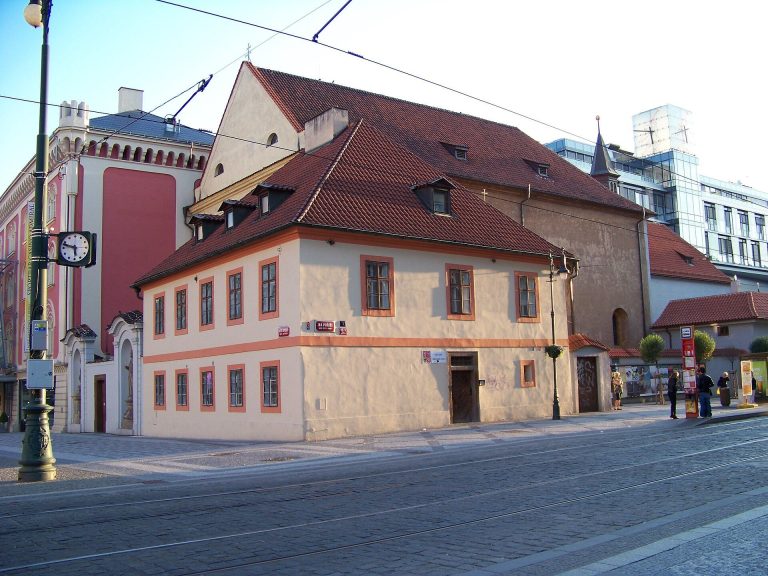
The Church of Saint Clemens in Holešovice, Czechia, is a small Gothic Roman Catholic church and the oldest surviving building in present-day Holešovice. It stands in the area of the former village of Bubny, between Kostelní, Dukelských hrdinů, and Skalecká Streets, near Strossmayer Square. The first reliable written mention of the church dates from 1234, while Bubny itself appears in written records in 1088.
Medieval origins
The church’s early history is connected by tradition with an ancient crossing of the Vltava, although that connection remains conjectural. An alteration or rebuilding took place in 1311. A contemporary record links the work with contributions from Elizabeth of Bohemia, a Přemyslid queen, and expresses thanks to the Zderaz Monastery for donations. The same record may instead refer to two residents of Bubny who donated land for a new church and cemetery. The present building may have resulted from this activity, while an earlier Romanesque sanctuary may have stood elsewhere.
Further changes followed the Hussite Wars, a period of religious conflict in Bohemia associated with the reform movement inspired by Jan Hus. The church’s principal bell was cast in 1572 by the bell-founder Brikcí of Cimperk. Its inscription named local reeves and residents of Holešovice and Bubny, including the benefactor Vavřinec Nemanický.
Fire, restoration, and parish status
The church was burned during the seventeenth century, either in 1603 or in 1639 during the Swedish siege of Prague. Restoration took place between 1659 and 1677 with the support of Maxmilián Valentin of Martinic. The work introduced Baroque alterations and produced the rich stucco decoration that characterizes the presbytery and triumphal arch.
In 1680, Jiří Adam transferred the right of patronage to the provosts of the Monastery of the Knights of the Cross with the Red Heart at the Church of the Holy Cross in Prague’s Old Town. The Knights of the Cross with the Red Heart were a Catholic religious order associated with pastoral care and ecclesiastical administration in the Bohemian lands. Following the transfer, Saint Clemens became a parish church. Its parish covered Bubny, Holešovice, and the vineyards on the far side of the river in Holešovičky. Jurisdiction over Štvanice Island remained disputed until the archiepiscopal consistory assigned it to the parish of Saint Peter at Poříčí in 1700.
Several administrators served the church during this period. They included Procopius Czechius, who served from 1684 to 1687; Ambrosius Blahowecz, from 1692 to 1694; Franciscus Kessel, appointed in 1699 and again in 1709; Paulus Brodsky, recorded both without a date and from 1717 to 1732; Petrus Anzebsky, appointed in 1702; Joannes Eustachius Riedl, from 1712; Sigismundus Franciscus Büller, from 1732 until his death in 1758; Joannes Swatojansky, from 1758 to 1762; Franciscus Benedictus Khun, from 1762 to 1770; and Antonius Pompejus, who served from 25 May to 7 June 1770. An inventory was compiled either around the turn of the seventeenth and eighteenth centuries or during Paulus Brodsky’s administration.
Nineteenth-century enlargement
Repairs were carried out in 1855 with parish contributions and support from Ferdinand the Good, Cardinal Friedrich Schwarzenberg, Auxiliary Bishop Vilém Tippmann, and Strahov Abbot Jeroným II Josef Zeidler. The adjacent cemetery remained in use until 1886. Its best-known tomb belonged to a soldier of the 18th Field Chasseur Battalion who died in the Austro-Prussian War of 1866.
After Holešovice was incorporated into Prague in 1885, the church became too small for the growing population. A historicizing enlargement was approved in 1898, and the nave was extended in 1899. The church was then separated from the parish at Bubeneč and received an independent parish. In 1897, part of its land had been sold to the Prague municipality to widen Kostelní Street.
In 1904 and 1905, Josef Richtr, the church’s patron and owner of the Malá Bubna estate, asked that patronage be transferred to Prague or that the church be abolished. The Prague municipal council rejected the request in July 1905. The parish administration associated with Saint Clemens changed as Holešovice-Bubny became part of Prague. A parish expositure established in 1899 later became associated with the newly built Church of Saint Anthony of Padua. By 1918, Saint Clemens was no longer the central church for Holešovice-Bubny, and in 1919 Jan Šimůnek, who had served the expositure since 1901 and had been its spiritual administrator since 1918, applied for the parish benefice at Saint Anthony.
Modern status and archaeological work
The bell cast in 1572 was transferred to the Church of Saint Anthony of Padua in 1920. The church’s organ prospect, meaning its visible case front, was entirely obscured by an alteration in 1942. Archaeological investigation took place in 1997, and the tabernacle was removed in 1999.
Saint Clemens is now a Roman Catholic filial church of the parish of Prague-Holešovice within the Prague Archdiocese and the Czech ecclesiastical province. It is dedicated to Saint Clement, a first-century bishop of Rome traditionally regarded as one of the earliest leaders of the Roman Church. The building was registered as an immovable cultural monument of the Czech Republic in 1964.
Remains
Layout and exterior
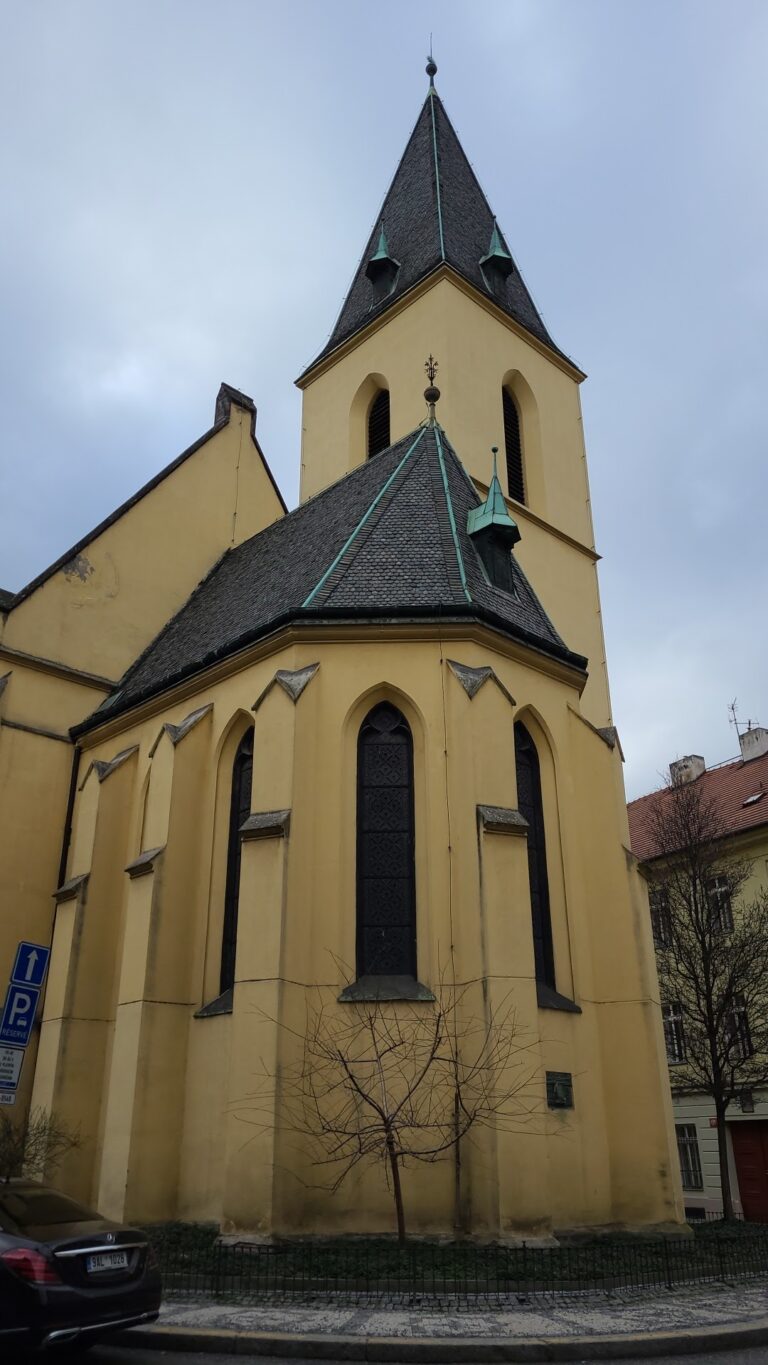
The present church is a compact Gothic structure shaped by the nineteenth-century enlargement. It has a slightly rectangular nave measuring approximately 7 by 6 metres, with a flat ceiling, and an almost square presbytery, the part surrounding the high altar, covered by a cross vault. A rectangular sacristy projects from the northern side at the eastern end. Its cornice runs at the same height as the nave cornice, creating a continuous horizontal line across the adjoining parts of the building.
The late-nineteenth-century windows of the nave and sacristy imitate Romanesque forms, although their chamfering is closer to Gothic treatment. The eastern facade ends in a triangular gable with two small semicircular-headed windows. Above the presbytery rises a relatively massive square bell turret. The sacristy is generally considered an Early Gothic part of the structure, while the building as a whole is identified as a small Gothic church designed by František Schlaffer.
Baroque decoration
The restoration of 1659 to 1677 gave the interior its elaborate stucco work. Twelve angels occupy the presbytery vault, each carrying an instrument associated with Christ’s Passion. Gilded laurel leaves are arranged in bundles over the ribs, and an oval medallion bearing the monogram of Christ marks the keystone.
The angelic figures are arranged in groups around the vault. Above the main altar, the central angel holds Saint Veronica’s veil, while the adjoining figures carry the Crown of Thorns and the column of the Flagellation. In the northern section are a sword, the ear cut from Malchus by Simon Peter, a lantern, a rooster symbolizing Peter’s denial, and the head of Saint John the Baptist. The western section contains a ladder, dice, and spear. To the south, the angels hold the jug and basin associated with Pilate’s hand-washing, three nails, and a cross.
Two angels hold a heraldic alliance emblem above the triumphal arch. The emblem combines the arms of Maxmilián Valentin of Martinic and Anna Kateřina of Bokůvky. One side shows an eight-pointed star within a water lily growing from five roots, while the other displays two crossed buffalo horns.
The triumphal arch is covered with stucco framed by bands bearing astragal ornament, a rounded bead-like moulding. Its central circular medallion shows the dove of the Holy Spirit surrounded by gilded rays. Nearby panels contain gilded images of the sun and moon, veiled female heads, eight-pointed stars, and vegetal ornament.
Altars and furnishings
Main altar
Maxmilián Valentin of Martinic and Anna Kateřina of Bokůvky donated the black-and-gold main altar. Around 1730, busts of Saint Clement and Saint Adalbert were placed there on Classical consoles. Saint Adalbert was a tenth-century bishop of Prague and missionary whose cult became important in Central Europe.
The altar now includes a relatively simple nineteenth-century mensa, or altar table, with the donors’ coats of arms on the predella, the lower section of the altarpiece. Its retable, the decorated structure behind an altar, is framed by gilded fluted Ionic columns. These support a richly moulded cornice with egg-and-dart ornament. A heart-shaped cartouche within an acanthus frame occupies the centre and serves as a reliquary.
The upper structure includes volutes, small pilasters, and a rustic representation of Saint Clement holding a cross and palm branch. Carved angels from the upper structure were moved into storage for safety. The crypt below the altar formerly contained the remains of Baron Jakub Wimmer, transferred there from the cemetery.
Altar of Saint John Nepomuk
The altar of Saint John Nepomuk was created around 1740. Its retable is framed by pilasters and twisted columns with gilded Corinthian capitals. The associated painting, made in the first half of the eighteenth century, shows Saint John Nepomuk praying. Its upper cartouche depicts the Virgin Mary with the Christ Child. The superstructure formerly ended with a figure of Saint John the Baptist holding a lamb and an angel’s head.
Beside this altar stands a ceramic Stations of the Cross made by František Kotrba. The arrangement adds a later devotional feature to the Baroque furnishings of the side altar.
Baptismal font and organ
The baptismal font dates from the late eighteenth century and stands on a base of Slivenec marble. Josef Scheller made its cover in 1890. The organ was built in 1857, while its original case front was entirely obscured by an alteration carried out in 1942.
Inventory and bells
The church inventory listed more than fifty ecclesiastical objects. These included a tin lamp, oil for the sick, two holy-water vessels, a large iron candlestick, twelve multicoloured veils, and seven cushions. It also listed nine large paintings and eleven small ones. Among the sculptures were figures of Saints Vitus, Wenceslaus, and Barbara, together with two carved figures of Saint Catherine containing consecrated wax and candles. The inventory also described a small side altar of Saint Anne with a carved figure and a statue of Saint John Nepomuk on the wall.
Seven bells were listed: one in the larger tower, three smaller bells in the smaller tower, one beside the sacristy, and two used by altar servers. The large bell was the 1572 bell cast by Brikcí of Cimperk, which was transferred to the Church of Saint Anthony of Padua in 1920. A plague column from a disused cemetery near Na Šachtě Street was later placed beside the church.