Santi Filippo e Giacomo: A Medieval Church in Ferruccia, Italy

Site at a Glance
- Rating
- 4.5
- Popularity
- Very Low
- Country
- Italy
- Primary era
- Medieval
- External website
- Open
- Eras represented
- Medieval, Early Modern, Modern
- Civilizations
- Grand Duchy of Tuscany, Italian, Republic of Florence
- Site type
- Religious
- Remains
- Church
On this page15 sections
History
Santi Filippo e Giacomo is a medieval Roman Catholic church in Ferruccia, Italy, within the municipality of Quarrata and the Diocese of Pistoia. Dedicated to Saints Philip and James the Less, it was associated with the locality of Vignole when its earliest records were created, before the place-name Ferruccia became established.
Medieval origins and the name Ferruccia
The earliest known reference appears in an act of 1357 concerning a land exchange. The document was signed by parishioners and church wardens of the church of Saints James and Philip at Vignole. The identification with Vignole reflects the unsettled use of local place-names, although a locality called Sancto di Mona Ferruccia was already known.
A document dated 7 December 1385 records a testator’s request to be buried in the church of Saints Philip and James called Santo di Monna Ferruccia, in the territory of Vignole. The geographer Emanuele Repetti connected the name with a woman called monna Ferruccia. The church’s property holdings in the late Middle Ages were listed during a pastoral visitation in 1383. By a visitation carried out by Bishop Donato dei Medici in 1447, the established form was “Church of Saints Philip and James of Ferruccia.”
Parish development and early modern works
From the late sixteenth century into the early seventeenth century, building works addressed the danger of flooding from the nearby Ombrone River. The campaign affected the church as well as the rectory, sacristy, adjoining square, and a new boundary wall. Inside, a pulpit was installed and a wall was built to close the gallery.
A portico was begun outside the church in 1620. In 1630, a stone altar dedicated to Saint Roch was built, and a painting of Saints Roch, Sebastian, and Pope Gregory was placed above it. Altars dedicated to the Annunciation, Saint Anthony, and Saint Mary Magdalene followed in 1636 and 1637, using the Saint Roch altar as their model.
Ferruccia was separated from the church of San Michele at Vignole in 1674. The separation followed disputes linked to Ferruccia’s increased standing after it was recognized as a pieve, a parish church with historically elevated ecclesiastical status that could serve surrounding districts.
Eighteenth- and nineteenth-century transformation
The church’s altars and baptismal font were altered repeatedly. In the late eighteenth century, the building was lengthened by incorporating the exterior portico. New windows with leaded glazing were installed, and the former separate entrance used by men was modified after the Saint Roch and Annunciation altars were moved.
Several furnishings were added or renewed during the eighteenth century. Francesco Arrighi made stucco statues of Saints Philip and James for the niches above the doors in 1737. In 1748, the stoneworker Antonio Giuseppe Piovanini created surrounds for two new confessionals placed along the side walls. In 1758, Alamanni installed relics inside the cabinet to the right of the high altar, renewed it with a silk covering, and added gilded steps.
After Bishop Enrico Bindi’s pastoral visitation in 1870, the parish priest Gaspare Ceccarelli was instructed to have the church cleaned and refurbished. The work arranged the choir loft in the counter-façade, restored the organ, renovated the pulpit, and installed a coffered ceiling with three painted octagonal panels. An inscription dated 1875 commemorates the work.
The nineteenth-century refurbishment left the church in debt. Repayment was supported by annual collections and by the sale of a chalice and cross, now in the National Bargello Museum in Florence, as well as a triptych by the Master of the Bracciolini Chapel. In 1899, the church lent five objects to an exhibition of sacred art in Pistoia and received a third-class honorary diploma.
The sacred-art museum
From the beginning of the 1970s, the parish priest Enrico Petrelli promoted the creation of a sacred-art museum. The museum was established by the municipalities of Quarrata and Agliana together with the Superintendency for Artistic Heritage, and it opened on 30 September 2000. It occupies three rooms on the first floor of the rectory.
The museum was intended both to preserve local memory and to restore the religious identity of liturgical objects. Its educational purpose is to explain the symbolic and ritual meanings associated with the displayed works and furnishings.
Remains
Church building
Façade and interior layout
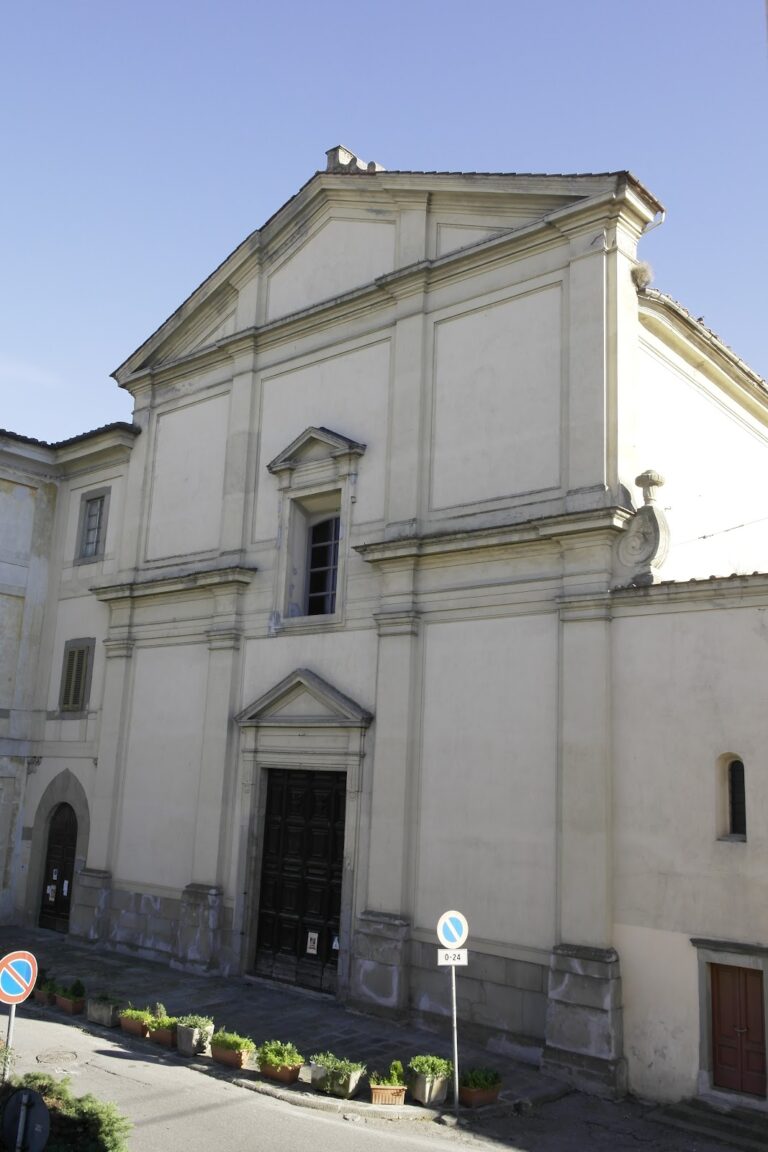
The church has a gabled façade crowned by a pointed fronton and framed at the ends by two Romanesque-style pilasters. Above the doorway, a lunette, the semicircular area over an opening, contains a mosaic of the Virgin Mary.
Inside, the rectangular building is divided into two naves, with minor altars along the sides. Single-lancet windows open above the altars. The ceiling combines white-lacquered wooden beams with a bluish octagonal feature centered on a gilded rose. The presbytery, the part reserved for the altar and clergy, is separated from the nave by a marble balustrade and contains two confessionals.
Presbytery and furnishings
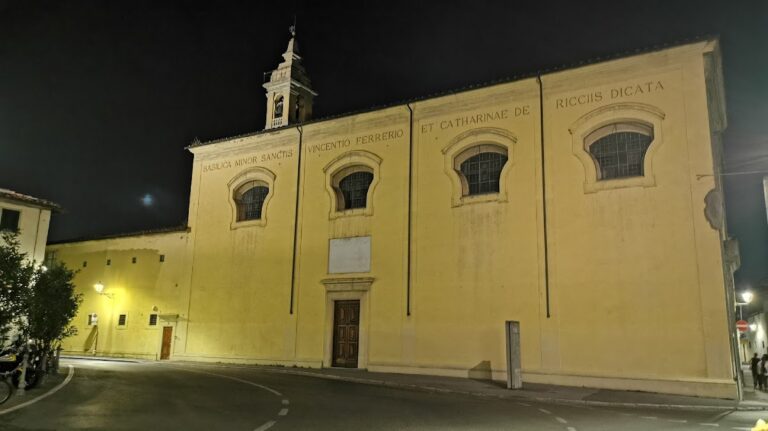
Two stone-framed doors beside the high altar lead to the sacristy and to a cabinet. The sacristy, a room for storing liturgical objects and vestments, lies beneath the bell tower. The high altar stands detached from the wall in the Roman manner and is decorated with three plaster putti, or winged child figures. The baptismal font was moved several times before reaching its present position at the beginning of the left aisle.
The choir loft occupies the counter-façade, the interior wall opposite the main altar, and houses the organ. The organ was restored during the works carried out after the 1870 pastoral visitation. The former exterior portico was incorporated into the enlarged church, while the earlier men’s entrance on the left side was modified after the Saint Roch and Annunciation altars were relocated.
Paintings and former altarpiece
Paintings in the church
The church contains an eighteenth-century painting of The Virgin and Child with Saints Dominic, Anthony Abbot, Roch, and Francis by an unknown artist. Other works include Pietro Paolo Lippi’s Mystical Marriage of Saint Catherine and Saint Mary Magdalene, painted in 1646, and Giovanni Martinelli’s seventeenth-century Assumption of the Virgin.
Antonio Puglieschi painted the Crucifix with the Virgin Mary, Saint Catherine of Alexandria, Saint John the Evangelist, Saint Anthony Abbot, and Saint Mary Magdalene about 1712. The unknown artist who painted the Crucifix with Saints Roch, Sebastian, and Gregory completed it in 1637. It was placed above the stone Saint Roch altar built in 1630.
Triptych and predella
The church’s former 1426 triptych by the Master of the Bracciolini Chapel is now preserved in the Museum of Fine Arts in Budapest. The conventional name identifies an unknown painter. The central panel shows the Virgin and Child with four angels. Saints Philip, James, Stephen, and John the Baptist appear on the side panels, while two female saints are represented in half-length within quatrefoils, four-lobed decorative frames, above them. The date and the name of the rector, the presbyter Vannino of Popiglio, appear below.
An old nineteenth-century photograph shows a predella, the painted or sculpted base of an altarpiece, formerly attached to the triptych. It contained scenes of the martyrdoms of the saints shown above and a central Pietà. The predella is now dispersed. The church’s former cross and chalice are preserved in the Bargello Museum in Florence.
Museum collections
Vestments and Marian devotion
The first museum room contains six display cases with seventeenth-, eighteenth-, and nineteenth-century vestments, including chasubles, copes, and albs. A chasuble is a priest’s outer vestment for celebrating Mass, a cope is a ceremonial cloak, and an alb is a long white liturgical garment. The oldest chasuble dates from the sixteenth century, came from Florence, and is made of brocatelle with two yellow-silk woven galloons, a lozenge pattern, and a waxed pink linen ground. A chasuble and two copes of iridescent brocaded taffeta with a meander pattern came from France in 1760.
The second room contains three display cases devoted to devotion to the Virgin Mary. They include an image of the Virgin and Child from the first half of the eighteenth century, two silver crowns, and a complete liturgical dress for a female statue, consisting of a bodice, skirt, and shoes. The dress, made for a statue of Our Lady of the Rosary, dates to the early 1760s and was restored before display because of its poor condition. The room also contains a painted papier-mâché sculpture of the Christ Child in swaddling clothes from the first half of the eighteenth century.
Reliquaries and liturgical furnishings
The corridor leading to the final room contains fourteen early nineteenth-century Tuscan wall lights made of carved and gilded wood. It also displays wooden reliquaries, containers made to hold and present relics, including the Reliquary of Saint Venantius, dated 1696 by an inscription inside its lid.
The third room contains an early seventeenth-century altar frontal of crimson-red cut silk velvet. It is embroidered with silver and gold lamé, silver and gold thread, purl, multicoloured silk, painted white silk satin, and yellow, white, and green silk gros de Tours. A mid-eighteenth-century Tuscan lectern of carved and gilded wood has concave-convex scrollwork linked by floral and acanthus-leaf ornament, together with angel heads.
Florentine workshops produced a pyx dated 1752 and three chalices, one dated 1692 and two from the second quarter and the eighth decade of the seventeenth century. A pyx is a vessel for consecrated Eucharistic hosts. The chalices are made of repoussé, chased, engraved, incised, and partly gilded silver, with cast elements.