Suma Temple: A Shingon Buddhist Temple in Kobe, Japan


Site at a Glance
- Rating
- 4.4
- Popularity
- Medium
- Country
- Japan
- Primary era
- Medieval
- External website
- Open
- Eras represented
- Medieval
- Civilizations
- Ashikaga shogunate, Toyotomi regime
- Site type
- Religious
- Remains
- Temple
On this page16 sections
History
Suma Temple is a major Shingon Buddhist temple in Kobe, Japan, whose foundation tradition places its establishment at the present site in 886 during the early Heian period. The temple belongs to the Suma-dera branch of Shingon Buddhism, formally affiliated with the Kogi Shingon tradition. Its mountain name is Jōyasan, and its principal image is the Holy Kannon, a form of Kannon, the Buddhist bodhisattva associated with compassion.
Foundation traditions
According to the temple’s abbreviated origin account, fishermen recovered a Holy Kannon image offshore from Wada Cape during the early Heian period. An imperial order led to the establishment of Hoppōji to house the image. In 886, Emperor Koko ordered the priest Monkyō to establish Uenosan Fukushōji at the present site and transfer the image there. Emperor Koko was a ninth-century Japanese emperor, and this tradition presents the move as the beginning of the temple in its current location.
Temple records preserve a different account of the image’s history. They state that Minamoto no Yorimasa installed the Holy Kannon in 1169 and donated three estates to the institution as temple lands in the same year. At that time, the temple worshipped both the Holy Kannon and Medicine Buddha and comprised twelve buildings. Minamoto no Yorimasa was a late Heian military commander and poet.
The Genpei War and medieval rebuilding
The temple’s records and foundation documents were dispersed during the Genpei War, the late twelfth-century conflict between the Minamoto and Taira clans that helped establish Minamoto rule in Japan. On February 7, 1184, the Battle of Ichi-no-Tani took place in the surrounding area. During the fighting, the Minamoto commander Kumagai Naozane killed the Taira warrior Taira no Atsumori, whose death later became a celebrated subject in Japanese literature and performance.
A memorial mound for Atsumori’s head was established at the temple after the battle. Suma Temple consequently became associated with the young warrior and with the wider memory of the Genpei War. At some point, the temple began displaying the Aoba Flute, an object associated with Atsumori, and collecting an admission fee for viewing it. The site’s connection with the conflict also attracted writers and poets.
A major fire in 1360 destroyed the Main Hall, Shaka Hall, Bell Tower, half of the temple’s thirty-three Buddhist images, scriptures, and ritual implements. Reconstruction began in 1365, and rebuilding and improvement continued for about fifty years. The sanctuary was constructed in 1368, during the Northern and Southern Courts period, a time when rival imperial courts contested political authority in Japan. A standing Fudo Myoo made in 1369 by the Buddhist sculptor Kōshun belongs to this rebuilding phase.
In 1427, forces of the Hosokawa clan destroyed most of the precincts while attacking the Akamatsu clan. The Main Hall and main gate survived. Restoration began in 1428, followed by the erection of a three-story pagoda in 1490. In 1496, the abbot of the subtemple Daishoin organized a fundraising campaign to revive the temple. A dispute over the temple mountain led a local deputy to destroy parts of the precincts in 1502, while the Lecture Hall was roofed in 1526.
Early modern disasters and later decline
The Fushimi earthquake of July 13, 1596, caused the Main Hall and three-story pagoda to collapse. Toyotomi Hideyori rebuilt the Main Hall in 1602, with Katagiri Katsumoto serving as commissioner. During the Keicho period, approximately 1596 to 1615, Suma Temple had fifteen subtemples, including four specifically named subtemples. By 1800, that number had fallen to twelve.
A landslide in 1750 severely damaged several buildings. They were rebuilt during the Hōreki period, approximately 1751 to 1764. By the beginning of the Meiji period, the complex had deteriorated so extensively that the Main Hall, Taishi Hall, and Nio Gate were reportedly the principal buildings remaining.
Modern institutional history
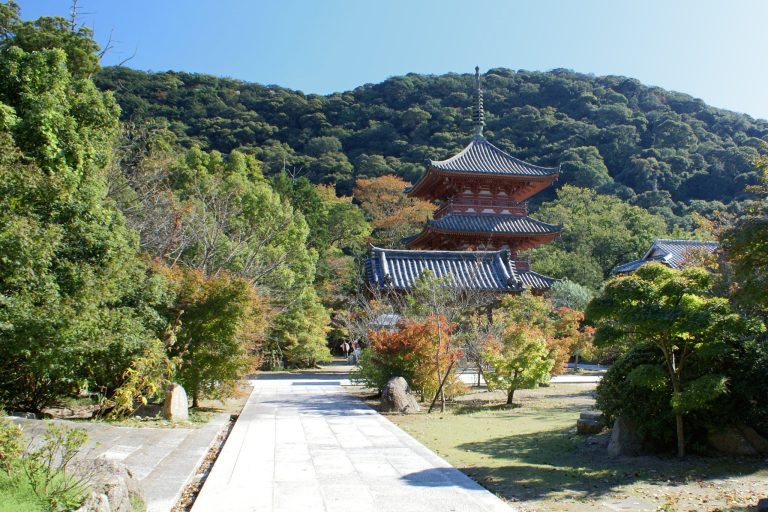
Young cherry trees helped make the grounds a noted cherry-blossom site in 1891, when a large recreational garden centered on the temple was created. In 1946, the Suma-dera branch became an independent Shingon branch, and Suma Temple became its head temple. The three-story pagoda was reconstructed in 1984.
The Great Hanshin-Awaji Earthquake of 1995 caused the Oju-in and Renshō-in subtemple halls to collapse and damaged the Main Hall, Goma Hall, Guest Hall, ossuary, and other buildings. These structures were subsequently restored. Suma Temple is also connected with several pilgrimage networks, including the New Saigoku Thirty-Three Sacred Sites, the Eighteen Head Temples of Shingon Buddhism, and pilgrimage groups based in Setsu, Fukuhara, and Kobe. It is the twenty-fourth site in the New Saigoku pilgrimage.
The temple’s protected holdings include the Main Hall sanctuary and altar complex, a standing eleven-faced Kannon, and a silk painting of Fugen with ten rakshasa women. Other protected works include a thirteen-story stone pagoda, a standing Fudo Myoo, a temple gong, historical temple records, paintings, and a folding screen with pasted calligraphic fragments. These holdings preserve evidence of the temple’s medieval religious life and its continuing associations with the Atsumori tradition.
Remains
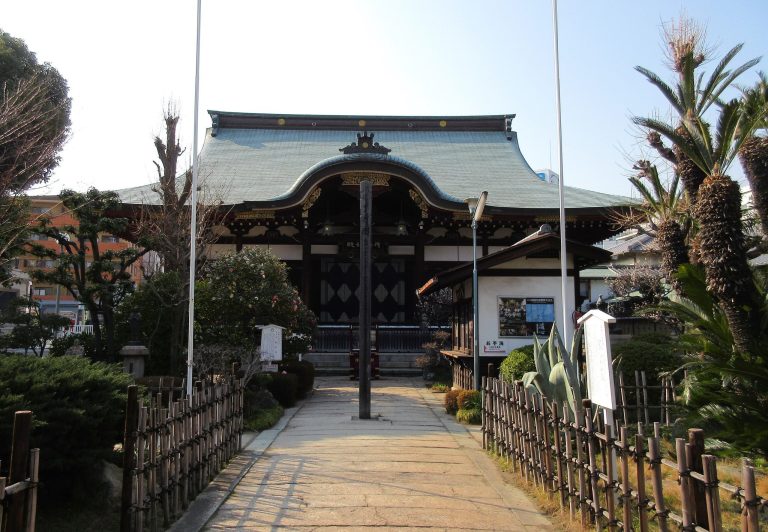
The surviving and restored complex is entered through the Nio Gate and includes the Main Hall, Taishi Hall, Goma Hall, Guest Hall, ossuary, three-story pagoda, and the subtemples Shōkaku-in, Oju-in, and Renshō-in. The buildings represent only part of a precinct that was historically much larger. The Main Hall, Taishi Hall, and Nio Gate survived the severe decline recorded at the beginning of the Meiji period, while the Main Hall, Taishi Hall, Goma Hall, and three-story pagoda were later restored or reconstructed.
Entrance and principal halls
Nio Gate
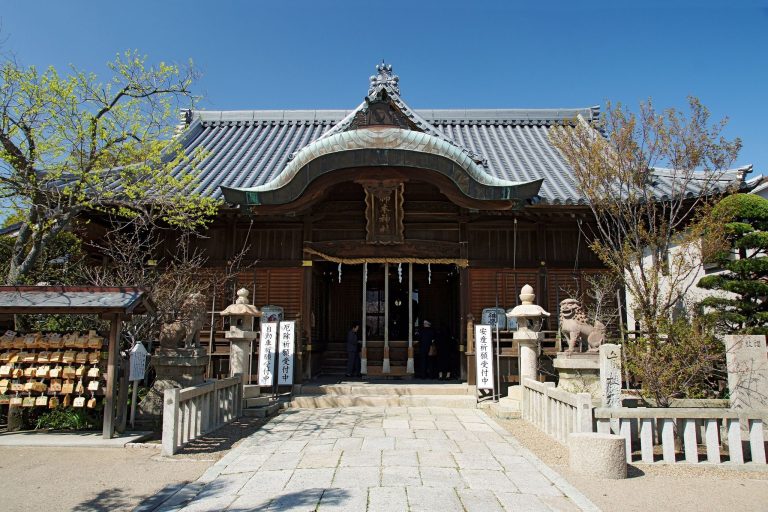
The Nio Gate forms the entrance to the temple. It is traditionally said to have been restored by Minamoto no Yorimasa in the twelfth century. Its side chambers contain the Kongōrikishi, paired Buddhist guardian figures traditionally placed at temple entrances. The figures are traditionally attributed to the sculptors Unkei and Kaikei.
Main Hall
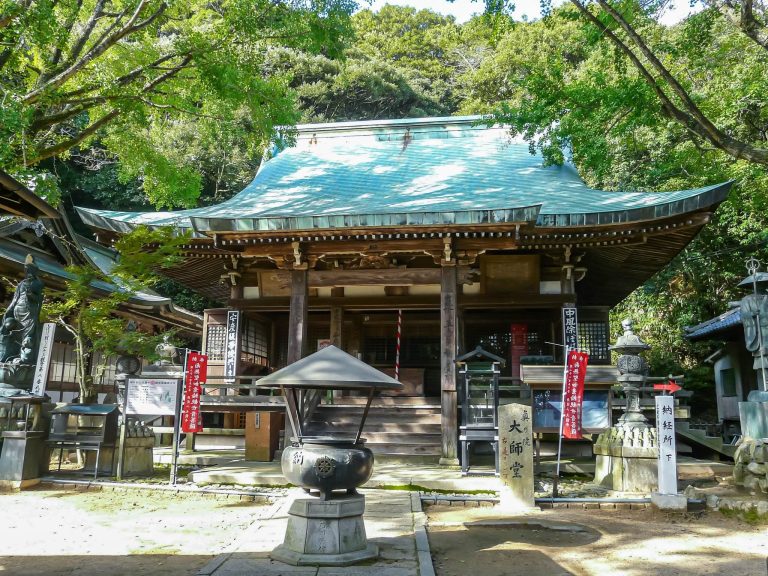
The Main Hall houses a seated Kannon image. The image is traditionally said to have originated at Hoppōji on Mount Egeyama and is identified with the Holy Kannon transferred to the temple in the foundation tradition. The hall contains a sanctuary and altar complex whose sanctuary dates to 1368. This medieval complex has protected cultural-property status. A separate standing eleven-faced Kannon, dating from the medieval period, is also preserved among the temple’s important works.
Taishi Hall
The Taishi Hall stands beside the Main Hall and houses an image of Kōbō Daishi, the posthumous name of Kūkai, the ninth-century monk who founded the Shingon tradition in Japan. The image is worshipped under the devotional title “The Revered Taishi of Suma.”
Medieval objects and records
Images, paintings, and ritual objects
Suma Temple preserves a standing Fudo Myoo made in 1369 by Kōshun, identified as a master Buddhist sculptor of Tō-ji. Its other religious works include a seated Holy Kannon, a medieval silk painting of Fugen accompanied by ten rakshasa women, and a silk painting of the four patriarchs of the Tendai tradition. A painting on paper depicts Taira no Atsumori, linking the temple’s artistic holdings with its medieval historical associations.
Pagoda, gong, and written records
The complex includes a reconstructed three-story pagoda and a thirteen-story stone pagoda. A Buddhist temple gong made in 1366 survives with two volumes of historical temple records covering the Northern and Southern Courts period through the mid-Edo period. Shōkaku-in owns a six-panel paired folding screen carrying pasted calligraphic fragments.
Genpei Garden and literary associations
Memorial landscape
The Genpei Garden commemorates the temple’s associations with the Minamoto and Taira clans. It contains the Bell of Benkei, a pine associated with Minamoto no Yoshitsune, and a pond where Taira no Atsumori’s head was washed. The temple grounds also contain the mound commemorating his head. The Aoba Flute, associated with Atsumori, is displayed among the temple’s historical treasures.
Poetic and commemorative remains
Stone monuments in the grounds carry haiku by Masaoka Shiki and Matsuo Bashō. The site also contains the grave of Ozaki Hōsai. Together with the Atsumori memorial features, these monuments reflect the temple’s long connection with literary and commemorative traditions.