Tenjō-ji Temple: A Maya-Centered Shingon Buddhist Temple in Kobe


Site at a Glance
- Rating
- 4.4
- Popularity
- Low
- Country
- Japan
- Primary era
- Modern
- External website
- Open
- Eras represented
- Modern
- Civilizations
- Japanese
- Site type
- Religious
- Remains
- Monastery
On this page8 sections
History
Tenjō-ji Temple is a Shingon Buddhist temple on Mount Maya in Kobe, Japan, traditionally founded in 646 during the Asuka period by the Indian monk Hōdō at the request of Emperor Kōtoku. Hōdō, a semi-mythical monk associated with several seventh-century temple foundations in Japan, is said to have brought the temple’s secret Eleven-Faced Kannon image after traveling through China. The temple is traditionally regarded as Japan’s only temple whose principal object of worship is Maya, the mother of Siddhartha Gautama, the historical Buddha.
Foundation and Association with Maya
The temple’s connection with Maya is traditionally attributed to Kūkai, the Japanese monk who established the Shingon school of esoteric Buddhism. He is said to have brought from China an image of Maya made by Xiao Yan, the founder and first emperor of the Liang dynasty, and enshrined it at Tenjō-ji. This tradition links the temple with the naming of Mount Maya. Its name refers to the belief that Maya was reborn in Tori-ten, a Buddhist heaven within the realm of desire.
Tenjō-ji became the head temple of the Maya-san Shingon Buddhist school and remained affiliated with the Old Shingon school. It formerly belonged to the Koyasan Shingon school. On April 3, 2020, the temple became independent and established Maya-san Shingon as a new umbrella religious corporation, with Tenjō-ji as its head temple. Its association with Maya also gave the institution a strong connection with women’s worship. Prayers for safe childbirth and the distribution of maternity belts are traditionally said to have originated there in Japan.
Growth and Regional Influence
At the height of its traditional development, Tenjō-ji is said to have contained numerous subtemples, smaller temples operating within or under a larger complex, together with monks’ quarters for about 3,000 monks. It was regarded as the leading great temple of Settsu Province and drew worshippers from different Buddhist affiliations. Members of the imperial family and military figures visited the temple, while Emperors Kazan and Ōgimachi treated it as a place of prayer.
During the Edo period, Tokugawa Iemitsu, the third shogun of the Tokugawa shogunate, designated Tenjō-ji as the guardian temple of Settsu Province. The Kii branch of the Tokugawa family made deputation visits on behalf of the shogunal house. The temple consequently used both the imperial paulownia crest and the Tokugawa hollyhock crest, linking its identity with imperial and shogunal patronage.
Castle Tradition and Destruction
A historical theory identifies the former temple precinct with Mayasan Castle. The castle is associated with the Battle of Mount Maya, fought between forces of the Kamakura shogunate and the Akamatsu clan at the end of the Kamakura period. This proposed connection places the earlier temple grounds within a landscape that also carried a military history.
On January 30, 1976, an arson attack by a thief targeting the offering box destroyed almost the entire temple complex. The Niō Gate, parts of several subtemples, and the kitchen and residential quarters survived the fire. Tenjō-ji was then relocated about one kilometre north to Maya Betsusan, a site regarded as the temple’s place of origin, where the complex was rebuilt.
The rebuilt temple continued to serve as the center of Maya-san Shingon worship. The present complex stands higher than the former precinct on Mount Maya, which is stated to rise to 699 metres. The former grounds are maintained as Maya-san Historic Park, with explanatory panels concerning the earlier buildings and surviving architectural elements. The remaining kitchen and residential quarters have not been restored and are deteriorating.
Remains
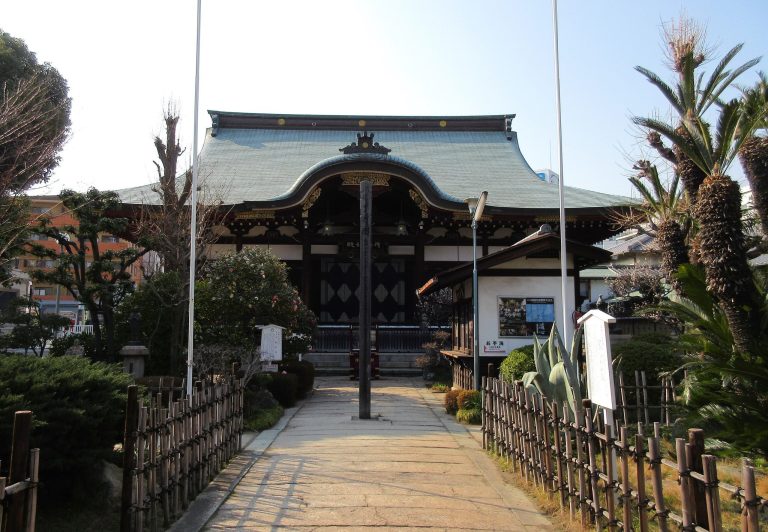
The present Tenjō-ji complex occupies a higher site north of the former precinct on Mount Maya. Its rebuilt buildings combine halls for the temple’s principal images with shrines, teaching spaces, residential facilities, and landscaped grounds. The former site survives separately through the Niō Gate, stone walls, and stone steps associated with the earlier complex.
Sacred Images and Principal Halls
The temple’s principal objects of worship are an Eleven-Faced Kannon and an image of Maya. The Kannon is a golden secret image about 6 centimetres high and is normally kept from public view. Its unveiling is traditionally held every 33 years. The image is attributed to the Buddha’s workmanship and traditionally to Hōdō’s arrival in Japan. It was regarded as a guardian Buddha for Osaka Bay and the surrounding regions of Settsu, Harima, Kawachi, Izumi, and Awaji.
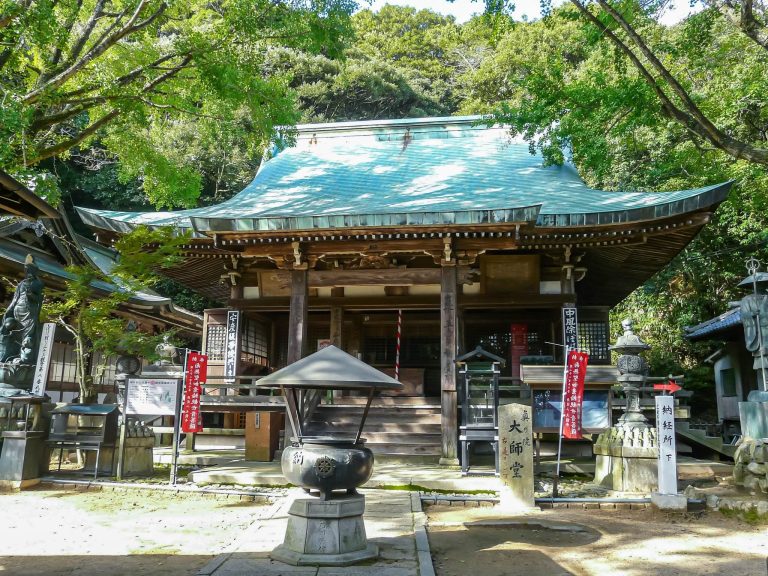
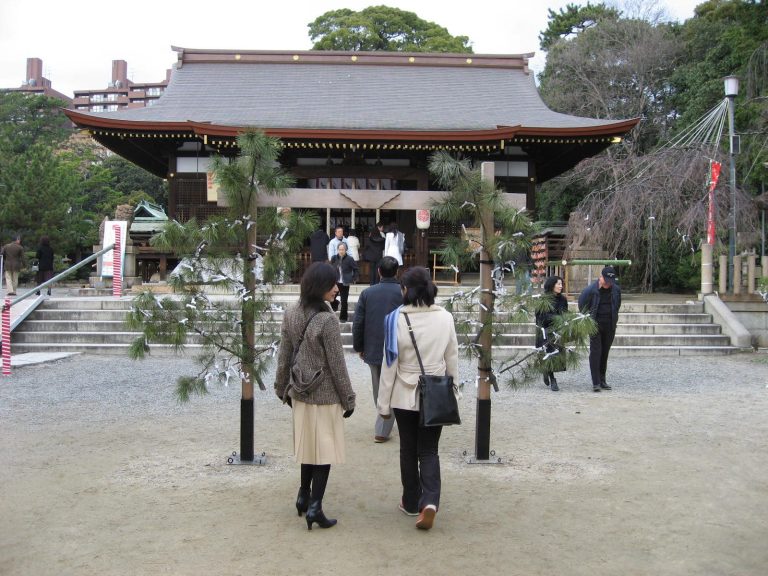
The Maya image is a life-size statue covered with vivid polychrome decoration. The original was lost in the 1976 fire, after which a new image was made. It was first installed in the Main Hall and moved to the Maya Hall after that building was reconstructed and its dedication ceremony took place in October 2002. The Maya Hall, rebuilt in 2002, is described as the only hall in Japan dedicated to Maya. The Main Hall, also called the Golden Hall, was rebuilt in 1985.
Secondary Buildings and Religious Spaces
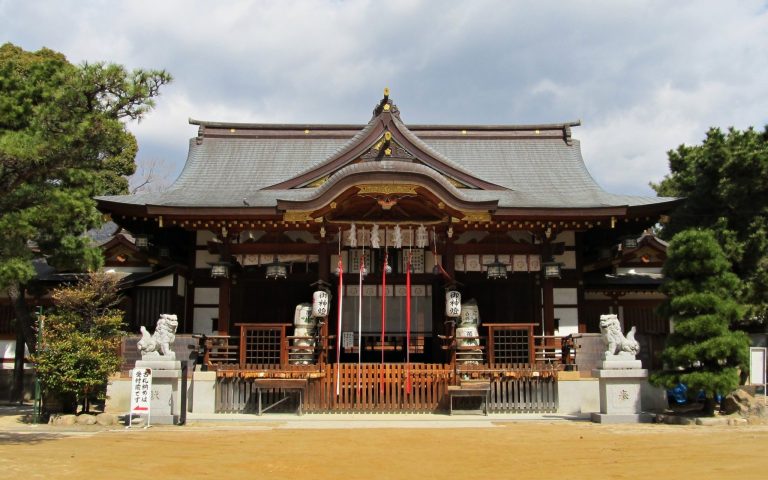
The rebuilt grounds contain several buildings associated with worship and instruction. The Gongen Shrine, rebuilt in 2010, enshrines Shakutei Gongen, the guardian deity of the temple precinct. Here, gongen refers to a Buddhist-Shinto manifestation or shrine deity. The One-Wish Jizō Hall was rebuilt in 2005 and is dedicated to Jizō, a Buddhist bodhisattva associated especially with protecting beings in difficult circumstances.
A stone statue of Hōdō stands within the grounds, alongside an Esoteric Buddhist instructional center and the Sky Grand Stage, built in 2005. The belfry was rebuilt in 1989, while the complex also includes a study hall, the Main Residence with kitchen facilities, and the West Gate, erected in 2010. These structures form part of the temple’s post-fire arrangement at Maya Betsusan.
The Kinrin Hall, rebuilt in 1983, enshrines Ichiji Kinrin, an esoteric Buddhist form of Dainichi associated with the “one-word wheel.” The Tenjiku Hall was rebuilt in 1979. Together with the Main Hall and Maya Hall, these buildings represent the successive rebuilding of Tenjō-ji after the destruction of 1976.
Garden and Former Precinct
The grounds include Maya Tenku no Niwa, a dry-landscape garden composed primarily of rocks, gravel, and carefully arranged plants rather than flowing water. It consists of the Garden of the Immortal’s Arrival and the Garden of Maya’s Creation, and was designed by a garden historian.
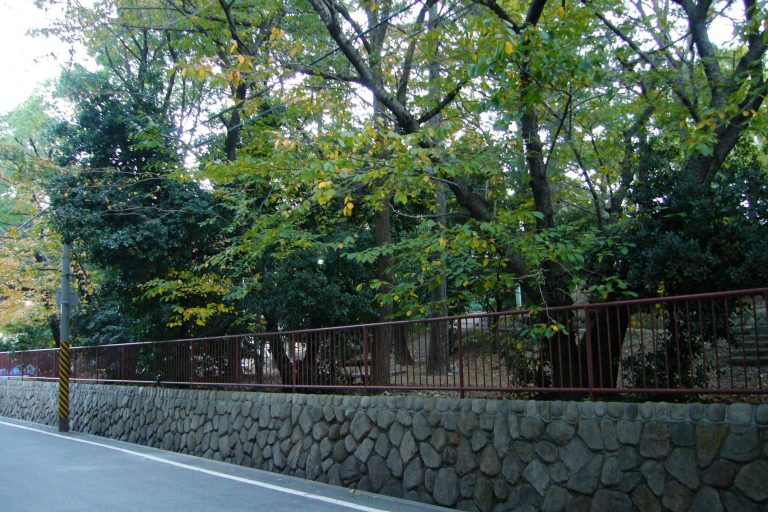
The former precinct, now within Maya-san Historic Park, retains the surviving Niō Gate, a Buddhist gate guarded by two muscular guardian figures. Stone walls and stone steps also remain from the earlier temple complex. Explanatory panels indicate the locations and character of the former buildings, while the surviving fabric preserves the physical setting of the temple before the 1976 fire.