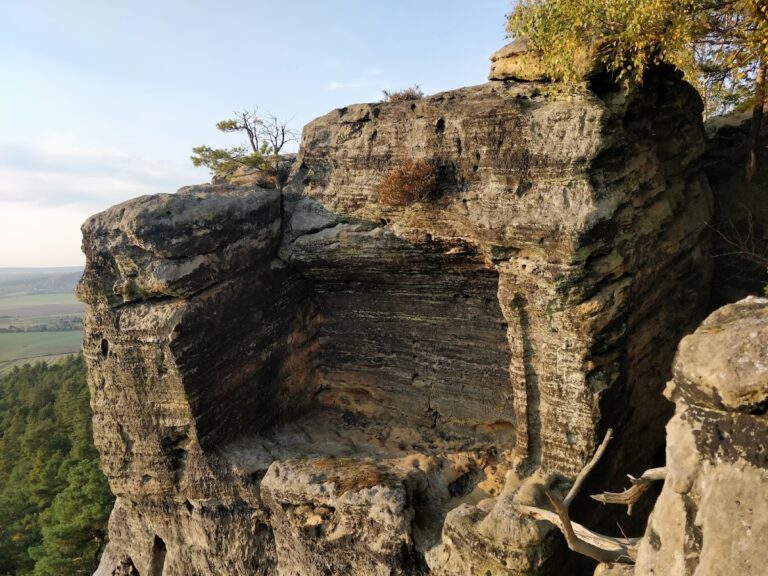
Chlum-Kozlov: A Gothic Rock Castle in Czechia


Site at a Glance
- Rating
- 4.7
- Popularity
- Very Low
- Country
- Czechia
- Primary era
- Medieval
- External website
- Open
- Eras represented
- Medieval
- Civilizations
- Holy Roman Empire, Kingdom of Bohemia
- Site type
- Military
- Remains
- Castle
On this page10 sections
History
Chlum-Kozlov is a Gothic rock castle in Czechia, about two kilometres south of Turnov, whose existence dates from the second half of the thirteenth to the first half of the fourteenth century. A rock castle uses natural rock formations as part of its defenses and may include rooms or other spaces cut directly into the stone.
Prehistoric occupation and medieval foundation
Kozlov Hill was occupied before the castle was built, probably by an unfortified hilltop settlement. Stone tools associated with this earlier use were mentioned by the historian Josef Vítězslav Šimák. The castle itself was probably founded by members of one branch of the Markvartic family, a medieval Bohemian noble family that included the lords of Valdštejn.
The castle’s early history is uncertain. August Sedláček was the first to identify the remains on Kozlov Hill with the castle called Chlum in written records. He connected the site with the lords of Valdštejn, some of whom used the byname “of Chlum.” A disputed reference from 1335 names Zdeněk of Valdštejn as living at a place called “Kopec.” Sedláček identified Kopec with Chlum, while the historian Rudolf Anděl considered Hrádek near Hostinné a more likely location.
The Valdštejn estate and abandonment
The first accepted written mention dates to 1353, when Chlum belonged to Jarko of Valdštejn. In 1362 it was held by Hynek of Lomnice, who also belonged to the Valdštejn lordly family. The castle was soon incorporated into the Valdštejn estate and abandoned after it was considered unnecessary.
Archaeological dating by Jiří Waldhauser helped establish the site’s medieval chronology. Finds included a key discovered outside the castle area and a counterfeit Prague groschen from the reign of King Wenceslaus IV. A Prague groschen was a medieval Bohemian coin, while a counterfeit was an unofficial imitation of that currency. The ruins have been protected as a cultural monument of the Czech Republic since 28 March 1964.
Remains
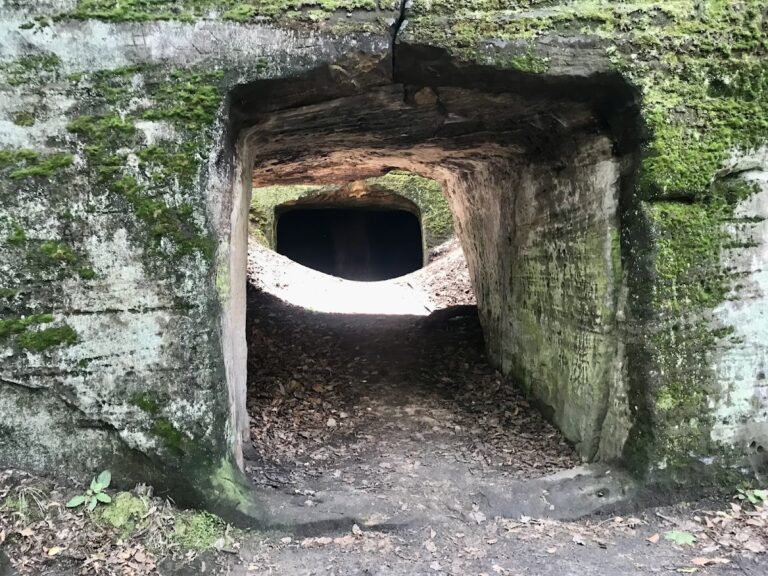
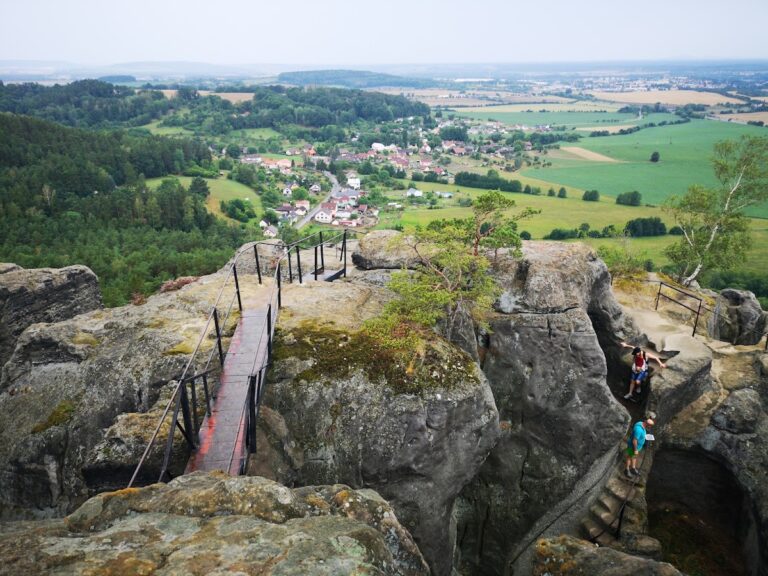
Chlum-Kozlov occupied the northwestern part of Kozlov Hill’s summit. The complex extended for approximately 250 metres and was arranged in three sections, an advanced fortification, a middle castle, and an upper castle. Its surviving fabric consists chiefly of spaces cut into the rock, cuts that once held wooden defenses, ditches, and traces left by demolished masonry.
Advanced and middle fortifications
Advanced fortification
The advanced fortification occupied the southwestern part of the summit. A ditch separated it from the middle castle. Its surviving evidence consists of cuts in the rock that anchored wooden fortifications. An access route may have descended into the ditch before rising between stone blocks toward the first gate of the middle castle.
Middle castle
The middle castle measured approximately 70 by 35 metres. Ditches bounded its front sides, while rows of rock blocks formed its lateral sides. Small groups of cuts in those blocks indicate that perimeter defenses were once fixed there. Four spaces cut into the rock are the most visible remains of this section. Their date is uncertain, and they may have been made after the castle had ceased to exist.
Upper castle and northeastern defenses
Upper castle
The upper castle lay northeast of the middle castle, with another ditch between them. A cistern, a reservoir for collecting and storing water, was cut into the rock at the bottom of the ditch. The upper section covered up to approximately 25 by 17 metres and contains traces of several rock-cut rooms. Small masonry fragments suggest that a rectangular stone building once stood there; its walls were dismantled after the castle ceased to exist.
Northeastern ditch and platforms
An arched ditch marked the northeastern end of the complex. Two small platforms in this area may be the remains of a bastion, a projecting defensive structure intended to strengthen the fortification and allow defensive fire against attackers from nearby parts of the hill.
Nearby sites