Valdštejn Castle: A Gothic Noble Seat and Romantic Ruin in Czechia

Site at a Glance
- Rating
- 4.6
- Popularity
- Medium
- Country
- Czechia
- Primary era
- Medieval
- External website
- Open
- Eras represented
- Medieval, Early Modern, Modern
- Civilizations
- Habsburg, Holy Roman Empire, Kingdom of Bohemia
- Site type
- Military
- Remains
- Castle
On this page11 sections
History
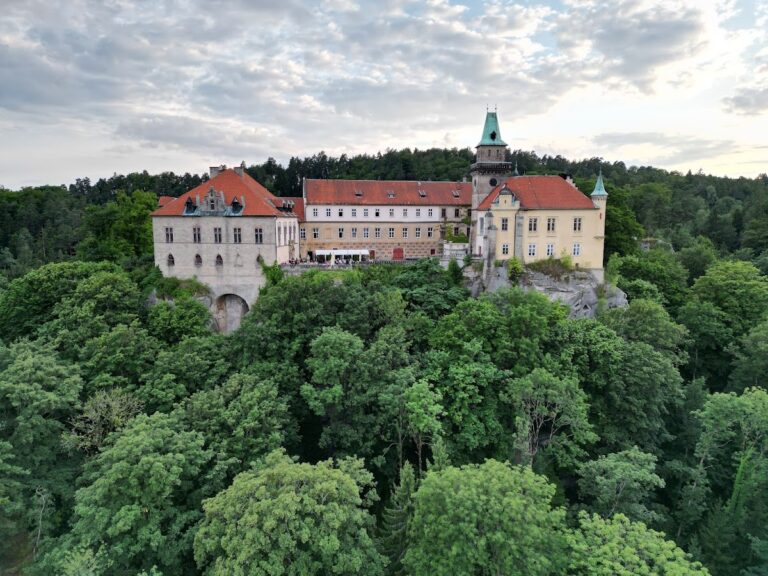
Valdštejn Castle is a ruined Gothic castle near Turnov in Czechia, built by a branch of the Markvartic noble family between about 1260 and 1280. It became the ancestral seat of the Valdštejn family and is among the oldest castles in the Bohemian Paradise region.
Foundation and the Valdštejn family
The castle’s founder was probably Jaroslav of Hruštice, who initially used the name Jaroslav of Lemberk, or his son Zdeněk. Once established, the castle became the family seat and gave the family its name. The first historically known holder was Zdeněk of Valdštejn, associated with the castle between 1280 and 1304.
The castle’s lordship extended over villages on both sides of the Jizera between Turnov and the Cistercian monastery at Hradiště. The Valdštejns retained Valdštejn for about a century. During the fourteenth century, the branch based at Lomnice held the castle despite disputes and accusations of raiding in nearby villages. Around 1380, possession passed to the Vartenbergs, another aristocratic lineage that developed from the Markvartic family.
Hussite occupation and changing ownership
Hussites, followers of the religious reform movement associated with Jan Hus, occupied Valdštejn after 1420. In spring 1424, the Hussite commander Jan Žižka of Trocnov captured Turnov, destroyed its monastery, and took the castle. He entrusted Valdštejn to the lord of Valečov.
The castle then served as a place of imprisonment for Prince Sigismund Korybutovič, a claimant to the Bohemian throne, who was held there for one year in 1427. Rameš Rozvoda of Stakory, another Hussite supporter, was at Valdštejn in 1431. Jan Čapek of Sány, commander of the Hussite force known as the Orphans, was mentioned as the castle’s castellan in 1436.
Raiding bands occupied Valdštejn and the nearby Kavčiny site in 1438 and 1439. The provincial military levy captured both strongholds in 1440. Ownership changed several times afterward. The Šofs of Helfenburk lived at Valdštejn before Zikmund Smiřický of Smiřice acquired the estate in 1514 and united it with the neighboring Hrubá Skála estate.
Fire, pilgrimage, and romantic transformation
A fire destroyed the castle around the middle of the sixteenth century, and by 1582 Valdštejn was described as a ruin. Albrecht von Waldstein, widely known as Albrecht Wallenstein, reacquired the former family estate in 1620. Although he was a prominent Bohemian nobleman and military commander during the Thirty Years’ War, he showed little interest in the destroyed ancestral seat. The property remained with the Valdštejn family until 1821, when Franz Adam von Waldstein sold the Groß Skal estate to the Aehrenthal counts.
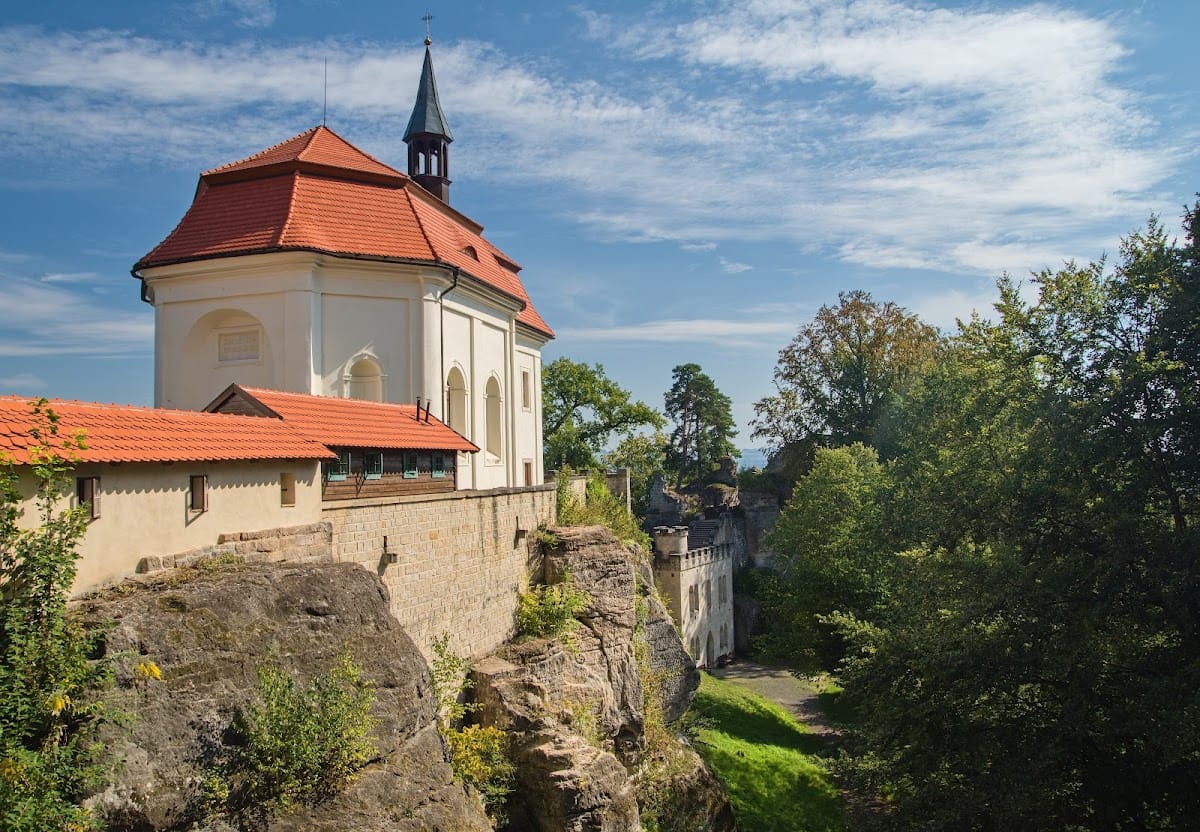
A new phase began in 1694, when Václav Karel Holan Rovenský, a former Prague organist and Baroque composer, settled as a hermit among the ruins. His presence attracted pilgrims, and the owners developed Valdštejn into a romantic pilgrimage site. A stone staircase was added in 1713, followed by a chapel dedicated to Saint John of Nepomuk on the first courtyard in 1722. Baroque statues were installed as part of this development.
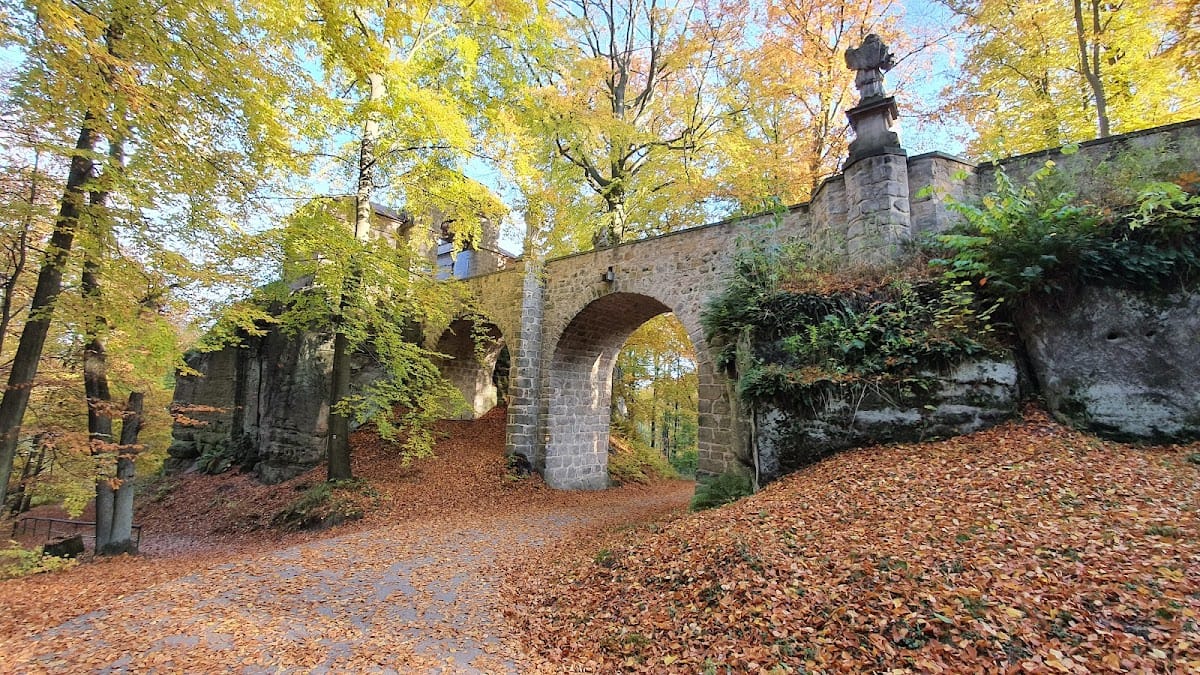
The pilgrimage complex continued to grow. Two stone bridges date from the eighteenth-century development, and the original sculptures by the brothers Jelínek, made between 1725 and 1735, were later moved into the chapel for protection. A chapel dedicated to Saint John the Baptist was added in 1817.
Nineteenth-century rebuilding and modern history
Between 1824 and 1843, the Aehrenthals rebuilt and extended parts of Valdštejn in a historicist manner, largely reviving Gothic forms in a neo-Gothic style. Further alterations continued until the end of the nineteenth century, creating the composite romantic complex visible today. A new entrance gate was built in 1836 beyond a stone bridge decorated with statues.
Valdštejn opened to the public during the second half of the nineteenth century and became a popular destination because of its setting in the Bohemian Paradise. The Čihulka family leased the castle restaurant from 1923 to 1949. After the Second World War, the site also became a center for climbers. Valdštejn has belonged to the city of Turnov since 1945 and is protected as a cultural monument within the Bohemian Paradise Protected Landscape Area.
The castle has also retained literary and musical associations. Josef Bohuslav Foerster composed the oratorio Saint Wenceslas and his Fifth Symphony at Valdštejn. The writer and poet Eduard Petiška lived there with his family from 1954 to 1958 and wrote several works at the castle, including Ancient Greek Myths and Legends.
Remains
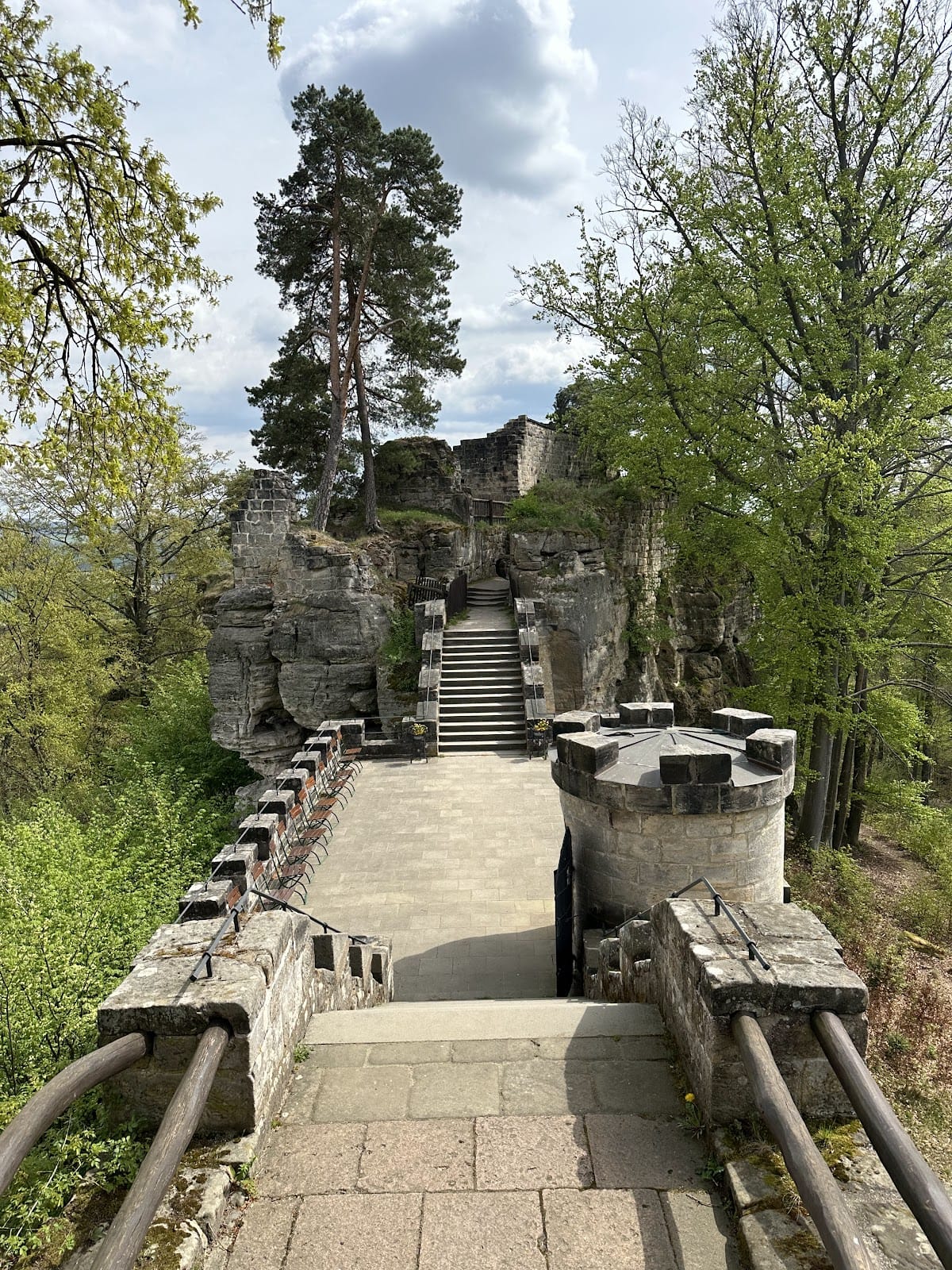
Valdštejn occupies a high rocky position about 3 kilometres southeast of Turnov, near the Hruboskalsko rock formation and nature reserve, at approximately 389 metres above sea level. Forest surrounds the castle on three sides, while steep rock faces overlook Turnov to the north. The original complex was built across three large sandstone pinnacles and separated from its surroundings by a deep defensive ditch. Wooden bridges connected the rock blocks, and the buildings stood against the defensive walls.
Medieval castle remains
Defensive complex and palace
The medieval castle included a keep, or donjon, and a wooden watchtower. Surviving remains comprise ruined walls, fragments of the palace, and vaulted cellars cut into the rock at the rear of the complex. These elements preserve the arrangement of a stronghold adapted to the three sandstone pinnacles and to the defensive ditch surrounding them.
Pilgrimage and historicist structures
Chapel of Saint John of Nepomuk
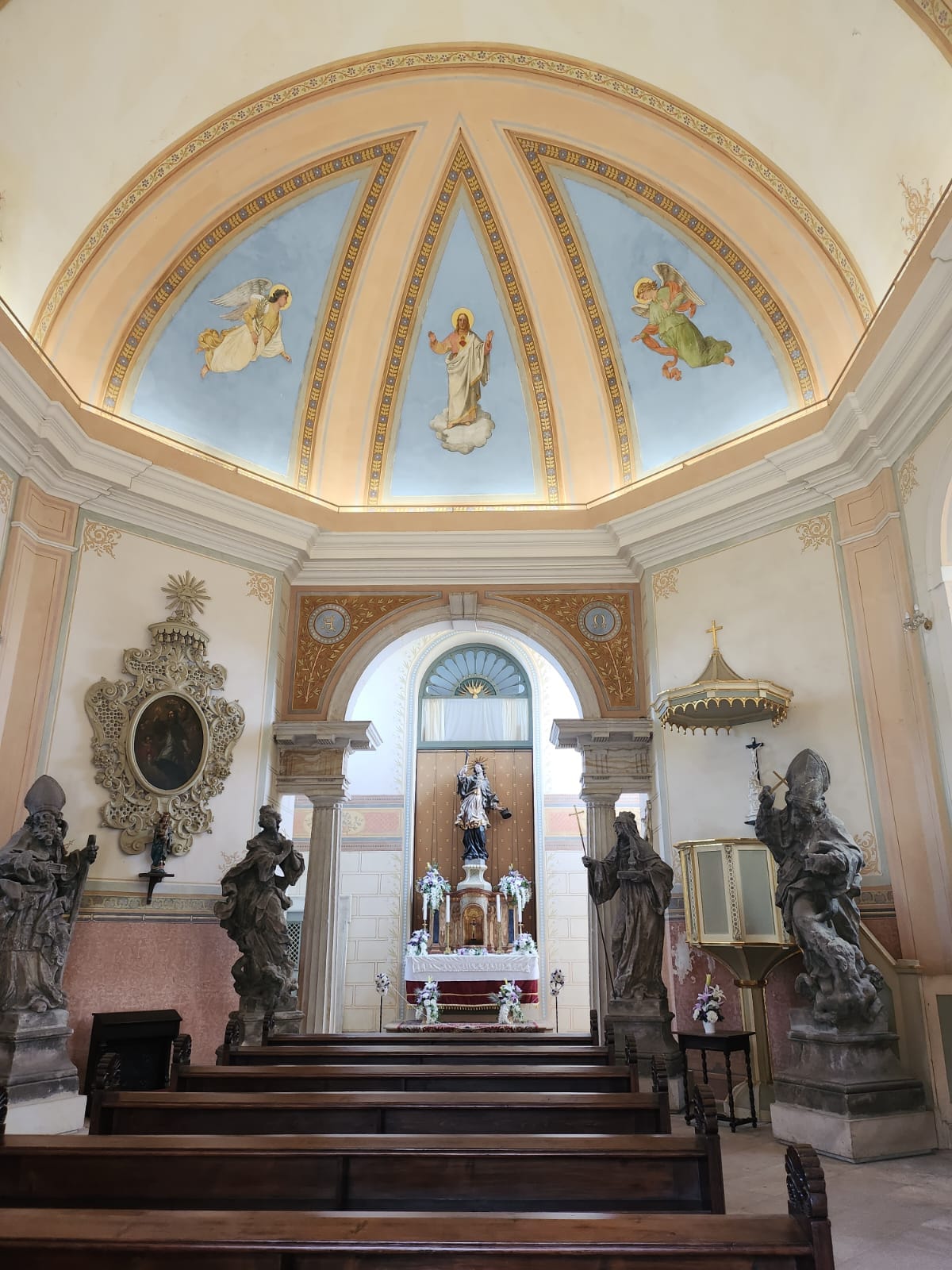
The Chapel of Saint John of Nepomuk stands on the first courtyard. It is a Baroque pilgrimage chapel associated with sandstone statues of Saint John and other Bohemian saints. Saint John of Nepomuk was a fourteenth-century Bohemian saint traditionally regarded as a martyr associated with the protection of the seal of confession and with bridges. The original Jelínek sculptures, dated 1725 to 1735, are preserved inside the chapel, while copies occupy the bridge.
Bridges, entrance, and Saint John the Baptist chapel
The later complex includes two stone bridges, an entrance courtyard, a central courtyard, a classical main building, a romantic palace structure, and former restaurant and hotel premises in the entrance courtyard. The entrance gate, built in 1836, stands beyond a bridge lined with statues. The Chapel of Saint John the Baptist, dating from 1817, is also part of the historic complex. A painting made there by František Mašek in 1836 may preserve the only surviving likeness of the poet Karel Hynek Mácha.
The surviving architecture therefore combines the fragmentary medieval fortress with the Baroque pilgrimage chapel, eighteenth-century bridges, and nineteenth-century neo-Gothic and historicist additions. The result is a layered complex in which the ruined castle, religious structures, and later romantic buildings occupy the same rocky setting.