Chimay Castle: A Princely Residence and Historic Fortress in Belgium


Site at a Glance
- Rating
- 4.3
- Popularity
- Medium
- Country
- Belgium
- Primary era
- Early Modern
- External website
- Open
- Eras represented
- Medieval, Early Modern, Modern
- Civilizations
- Belgian, Holy Roman Empire
- Site type
- Domestic
- Remains
- Castle
On this page15 sections
History
Chimay Castle is a residential castle in Chimay, Belgium, whose origins lie in a medieval stronghold traditionally dated to around the year 1000. Associated for centuries with the princely family of Chimay, it developed from a fortified site overlooking the Eau Blanche valley into a Renaissance-style residence that remains inhabited by descendants of its former ruling family.
Early stronghold and medieval fortress
Ancient chronicles place the construction of an initial fortress at Chimay around the year 1000, although the precise date of the earliest secure building phase remains uncertain. The central keep, the principal fortified tower of a medieval castle, is generally associated with this early period. Its construction coincided with the development of Chimay’s first urban settlement.
The site occupied a rocky promontory above the Eau Blanche valley, close to a river crossing. This defensible position helped establish Chimay as the seat of an important local family. The town is recorded in the eleventh century, and an act dating from 1065 to 1070 names Gauthier de Chimay.
The stronghold expanded during the thirteenth and fourteenth centuries. Towers and an enclosing wall were added around the keep, progressively transforming the original residence into a fortress. The Chimay family line apparently ended in 1226, after which control passed to the Counts of Soissons, who held it until 1317. Ownership then went to the Count of Hainaut and later to the house of Blois.
The Croÿs and the creation of the principality
Jean II de Croÿ purchased Chimay from Philip the Good, Duke of Burgundy, around 1445. Jean was exiled in 1465 and pardoned in 1473 by Charles the Bold, Philip’s successor. His descendants were subsequently allowed to govern the County of Chimay.
Chimay reached its greatest political importance in the fifteenth century. In 1486, Maximilian I, the elected head of the Holy Roman Empire and a member of the Habsburg dynasty, raised the county to a principality. The decision recognized Charles de Croÿ’s support, and Charles became the first Prince of Chimay. He remained close to three successive generations of Habsburgs and served as godfather to Charles V, the Habsburg ruler who became Holy Roman Emperor and king of several European territories.
The castle also acquired a religious association during this period. In 1449, its chapel was said to have housed for several years the relic now known as the Shroud of Turin, a cloth traditionally believed by Christians to have wrapped Jesus after his death. The relic was later transferred to Turin, while the historical authenticity of the cloth remains disputed.
War, inheritance, and aristocratic residence
The fortress suffered repeated damage from warfare, invading troops, looting, and pillage. During the seventeenth century, the armies of Don Juan of Austria, a Habsburg military commander, and Turenne, a leading French commander, successively besieged Chimay. These attacks caused extensive destruction and added to the accumulated damage of earlier conflicts.
After Charles III de Croÿ died without children, the castle passed to his sister, who was married to Charles d’Arenberg. The Arenberg-Croÿ line retained the property until 1686, when inheritance transferred it to the Hénin-Liétard family. Through the marriage of Anne-Gabrielle d’Alsace to Victor Maurice de Caraman, the estate later entered the Caraman line.
François Joseph de Riquet de Caraman inherited the castle in 1804 and became the sixteenth Prince of Chimay. He repaired damage that had accumulated over preceding centuries and adapted the residence for greater comfort. His marriage in 1805 to Madame Tallien, a prominent French political and social figure of the revolutionary and Napoleonic eras, brought a new cultural dimension to the castle.
Music and theatre at Chimay
Madame Tallien’s interest in music led to the construction of a theatre within the castle. In 1808, the composer Luigi Cherubini wrote the Mass in F major, later known as the Mass of Chimay, at Chimay. The castle also received the celebrated nineteenth-century mezzo-soprano Maria Malibran in 1829.
In 1857, Franz Liszt dedicated a mass to the parents of Countess Greffulhe. The dedication commemorated a concert at which Princess Marie played the piano and Prince Joseph played the violin. These events helped establish the castle as a setting for aristocratic musical life.
The theatre was remodelled in 1863. It later hosted distinguished musicians during a festival held between 1958 and 1985. Restoration in 1991, carried out with financial assistance from the Walloon Region, secured the theatre’s continued use. It has since occasionally hosted singing competitions and a baroque music festival established by Christine de Chimay.
Fire, reconstruction, and continued use
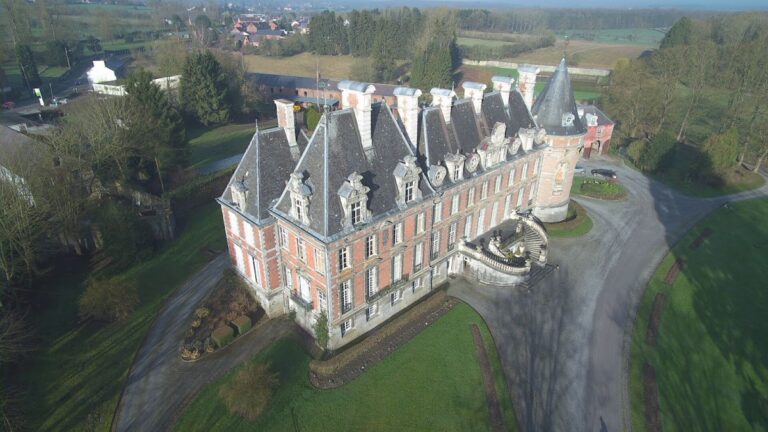
A major fire in 1935 almost completely destroyed the castle and consumed many irreplaceable works of art. Architect Raymond Pelgrims de Bigard directed the reconstruction, which restored the building’s Renaissance appearance in a style associated with Henry IV. Repairs and adaptations continued under later generations of the princely family.
The castle theatre later served as a setting for Gérard Corbiau’s film The Music Teacher. Chimay has continued to function as a cultural venue for classical and baroque music. Following Prince Philippe’s remarriage in 2012, the castle underwent comprehensive renovation and was adapted to new technologies, including tours conducted with iPads.
Chimay Castle and its theatre are protected as classified heritage in Wallonia. The theatre received classification in 1958 and recognition as exceptional heritage in 2013. The walls, keep, façades, roofs, fortress platform, and specified historic fabric were classified in 2004. The current owner is Société Anonyme Chimay Malgré Tout, while descendants of François Joseph de Riquet de Caraman continue to live in the castle.
Remains
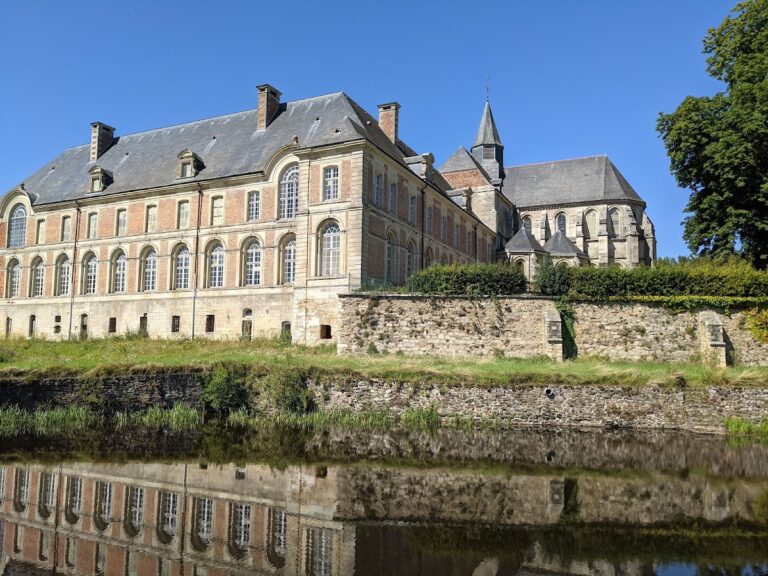
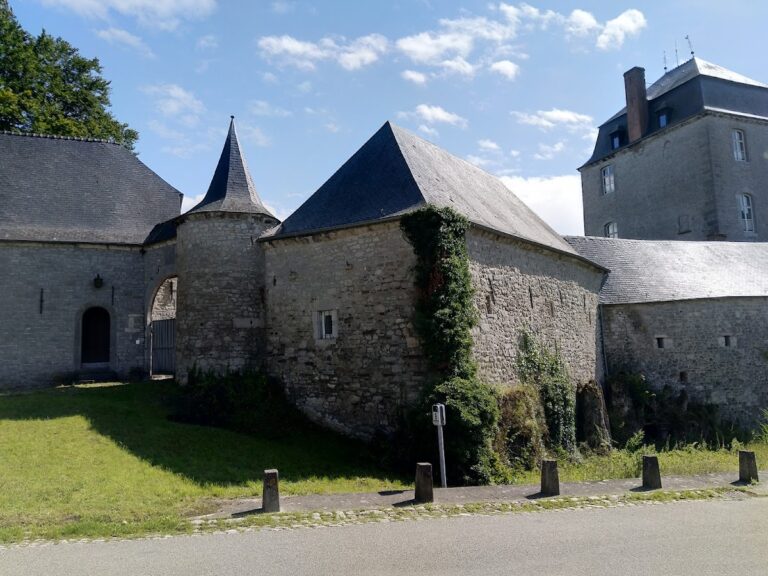
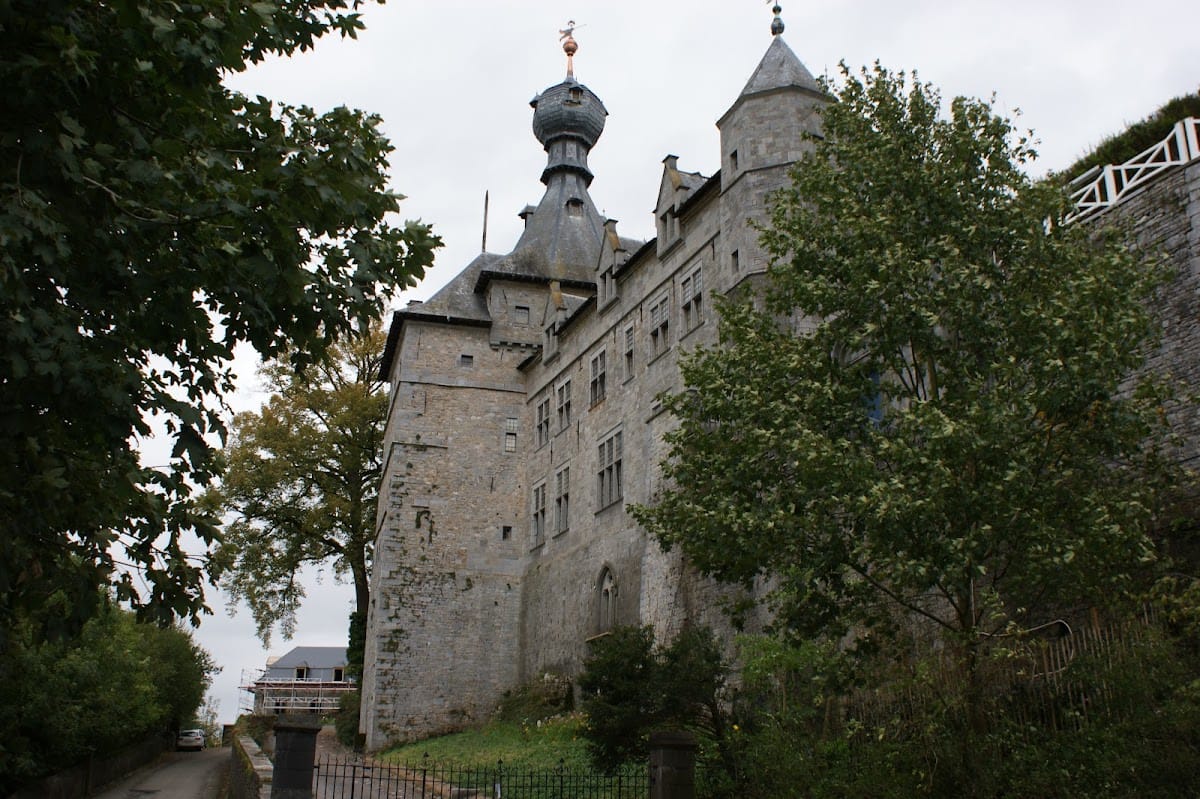
Chimay Castle stands on a rocky promontory above the Eau Blanche valley. Its surviving form combines a sixteenth-century residential manor with defensive elements that developed from the medieval stronghold. Grey stone is the principal building material, and the complex retains the ancient central tower, low vaults, fortified walls, towers, and a large surrounding park.
Fortified core
Central keep and medieval enclosure
The central keep forms the oldest architectural core of the castle and is traditionally linked with the building phase around the year 1000. It was both the principal defensive tower and an important residential stronghold. During the thirteenth and fourteenth centuries, an enclosure grew around it, incorporating surrounding walls and several towers.
Fifteenth-century defensive works
The defensive complex was enlarged in the fifteenth century with five new towers connected to the keep by corridors. These additions increased the fortress’s defensive capacity and extended the fortified structure around the earlier tower. The walls, towers, keep, façades, roofs, and fortress platform form part of the historic fabric protected as classified heritage.
Residential and cultural spaces
Renaissance residence and guardroom
The present building largely reflects its reconstruction as a Renaissance-style residence associated with the period of Henry IV, while preserving earlier medieval elements. The sixteenth-century guardroom retains vaulted ceilings and a slate floor. These features belong to the castle’s residential and defensive interior rather than to a separate modern reconstruction.
Chapel
A small chapel is associated with the tradition that the Shroud of Turin was kept at Chimay before its transfer to Turin. Its historical importance therefore rests on the relic tradition connected with the castle as well as on its place within the residential complex.
Castle theatre
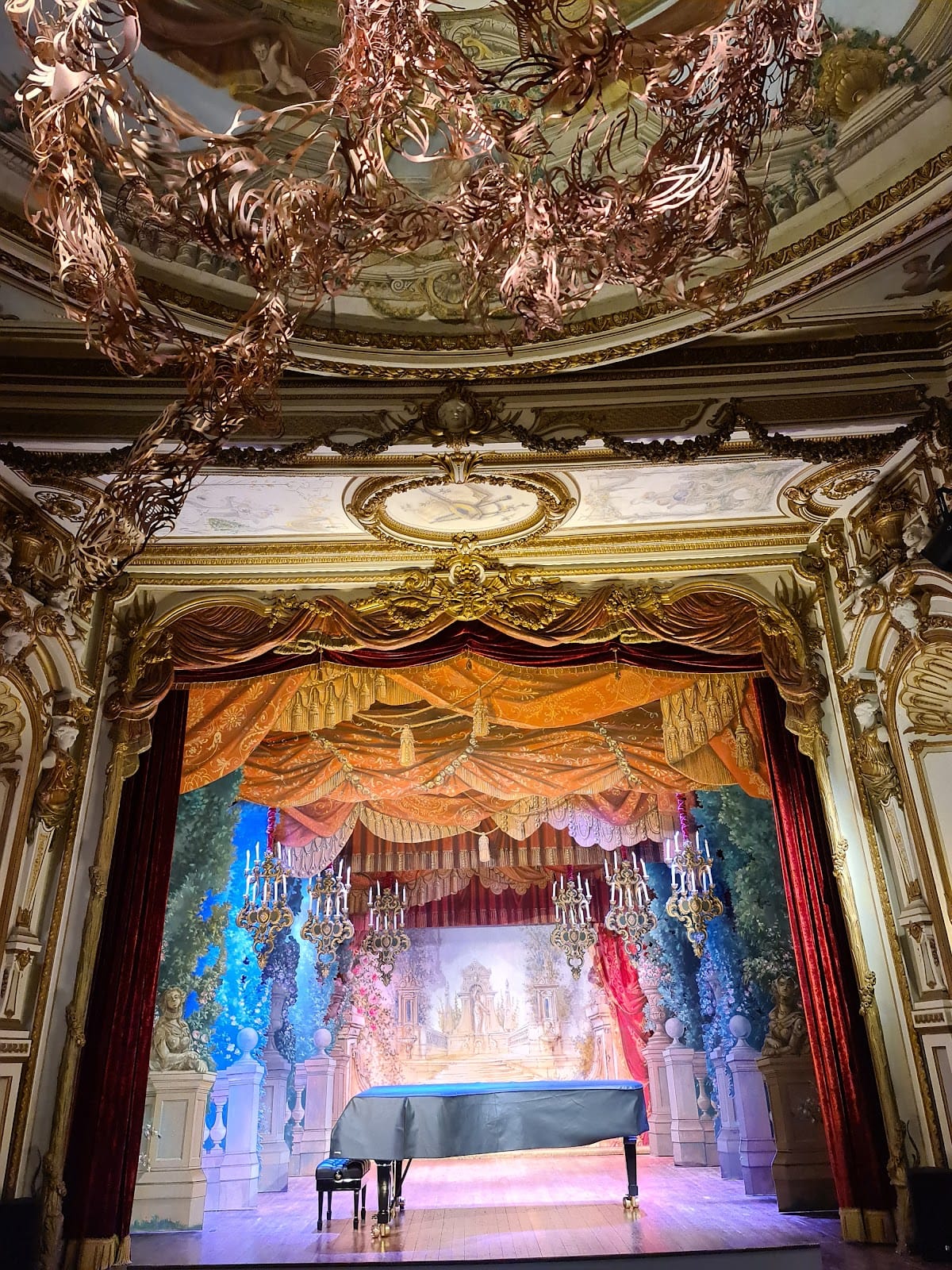
The theatre was created for Madame Tallien’s musical activities and rebuilt in 1863 by Le Fuel and Cambon. Its Rococo interior uses elaborate ornament, curved forms, and theatrical decoration in a miniature version of the Louis XV theatre at Fontainebleau. The auditorium provides seating for approximately 200 people and remains an important cultural space within the castle.
Park and gardens
The castle complex includes a park extending over approximately 200 acres. Its grounds contain gardens and plots used for medicinal herbs, giving the residence a substantial landscaped setting alongside its fortified and residential buildings.
The 1935 fire left the castle almost entirely destroyed, but the subsequent rebuilding restored its Renaissance appearance and preserved elements of its earlier defensive structure. Later renovations adapted the historic building for modern technological use while maintaining its role as a princely residence and musical venue.