Liessies Abbey: A Benedictine Monastery in France
Site at a Glance
- Rating
- 4.6
- Popularity
- Low
- Country
- France
- Primary era
- Medieval
- Eras represented
- Medieval, Early Modern
- Civilizations
- Carolingian, French, Holy Roman Empire
- Site type
- Religious
- Remains
- Fortified Monastery
On this page14 sections
History
Liessies Abbey is a former Roman Catholic Benedictine abbey in Liessies, France, founded in 751 by Wilbert, Count of Poitou and a cousin of Pepin the Short. The Benedictines were monks who followed the Rule of Saint Benedict, a religious code centred on communal prayer, work, and obedience. The abbey belonged to the Archdiocese of Cambrai and became associated with Saint Hiltrude, important relics, manuscript production, and a long monastic history on the frontier between France and the Empire.
Foundation and the double monastery
According to tradition, Wilbert fled persecution by Gaivre, Duke of Aquitaine, and received lands extending from Molhain to Vaux-en-Arrouaise. While hunting in the Fagne forest, he killed a wild boar and chose the place where it fell for his new foundation. Building began in 751 and continued for seven years. Wilbert appointed his son Gontrad as the first abbot, and Gontrad obtained relics of Saint Lambert from Fulcaire, Bishop of Liège. Saint Lambert, a bishop of Maastricht and Liège, was venerated as a Christian martyr. Alberic, Bishop of Cambrai, consecrated the church.
Wilbert’s daughter Hiltrude refused a marriage arranged with a nobleman and became a recluse in a cell beside the abbey church. A recluse was a religious person who voluntarily lived in seclusion, usually beside a church or monastery. Other noblewomen joined Hiltrude, creating a female annex and a double monastery in 752. Hiltrude died on 27 September 769 and was buried near Gontrad in the church. Her tomb later became associated with miracles, leading to her formal veneration and canonization.
Destruction, recovery, and Benedictine restoration
A Norman attack in 881 killed or enslaved the monks and their servants. The church was spared, but neighbouring lords seized the abbey’s properties, leaving a single priest in the village. In 1003, the Bishop of Cambrai ordered Hiltrude’s body removed from the church after a priest had buried a brigand there. A community of canons then took possession and pursued the return of the confiscated lands. Their legal action brought compensation that helped pay for repairs, although their control was later replaced by Benedictine monastic life.
Restoration followed through the intervention of Thierry of Avesnes, who regretted the earlier destruction of churches at Maubeuge and Mons. Ermentrade, the wife of the wealthy lord Adelard, rebuilt the church. A Benedictine monastery was finally established between about 1095 and 1110 under Theodoric of Avesnes and his wife Ada. Gossuin of Avesnes was buried at Liessies, while his wife Agnes entered the monastery. Agnes founded two chapels and gave the abbey numerous valuable objects.
Conflict and the growth of the abbey
Gautier d’Oisy, lord of Avesnes, repeatedly plundered Liessies. The monks obtained permission from the Count of Hainaut to raise his banner on the abbey tower as a signal requesting protection, but Gautier destroyed the tower during an attack. Bernard of Clairvaux attempted to mediate between the monks and Gautier, without producing a lasting peace. Further attacks eventually forced the monks to leave.
Around 1100, Gautier’s son Thierry was killed in an ambush while acting as a highway robber. Gautier understood the death as divine punishment for his treatment of the abbey. He repaired the damage and paid for Thierry’s burial at Liessies, where Gautier himself was later buried. The abbey also expanded its religious connections. It received the priory of Sart-les-Moines in 1125 and the priory of Dompierre, together with the body of Saint Etton, in 1162 through a donation by William, lord of Dompierre. Saint Etton was a locally venerated saint associated with Dompierre. In 1208, Thomas de Walcourt donated a fragment of the True Cross after returning from the Holy Land. The True Cross was the Christian relic traditionally identified as part of the cross on which Jesus was crucified. These relics helped make Liessies an important pilgrimage destination.
War, reform, and intellectual life
Liessies suffered during the Hundred Years’ War, the prolonged series of conflicts between the English and French crowns from the fourteenth to the fifteenth century. Its position on the frontier between France and the Empire placed the abbey in a major combat zone. In 1339, the forces of Edward III of England, which had reached Avesnes-sur-Helpe, plundered the surrounding region.
Renewed prosperity began around 1520 under the abbots Gilles Gipus and Louis de Blois-Châtillon. In 1530, Louis de Blois, also known as Blosius, began a reform that restored strict observance of the Benedictine Rule. Blosius was a sixteenth-century Benedictine abbot and mystical writer. Liessies reached an artistic and intellectual high point in the sixteenth and eighteenth centuries, particularly through its illumination work. The abbey maintained a good library and had produced books in the twelfth century using exemplars borrowed from Clairvaux.
Abbot Antoine de Wynghe supported the hagiographer Jean Bolland and provided a stipend for Godfrey Henschen to assist him. In 1702, François Fénelon, Archbishop of Cambrai and a French Catholic archbishop and religious writer, visited Liessies and issued instructions for reform. Lambert Bouillon, the forty-first abbot, died in 1708. He was said to have dissipated monastic revenues through lawsuits and diverted them to family members, although he and his successor, Agapit d’Ambrine, were also credited with enlarging and improving the abbey buildings.
Suppression and later survival
Liessies Abbey was suppressed in 1791 during the French Revolution. The last abbot, Dom Mark Verdier, and his community had declared their wish to remain in religious life, but the suppression proceeded. The property was sold in 1791 and 1792, and the church was pillaged and destroyed. The site later passed to the Lhomme family, which gradually demolished the principal buildings.
During the Great Fear in 1789, inhabitants of Dompierre came armed to recover the relics of Saint Etton. The relics were saved, while much of the remaining abbey progressively disappeared. The former abbey park was preserved as part of the Avesnois ecomuseum. Since 2008, the Bûcher aux Moines in the park has hosted international interdisciplinary meetings devoted to relations between societies and the environment. A procession honouring Saint Hiltrude was held for the last time in 1963. The parish church retains objects and works of art from the abbey, including some of the paintings for which Liessies was once known.
Remains
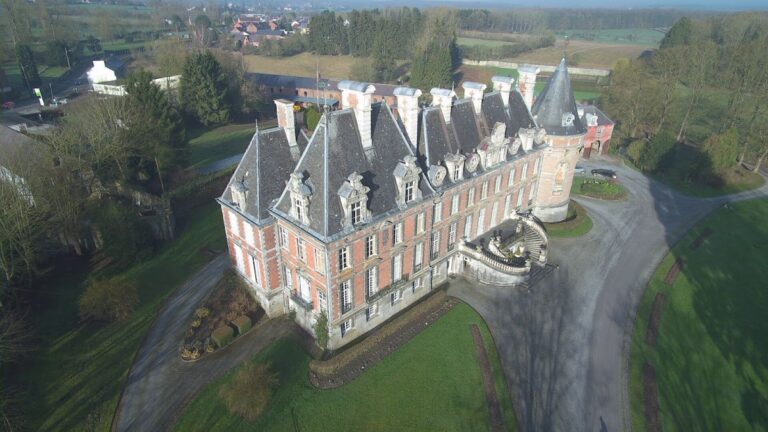
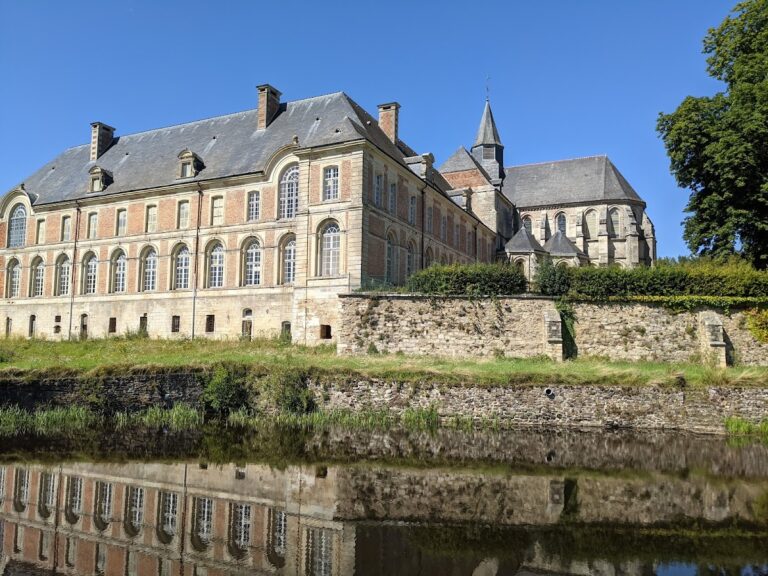
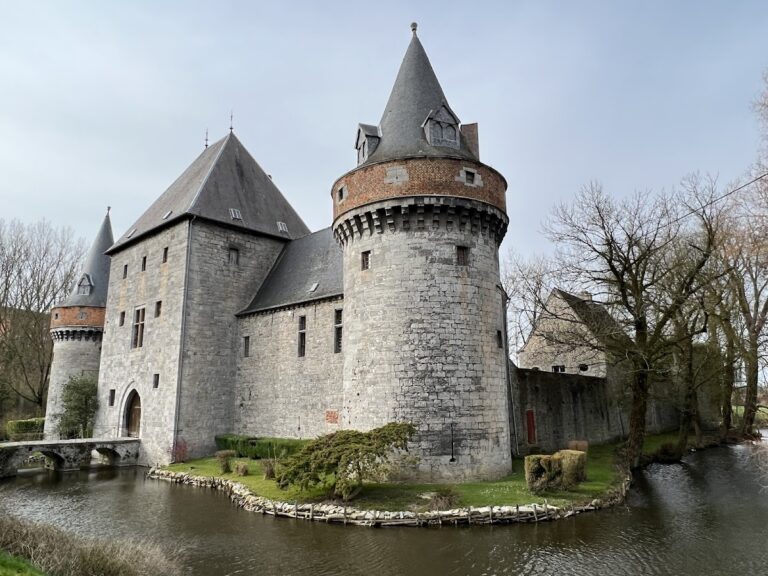
The abbey was once a loosely connected complex of religious, residential, and agricultural buildings enclosed by a wall and a line of towers or bastions. A Gothic quadrangular building surrounded by a cloister housed the monks. Its imposing facade contained two towers and a gateway. A second quadrangle incorporated the church dedicated to Saint Hiltrude, while modest agricultural buildings of one or two storeys served the working life of the institution. Small monastic working buildings remain scattered around the former abbey park.
Saint Hiltrude church and associated buildings
Church remains
The Saint Hiltrude church was a single-nave building with a tall tower. Part of its walls remains, while the present church has been heavily altered. Its roof is new, and its replacement tower is considerably lower than the former one and ends in a cupola. Gothic portals survive above the side entrance, accompanied by simple pointed-arch windows. The facade contains a single semicircular window in the position once occupied by the principal upper opening.
Burials and chapel
The abbey church contained the tombs of Gontrad and Hiltrude and later received the burials of Thierry of Avesnes and Gautier d’Oisy. A Saint Hiltrude chapel still stands in the forest associated with the former abbey site. These places preserve the material setting of the abbey’s principal local religious associations.
Park landscape and working remains
Water installations
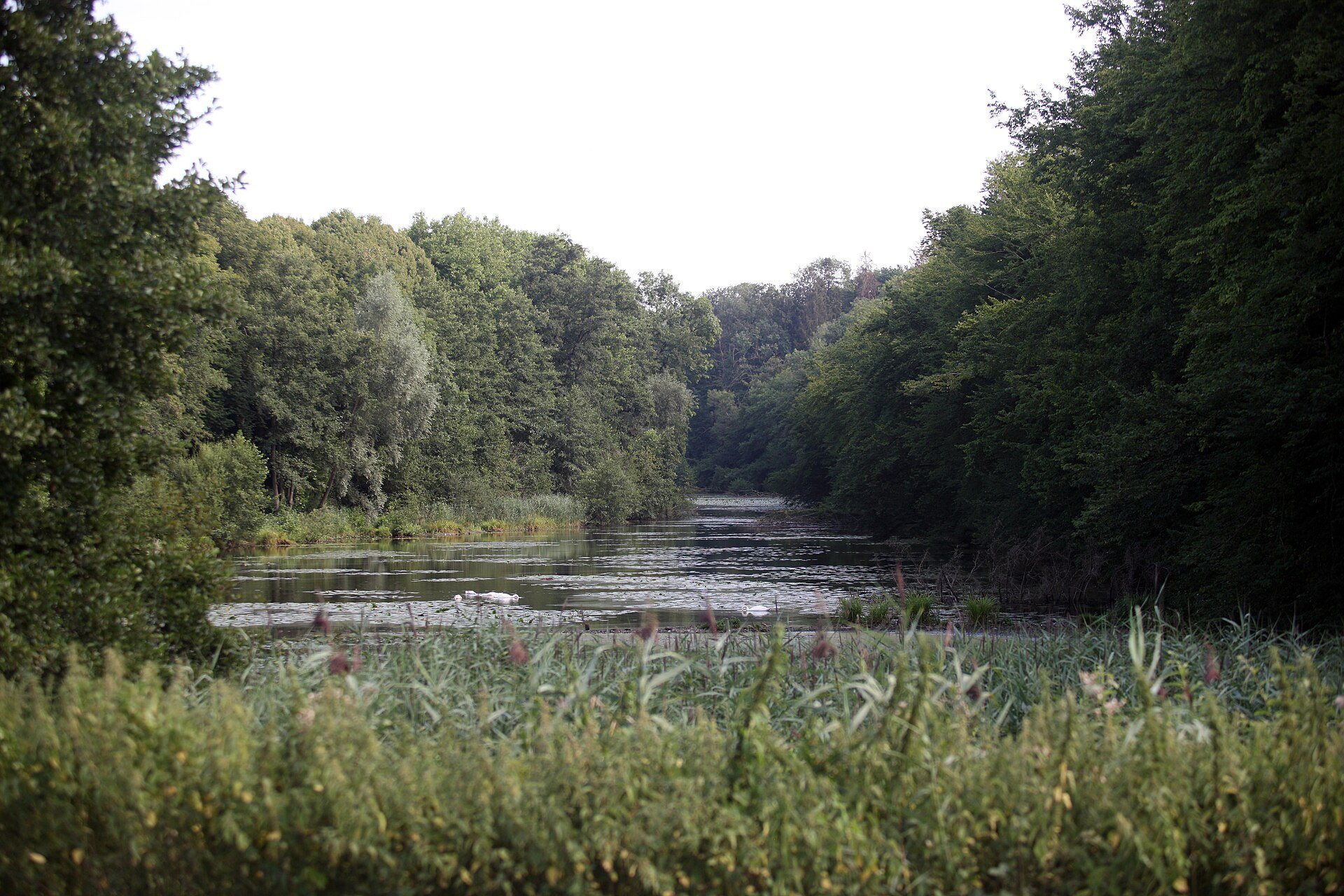
The former abbey park retains hydraulic installations that include ponds or other water bodies, a bridge, and associated paths and avenues. This surviving water layout forms one of the park’s principal preserved features and reflects the practical infrastructure of the former complex.
Bûcher aux Moines and service buildings
The Bûcher aux Moines occupies a named site at the centre of the park. Common or service buildings and scattered paths also remain among the park installations. Together with the surviving fragments of the church and other small working buildings, they convey parts of the abbey’s former spatial organization.
Relics, art, and music
Relics associated with Liessies included those of Saint Lambert, the body of Saint Etton, and a fragment of the True Cross. The inhabitants of Dompierre recovered Saint Etton’s remains in 1789. Neighbouring and parish churches retained objects and works of art from the abbey, including a few paintings from its former collection.
Liessies was known for illuminated manuscripts and paintings, including a series representing religious founders. Revolutionary destruction caused paintings to be burned or dispersed, with a few surviving in neighbouring churches. The abbey also possessed a Vanden Gheyn carillon, a set of tuned bells played from a keyboard or mechanical mechanism and made by the Vanden Gheyn bellfounding tradition.