Klosterkirche Heilig-Kreuz: Dominican Convent Church in Regensburg
Site at a Glance
- Rating
- 4.8
- Popularity
- Very Low
- Country
- Germany
- Primary era
- Medieval
- Eras represented
- Medieval
- Civilizations
- Holy Roman Empire
- Site type
- Religious
- Remains
- Church
On this page10 sections
History
Klosterkirche Heilig-Kreuz is the Roman Catholic convent church of the Dominican women’s convent Heilig Kreuz in Regensburg, Germany. Built between 1237 and 1244 in the medieval period, it belongs to a convent that has remained continuously at this site since 1233 and is described as the oldest still-existing and never-dissolved Dominican women’s convent in Germany.
Foundation and Dominican administration
On 22 February 1233, Bishop Siegfried of Regensburg donated a building site to a community of pious women from the city. This act established the foundation of the convent. In 1237, Count Heinrich of Ortenburg and Murach transferred the parish of Schwarzhofen to the women. Its income helped support the convent and finance the construction of the church, which was completed between 1237 and 1244.
The site lay in the western foreland of Regensburg, at the end of a lane that initially had no name. Around 900, Duke Arnulf I of Bavaria had opened a quarry there to provide stone for the Arnulfian city wall. After the quarry was exhausted and filled, the former stone pit became the location of the church and later convent buildings. The area and lane were first known as Arnulfswinkel or Arnoldswinkel. After 1800, the names Hl. Creuzgäßl and Kreuzgasse came into use.
In 1246, the convent was formally transferred to the Dominican Order, a Catholic religious order devoted to preaching, theological study, and pastoral ministry. Dominican friars from the nearby monastery of St. Blasius served the sisters as confessors and spiritual advisers. Reform at Heilig Kreuz gained considerable momentum in 1484, when sisters from Nuremberg’s St. Catherine’s Convent joined the community.
Rococo transformation
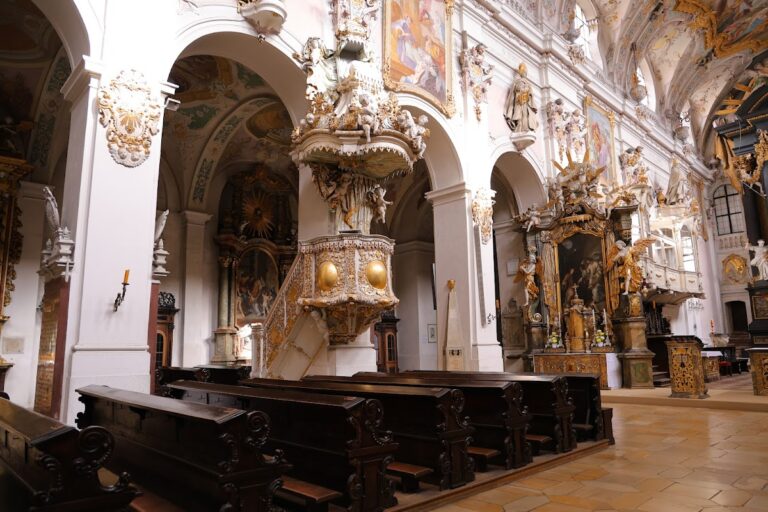
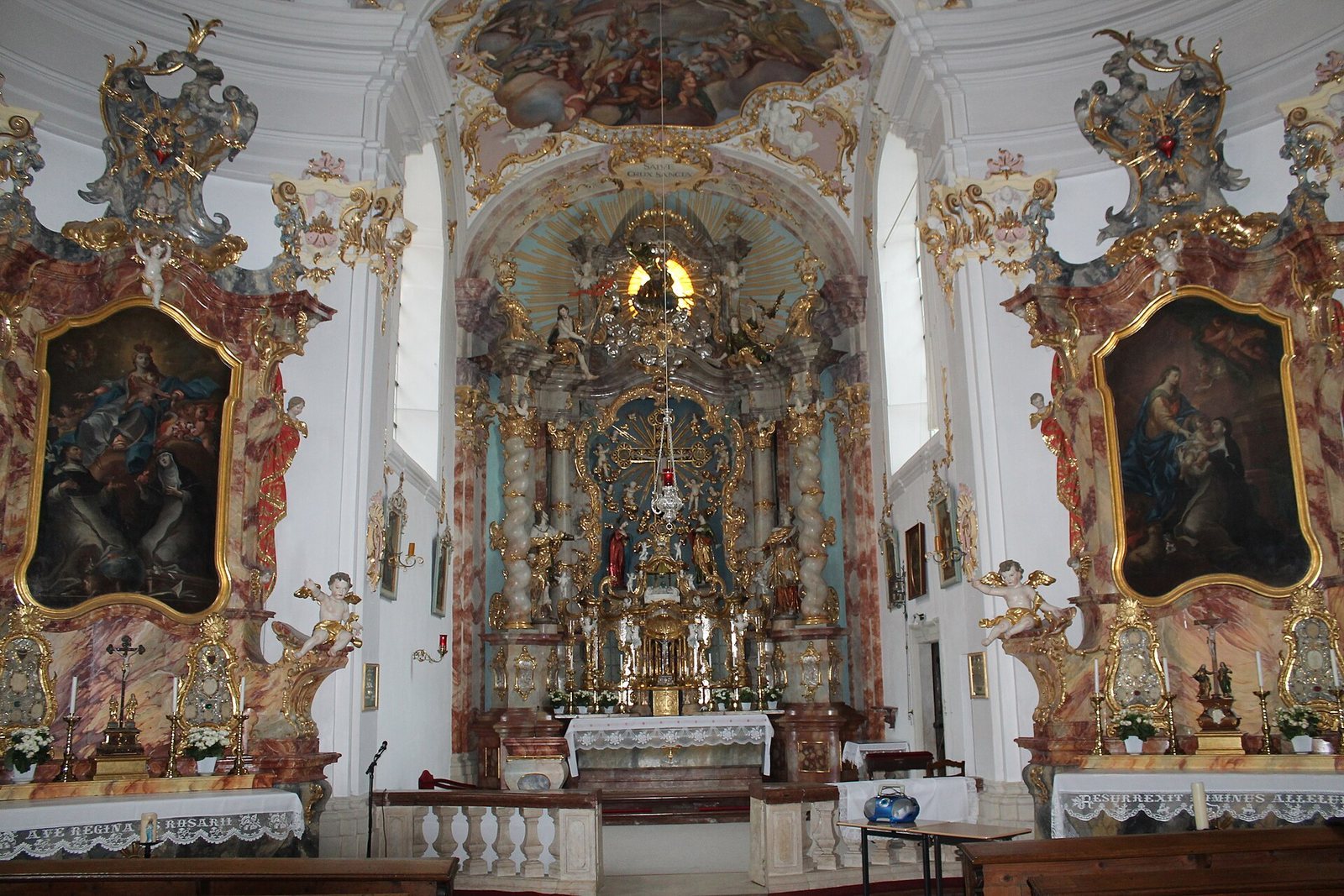
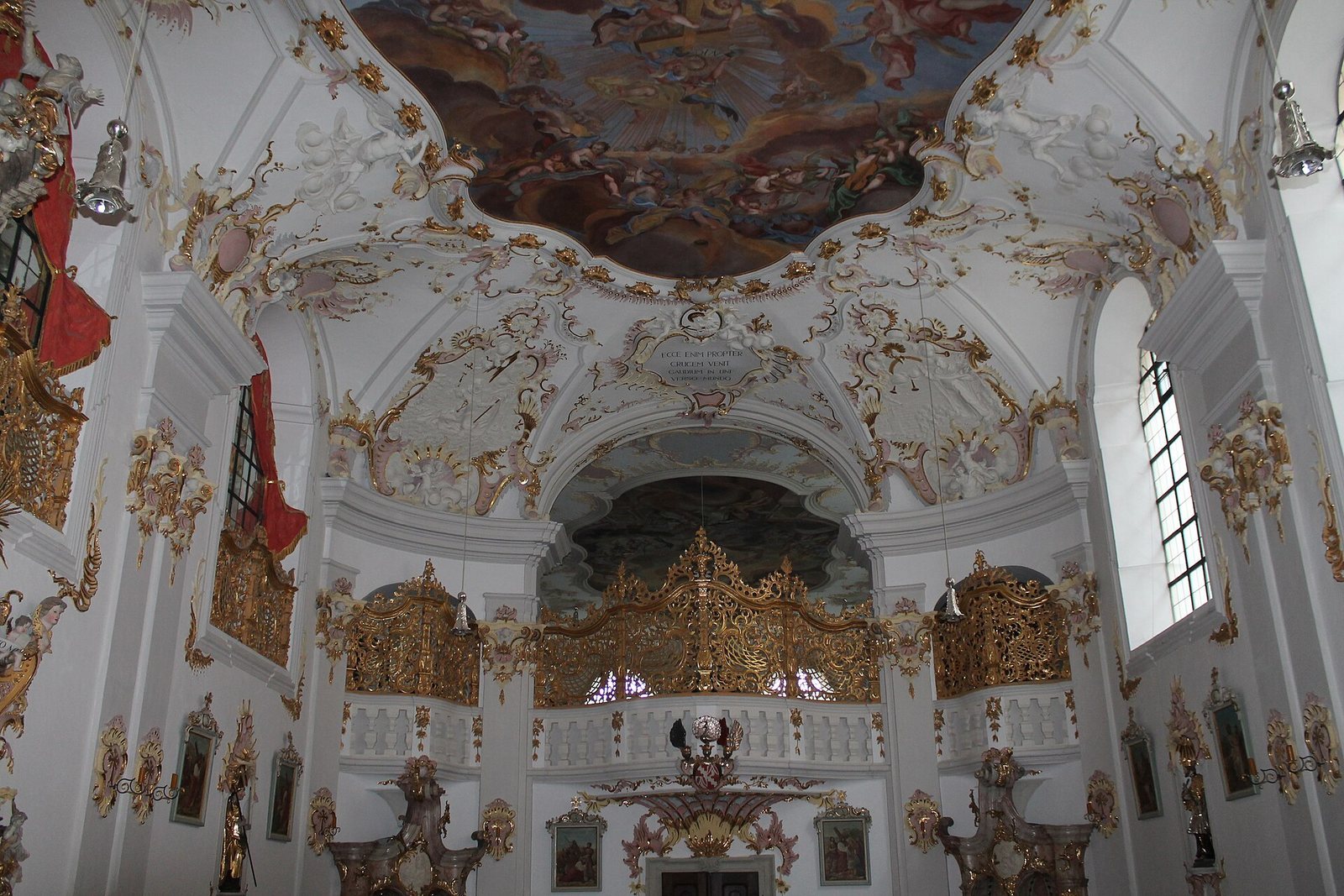
In 1751, Prioress Hyazintha Hämmerl commissioned the transformation of the church in the Rococo style, an eighteenth-century manner known for light ornament, flowing decoration, and elaborate stucco and painting. The principal collaborators were the altar builder Simon Sorg, the stucco artist Johann Baptist Modler, and the painter Otto Gebhard. Their work was completed around 1757.
The redesign followed a unified theological program connected with the Dominican preaching mission. It presented central Catholic teachings, explained the meaning of Christ’s Cross, and used prominent Dominican figures to express the aims of the order. The figures represented were Hyacinth of Poland, Thomas Aquinas, Raymond of Peñafort, and Vincent Ferrer, all notable Dominican saints, theologians, or preachers.
Survival and modern restoration
During the secularization period after 1800, the convent’s continued existence was made conditional by Carl Theodor von Dalberg, an ecclesiastical prince of the Holy Roman Empire who served as Elector of Mainz and later as an archbishop and prince-primate. The condition required the opening of a girls’ school. Although it was fulfilled only hesitantly, the convent survived. In 1872, the city built a separate schoolhouse, now called Kreuzschule.
Under the priorate of Mother Benedikta Bauer, the convent also established new foundations. These were founded in Niederviehbach on the Isar in 1853, in Brooklyn, New York, in 1859, and in Racine, Wisconsin, in 1862. Bombing during the Second World War severely damaged the church. Between 1980 and 1983, renovation restored its original color scheme. Since 2006, Klosterkirche Heilig-Kreuz has formed part of the UNESCO World Heritage property “Old Town of Regensburg with Stadtamhof.”
Remains
Medieval structure and later interior
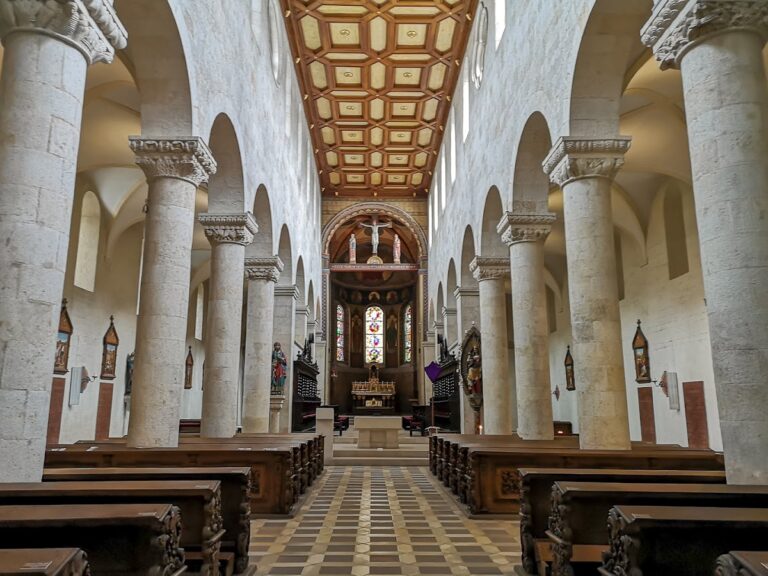
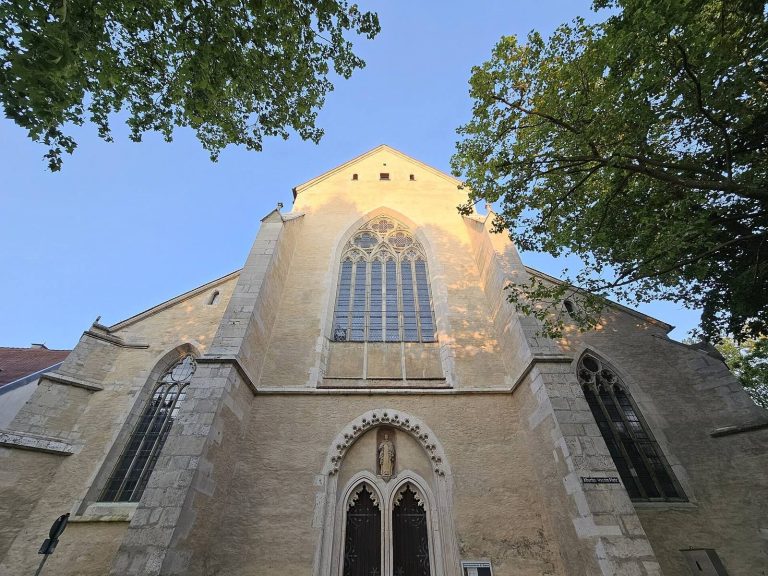
The church stands in the northwestern part of Regensburg’s old town, near the Dominican church of St. Blasius, the male Dominican counterpart of the convent. The original building was broad and rectangular, with a single nave, a simple wooden ceiling, and fourteen tall, very narrow windows. At the eastern end, an integrated choir, meaning a choir incorporated into the main body of the church, formed a three-sided polygonal termination and carried a vault.
The interior preserves the meeting of medieval and eighteenth-century traditions. A Romanesque crucifix from the convent’s foundation period gives Heilig Kreuz its name. In 1669, it was moved from the convent buildings into the church so that it could be publicly venerated. The later Rococo decoration incorporated the crucifix into a visual program centered on redemption through the death and Resurrection of Jesus Christ.
Altars and theological imagery
High Altar
The High Altar and the Romanesque crucifix together express redemption through Christ’s death and Resurrection. The figure of Christ presents the Rex triumphans, or triumphant Christ, emphasizing victory over death. The Romanesque crucifix and Rococo altar remain visibly distinct within the same composition.
Ceiling paintings
An image of the apocalyptic Lamb above the tabernacle frame summarizes the theme of Christ’s death, Resurrection, and exaltation. A tabernacle is the receptacle in which consecrated Eucharistic elements are reserved. The same theme appears in the ceiling painting of the nuns’ choir, the section used for the religious community’s liturgical singing or prayer and accessible only to the nuns. Over the presbytery, the part of the church surrounding the High Altar, a ceiling painting depicts the casting down of the dragon, a subject used descriptively in Baroque art.
Statue of Saint Blasius
A Gothic statue of Saint Blasius stands in a niche in the southeastern wall beside the confessional. Saint Blasius was an early Christian bishop and martyr. The statue commemorates the connection between Klosterkirche Heilig-Kreuz and the Dominican friars of the nearby monastery of St. Blasius.