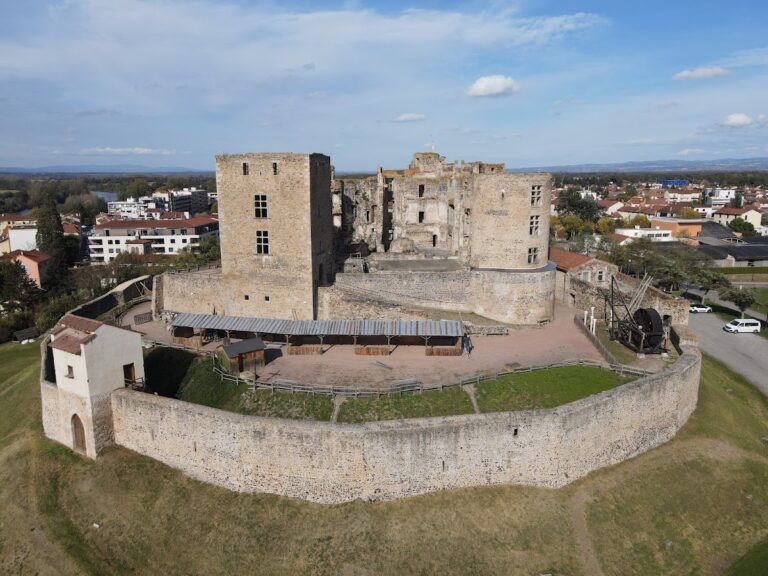
Roche-la-Molière Château: A Fortified Residence in France


Site at a Glance
- Rating
- 4.3
- Popularity
- Low
- Country
- France
- Primary era
- Medieval
- Eras represented
- Medieval, Early Modern
- Civilizations
- French
- Site type
- Domestic
- Remains
- Castle
On this page8 sections
History
Château de Roche-la-Molière is a fortified château in France, built by stages from the fourteenth through the eighteenth century. Designed as both an aristocratic residence and a defensible stronghold, it belonged successively to several families of Forez and the surrounding region before becoming the property of the merchant Jacques Neyron, regarded as the last seigneur, or lord of the estate under France’s ancien régime.
Families of Forez and the sixteenth-century conflict
The estate passed through marriage among the Lavieu family of Forez, the d’Augerolles or d’Ogerolles family of Sapolgue, the Capponi family of Feugerolles, and the Charpin family of Feugerolles. These transfers connected Roche-la-Molière to the local network of noble households that held estates and jurisdiction in the region.
On 31 March 1584, Antoine d’Augerolles of Roche-la-Molière and his son Jean were travelling to Easter Mass at Saint-Genest when their enemy and relative, Aymar de Saint-Priest of Saint-Étienne, ambushed and killed them at La Rochette. Henri III, king of France from 1574 to 1589, later pardoned Aymar de Saint-Priest through royal letters of remission, formal pardons issued by the monarch.
Seventeenth- and eighteenth-century transfers
On 10 August and 25 October 1677, Madeleine du Peloux, widow of Gaspard Capponi of Feugerolles, and her daughter Catherine-Angélique Capponi transferred Roche-la-Molière for 111,000 livres to Jean-François Anselmet des Bruneaux. Catherine-Angélique and her husband, Pierre-Hector de Charpin de Souzy de la Forest-des-Halles, recovered the estate on 20 August 1683 through an exchange with Claude-Gabriel Anselmet.
On either 12 or 16 December 1683, Pierre-Hector de Charpin and Catherine-Angélique Capponi sold Roche-la-Molière to Pierre Duon, president of the Treasurers of France in Lyon, for 74,500 or 76,000 livres. The Treasurers of France were royal financial and judicial officials involved in provincial revenue and administration. After Duon’s death, his widow, Madeleine Chappuis de La Faye, sold the château on 21 April 1719 to Jean Perrin de Vieux-Bourg, a former alderman of Lyon.
Alexis-Bonaventure Perrin de Vieuxbourg transferred the estate on 25 January 1745 to Jean-Louis Girard for 136,000 livres. Girard died in a duel at Lorient on 9 August 1746, after which his sister Marie Girard held the property. In 1765, she and her husband, Pierre-Antoine Chappuis de Maubon, sold it to the Duke of Chârost and Ancenis.
The duke obtained a coal concession at Roche in 1766, but that concession was transferred separately to René Eustache d’Osmond in 1786. On 26 February 1772, the merchant Jacques Neyron purchased the château estate and the land of Roche from the duke for 205,000 livres. Neyron had become a secretary of the king in 1768 and later served as mayor of Saint-Étienne from 1778 to 1783. During his ownership, he commissioned substantial works, particularly improvements to the interior salons.
Municipal and cultural use
The municipality acquired the château from the Neyron family in 1951 and briefly converted it into a college. The property later passed to the local-history society and became a cultural space used for exhibitions. Roche-la-Molière Château was listed as a French historic monument on 17 December 1985. This national register identifies buildings and sites with historical or architectural value and places them under heritage protection.
Remains
Château and grounds
Fortified château and interior salons
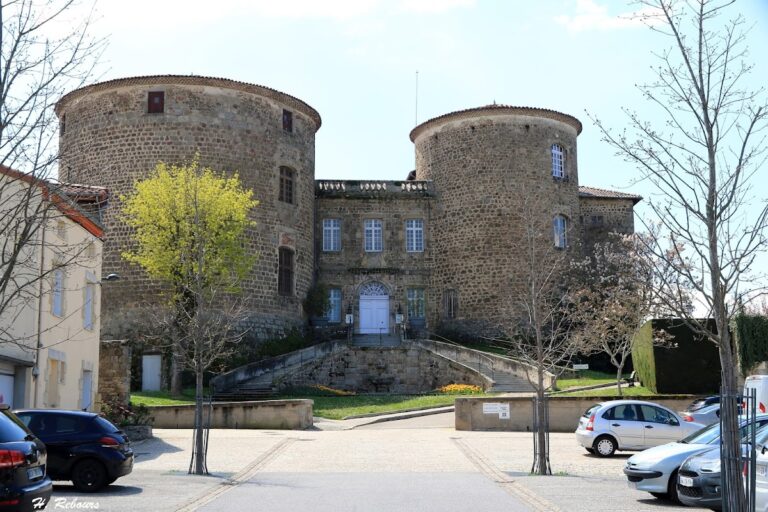
The surviving château is a fortified residence whose construction extends from the fourteenth to the eighteenth century. Its form reflects the combination of aristocratic habitation and defensive purpose associated with a fortified château. The interior salons were substantially altered or improved during Jacques Neyron’s ownership, preserving the physical effect of the major eighteenth-century campaign within the residence.
Park and vaulted spaces
The estate includes a large park crossed by walking paths and containing children’s play areas. At the northern end of the park, vaulted spaces survive as witnesses to the site’s earlier history. These remains form part of the physical evidence connecting the landscaped grounds with the older fortified estate.