Château-Figeac: A Historic Wine Estate in Saint-Émilion, France

Site at a Glance
- Rating
- 4.6
- Popularity
- Very Low
- Country
- France
- Primary era
- Early Modern
- External website
- Open
- Eras represented
- Classical, Medieval, Early Modern, Modern
- Civilizations
- French, Roman
- Site type
- Economic
- Remains
- Production Complex
On this page15 sections
History
Château-Figeac is a historic wine estate in France, near Saint-Émilion in the Libournais region of Bordeaux. Its origins are traced to the Gallo-Roman period, probably the second century, when a Roman rural estate or residence called Figeacus occupied the site. Stone conduits survive from this early phase. The name is traditionally linked to the Figeacus family, and the geographer Henri Enjalbert associated it with the name of the commune of Figeac in the Lot. Château-Figeac later became one of Saint-Émilion’s five noble houses and developed into a large vineyard estate whose buildings preserve several periods of construction.
Medieval ownership and Renaissance rebuilding
During the Middle Ages, Château-Figeac belonged to several leading regional families. In the fifteenth century, the Lescours family sold the property to the Cazes, or Decazes, family. The château was burned in 1586 during the Wars of Religion, a period of civil and religious conflict in France between Catholics and Protestants. It was subsequently rebuilt, leaving Renaissance elements within the present complex.
In 1654, the seigneurie, or feudal lordship, passed by marriage from Marie de Cazes to François de Carles. The Carles family then shaped much of the estate’s later development. During the eighteenth century, Élie de Carles renewed the château, expanded the property, and strengthened its wine production. The estate included vineyards, woodland, and pasture and covered roughly 200 to 250 hectares. Its wine was supplied to wealthy customers across Europe. After Élie de Carles died, his widow’s costly lifestyle contributed to the property’s financial difficulties.
Nineteenth-century subdivision
In 1838, the Carles-Trajet widow sold the whole estate to a purchaser from Paris. Château-Figeac changed hands several times during the nineteenth century, while its land was progressively divided and sold. The estate declined from an extent of roughly 130 hectares, or more at its eighteenth-century maximum, to about 54 hectares.
These divisions created or contributed to a group of neighboring properties whose names preserve the estate’s earlier identity. They included Château Cheval Blanc, Château La Tour Figeac, the two later Château La Tour du Pin Figeac properties, Château Yon Figeac, Château La Graves Figeac, and Château Petit-Figeac. Château La Tour Figeac emerged from a subdivision in 1879, while part of the later La Tour du Pin Figeac property was eventually absorbed into Château Cheval Blanc.
The Villepigue and Manoncourt families
Henriette Chèvremont and André Villepigue acquired the remaining estate in 1892. Their family retained ownership through Henriette’s descendants, and the property passed to the Manoncourt family in 1946 through Adda Elizabeth Manoncourt. Château-Figeac remains owned by the Manoncourt family.
Robert Villepigue, an agronomist from the owning family, assumed management in the early twentieth century and created the estate’s celebrated label in 1906. After Henriette Villepigue died in 1942, ownership was disputed within the family before passing to Adda Elizabeth Manoncourt four years later.
Thierry Manoncourt, an agronomical engineer trained in Paris, made his first harvest at Château-Figeac in 1943 and took over its management in 1947. He studied the estate’s soils and vinified and stored grapes from individual parcels separately. His work led to the elimination of Malbec and established the present dominance of Cabernet Sauvignon and Cabernet Franc alongside Merlot. These changes restored Château-Figeac to the front rank of Saint-Émilion estates.
Thierry Manoncourt and Marie-France Manoncourt, whom he married in 1956, developed the estate’s international reputation. Thierry remained actively involved until his death in 2010. His son-in-law, Comte Éric d’Aramon, assisted him from 1988 and served as director from 1988 to 2013, introducing gradual changes to winemaking. From 2013, Frédéric Faye became managing director, with Jean-Valmy Nicolas as co-managing director, while Michel Rolland served as consulting oenologist. Marie-France Manoncourt continued to lead the property as honorary president and co-manager with their daughters, Hortense Idoine Manoncourt and Blandine de Brier Manoncourt.
Classification and modern development
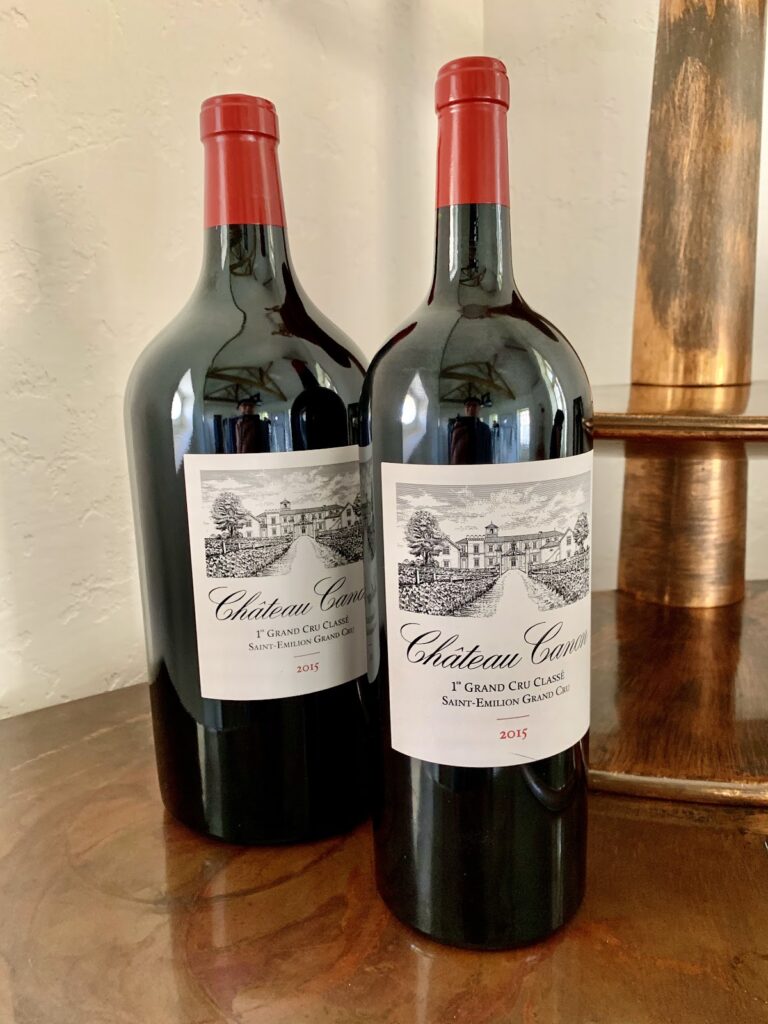
Château-Figeac’s wine was classified as Premier Grand Cru Classé B from the first Saint-Émilion classification in 1955 until 2022. The 2022 revision placed it in Premier Grand Cru Classé A, the highest rank in the official Saint-Émilion classification.
Thierry Manoncourt introduced the concept of a second wine in 1945 to maintain consistent quality in the grand vin, the estate’s principal wine. From 1945 to 2011, this wine was called La Grange Neuve de Figeac. A special cuvée named Petit-Figeac appeared in 2006, and from the 2012 vintage it became the estate’s sole second wine. It is made from a separate annual selection assembled alongside the grand vin and offers a lighter introduction to it. Château Petit-Figeac, a historical parcel associated with the name, was bought back by Château-Figeac in 2002.
Between 2018 and 2021, Château-Figeac built new cellar, winemaking, office, and reception facilities as part of a major modernization. The estate subsequently obtained high-level environmental certifications, including HVE Level 3 and individual ISO 14001 certification. Today, the property covers a single block of approximately 54 hectares, including about 40 to 41 hectares of vineyards, roughly three kilometres west of Saint-Émilion and near the border with Pomerol. It produces Château-Figeac under the Saint-Émilion Grand Cru appellation, a regulated wine designation within Saint-Émilion, and the second wine Petit-Figeac. Its wines are sold to Bordeaux négociants as futures, a practice known as primeurs, in which wines are offered before completing their maturation.
Remains
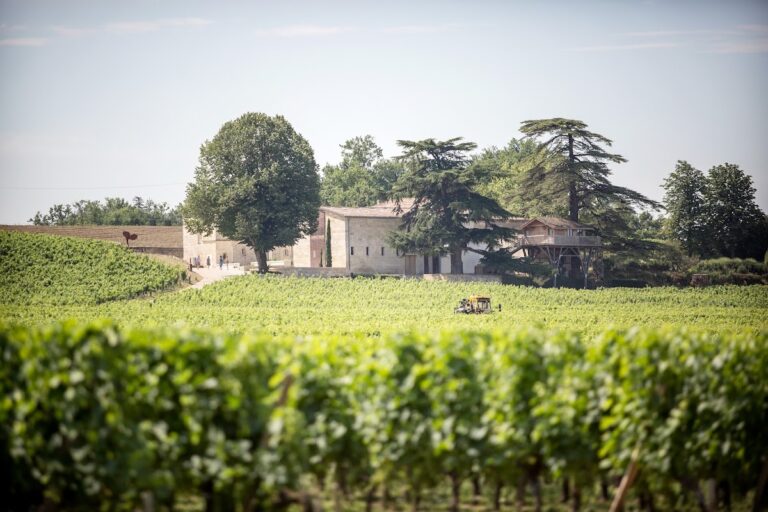
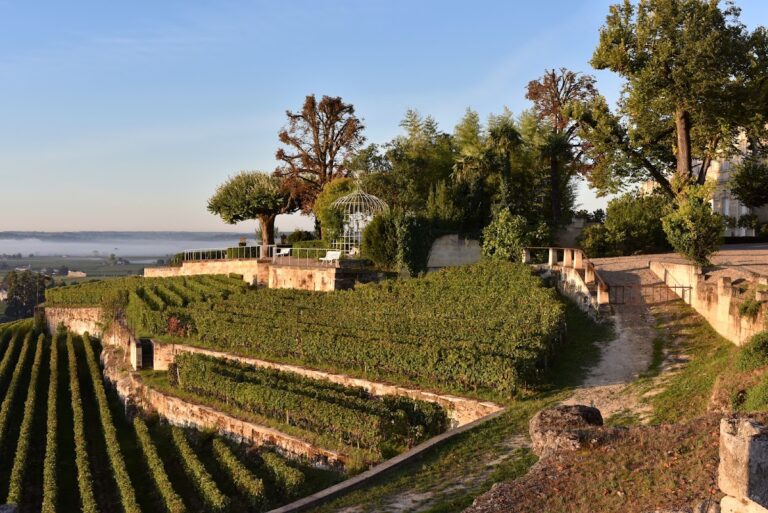
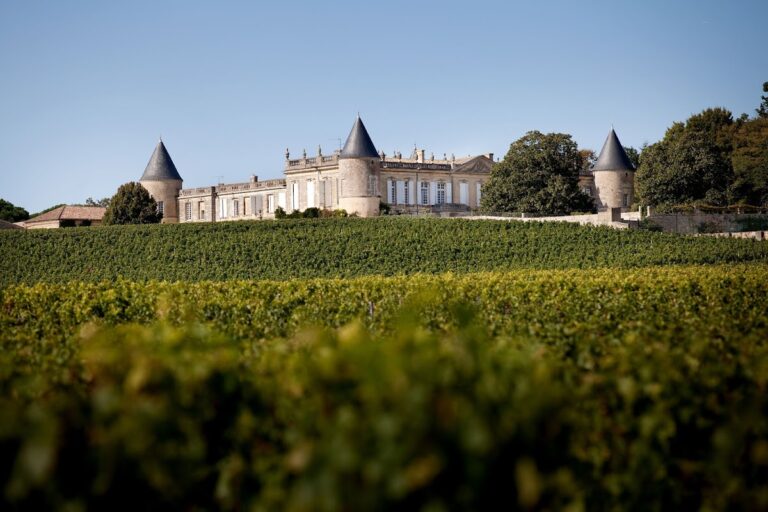
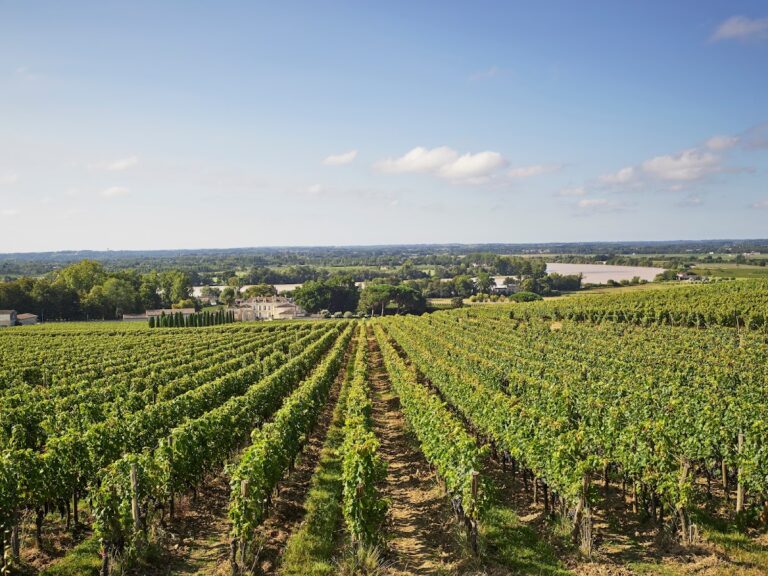
Château-Figeac combines a historic château, formal courtyard, park, vineyard, and modern subterranean production complex. The estate occupies three gravel knolls over iron-rich or blue clay. The gravel contains materials including quartz and flint and reaches up to seven metres in thickness. These deposits were carried by the River Isle from the Massif Central during the Günz glacial period, an early Pleistocene glaciation. Some parcels consist of wind-deposited sand. The property also includes a park of approximately 13 hectares.
Historic château and grounds
Medieval and Renaissance fabric
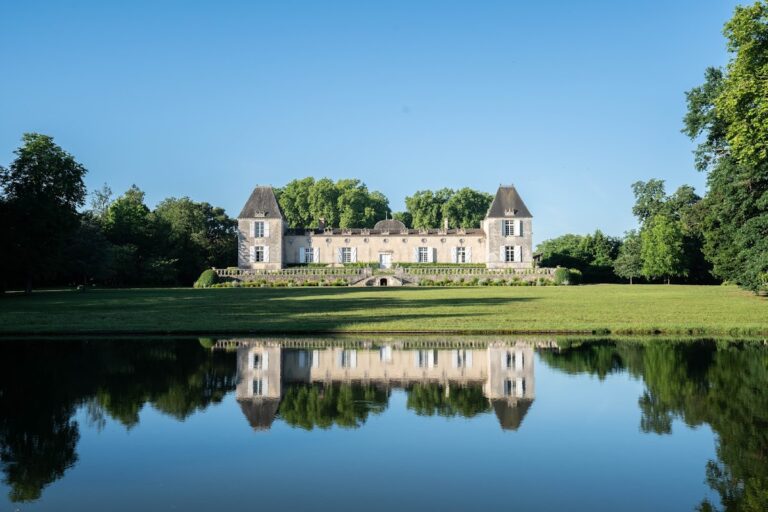
The château preserves medieval doors and windows in its right wing. The rebuilding that followed the 1586 fire is represented by the pillars of the main courtyard, the château’s wings, a tower, and several windows divided by stone mullions. These elements preserve the building’s Renaissance phase while also showing how the property was reconstructed after major damage.
Eighteenth-century and later alterations
The central section of the château and the pillars of the formal courtyard date from the eighteenth century, when Élie de Carles renewed the residence and expanded the estate. Around 1900, the right wing was extended and a terrace was created. The buildings therefore incorporate successive repairs and alterations rather than belonging to one uniform construction period.
Vineyard and cultivation
Gravel knolls and planted parcels
The vineyard’s physical character is shaped by the three Günzian gravel knolls, whose drainage and heat-reflecting properties favor Cabernet Sauvignon and Cabernet Franc. The estate contains roughly 275,000 vines, with an average age of approximately 35 to 45 years. About 35 percent of the vineyard is planted with Cabernet Sauvignon, 35 percent with Cabernet Franc, and 30 percent with Merlot. These proportions were established after Thierry Manoncourt replanted the vineyard following the frost of 1956. The resulting composition is unusual for Saint-Émilion and is closer in character to plantings associated with the Médoc.
Harvest and vinification areas
Grapes are harvested by hand, destemmed, optically sorted, and resorted in the cellar. Fermentation takes place in wooden vats and stainless-steel tanks with natural yeasts. Since 1998, the grapes have undergone a cold pre-fermentation lasting several days at approximately 14 degrees Celsius. Maceration uses an immersed cap that is periodically loosened.
Modern cellar complex
Fermentation cellar
Built between 2018 and 2021, the new cellar complex covers approximately 5,000 square metres over three levels and extends as much as 12 metres underground. Its partly subterranean fermentation cellar contains eight French-oak vats and about 40 truncated-conical stainless-steel tanks. Counterweight systems help open the heavy tank lids, and the acoustics were specially designed as part of the facility.
Barrel and bottle cellars
Two underground levels contain approximately 500 barriques stored on the floor. The bottle cellar was designed to permit bottling entirely by gravity and also houses older vintages. The grand vin is aged exclusively in new oak barriques for approximately 18 to 20 months and is bottled at the château. The first, gentler pressing is incorporated into the grand vin, while the second pressing is used for the second wine. The wine is transferred to barrel without filtration, and egg-white fining is used.