Menhir de Peyrefitte: A Prehistoric Standing Stone in France
Site at a Glance
- Popularity
- Low
- Country
- France
- Primary era
- Stone Age
- Eras represented
- Stone Age, Medieval
- Civilizations
- Unclassified
- Site type
- Religious
- Remains
- Sanctuary
On this page6 sections
History
The Menhir de Peyrefitte is a prehistoric standing stone at Saint-Sulpice-de-Faleyrens in southwestern France. Its precise date is uncertain, but it is thought to belong to the Late Neolithic, the later part of the Stone Age before the Bronze Age, and may be contemporary with regional gallery graves, long, covered megalithic tombs.
Medieval names and traditions
Known also as Pierrefitte or Pierre Fitte, the stone appears in a judgment issued by King Edward I of England in 1289 against J. de Grailly, where it is called Petra-fixa. Its name occurs again in a 1290 legal text setting the boundaries of the jurisdiction of Saint-Émilion’s mayors and jurats, the town’s municipal magistrates.
Local traditions associate the stone with the Virgin Mary, who is said to have left it there while travelling to the Abbey of La Sauve-Majeure, intending it for one of the abbey’s two bell towers. Another tale locates a golden calf and the entrance to an underground passage at the menhir.
Devotion and later customs
For centuries, people prayed at the stone and believed it could cure rheumatism, especially ailments that caused a person to limp. This worship ended with the French Revolution of 1789. In 1806, historian J. B. Souffrain proposed a different origin, arguing that local inhabitants had raised the stone around 1451 to commemorate the English departure. He also linked its name to a French phrase meaning “stone of flight,” referring to the English.
The menhir was classified as a French protected historic monument in 1889, and practices associated with it are included in France’s Inventory of Intangible Cultural Heritage. Festivities continue on 24 June, the feast of Saint John, a Christian celebration of John the Baptist. The stone is decorated, and participants carrying lit candles circle it twice while making wishes. The candles are then entrusted to the Dordogne’s current; some people also send written wishes in paper boats. Fireworks accompany the celebration and its association with the summer solstice.
Remains
The limestone standing stone
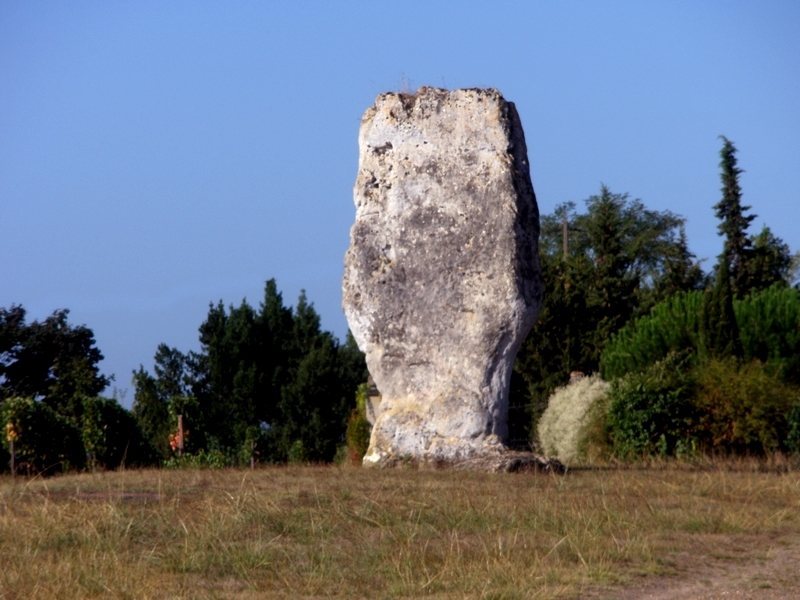
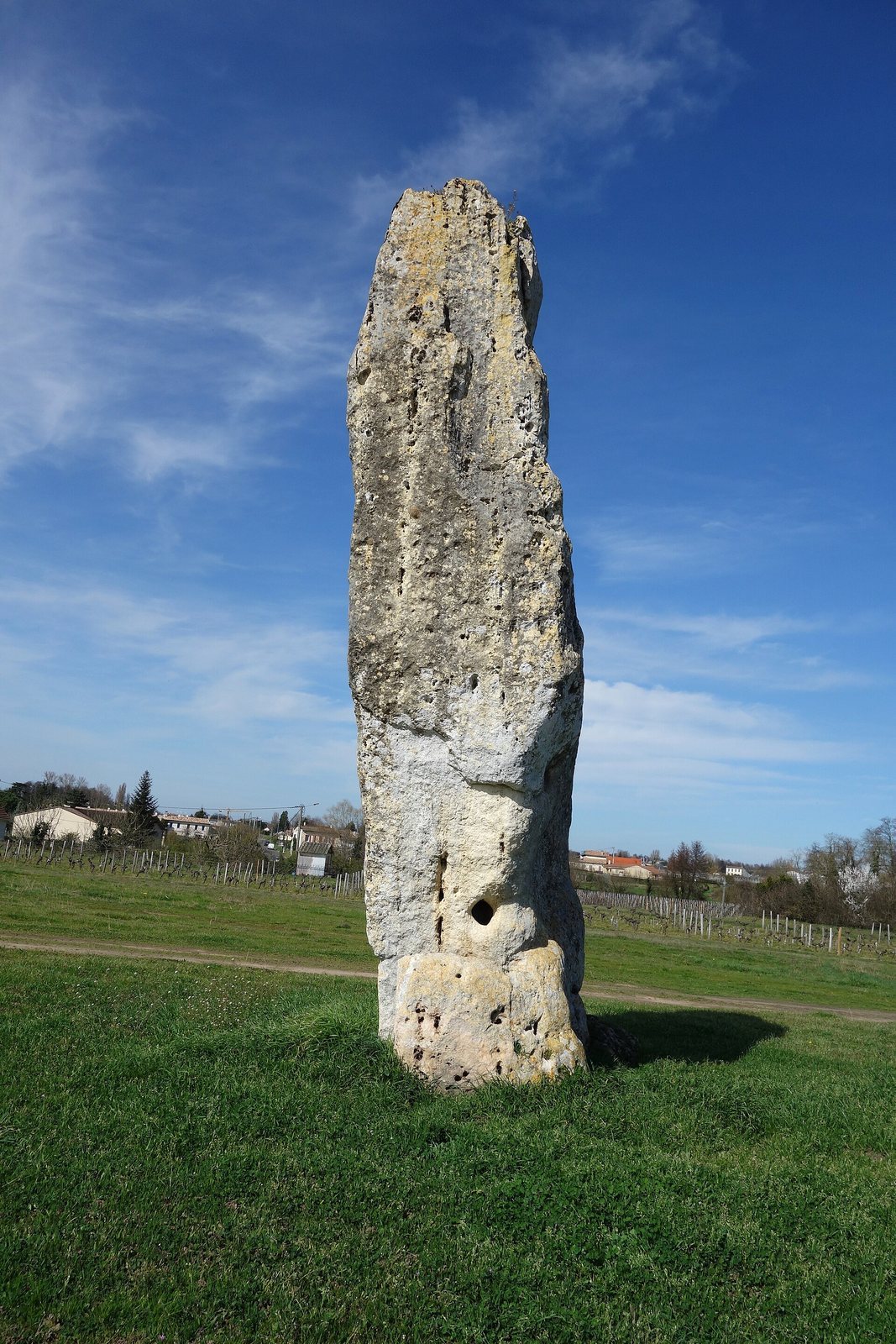
The menhir stands about 50 metres west of the road from Libourne to Branne and 200 metres from the Dordogne River. It is a single block of asteriated limestone, a rock containing star-shaped fossil fragments, with a four-sided cross-section. The stone is about 5.2 metres high, 3 metres wide and 1.5 metres thick; its estimated weight is roughly 50 tonnes, including the buried part. It is the largest menhir in southwestern France.
The stone leans slightly, and its lower portion narrows. This shape may have resulted from the way it was set upright or from later quarrying. The limestone was probably taken from outcrops near Saint-Émilion, about 2.5 kilometres away.
The offering hole and nearby burial
A circular hole, probably cut in medieval times, is set into one face of the stone, 0.7 metres above the present ground. A nearby grave, discovered in the nineteenth century, dates to the Merovingian period, when an early Frankish dynasty ruled. It contained human bones and two iron keys.