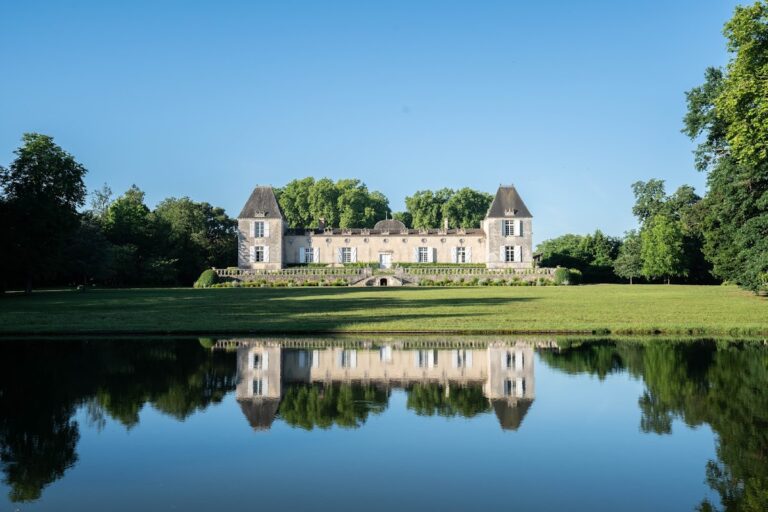
Château Canon: A Historic Saint-Émilion Wine Estate


Site at a Glance
- Rating
- 4.8
- Popularity
- Very Low
- Country
- France
- Primary era
- Early Modern
- External website
- Open
- Eras represented
- Early Modern
- Civilizations
- French
- Site type
- Economic
- Remains
- Production Complex
On this page12 sections
History
Château Canon is a historic wine estate in France, located just southwest of Saint-Émilion’s old town in the Bordeaux wine region. Its principal estate building and new cellars were completed in 1767, and the property remains part of the Saint-Émilion appellation, a legally protected wine-growing designation. Since 1955, it has been classified as a Premier Grand Cru Classé B, a high-ranking category below Premier Grand Cru Classé A and above the other classified estates. The estate retained this status in the classifications of 2006, 2012, and 2022.
From Clos Saint-Martin to Château Canon
The property was formerly known as Bourdieu Saint-Martin, or Clos Saint-Martin, and its earliest known owners were members of the Biès family. Jean Biès the Elder sold it on either 2 or 11 April 1760 to Jacques Kanon, a frigate lieutenant and privateer from Blaye, for 40,400 livres. At that time, the walled vineyard covered approximately 12 to 13 hectares and was already entirely devoted to wine production.
Kanon expanded the estate by acquiring seven adjoining parcels. He also commissioned new cellars and an estate building, completed in 1767. On 4 December 1770, he sold the property for 80,000 livres to Raymond Fontémoing, a merchant who also owned Château Canon de Fronsac. Fontémoing renamed the estate Clos Saint-Martin, while the modern name Château Canon preserves the memory of Kanon’s ownership.
Nineteenth-century ownership and vineyard crisis
After Fontémoing died in 1800, the estate passed to his youngest son, Jean-Raymond. Seven years later, Jean-Raymond’s sister Jeanne de Tranchère assumed its management. She married Ferdinand Auguste Joseph Hovyn in 1815, and their son Jules Hovyn de Tranchère later directed the property. Jules sold it in 1857 to Bertrand Henri de Bonneval for 92,000 francs. By then, the estate extended across 18 hectares, and its name had changed to Château Canon Saint-Émilion in 1853.
Following Henri de Bonneval’s death, the property was sold in 1883 to Honoré-Maurice Domecq-Cazaux. Powdery mildew, downy mildew, and phylloxera, an insect pest that caused a major nineteenth-century European vine crisis, placed severe pressure on vineyards. Domecq-Cazaux soon sold the estate to Félix Guignard, who replanted it with grafted vines using phylloxera-resistant rootstock.
During this period, Louis Pierre Hisman Peyraud, a physician and owner of Château Canon-La Gaffelière, and his wife Marie-Louise Boitard de la Poterie provided technical management. Their involvement accompanied the effort to restore productive viticulture after the disease crisis.
The Fournier period
Gabriel Supau bought Château Canon in 1919 and transferred it to his daughter Henriette, who was married to the lawyer and wine merchant André Fournier. After the Second World War, their son Pierre Fournier directed the estate. The Fournier family remained its owner until vine diseases and falling yields became serious problems in the early 1990s.
Severe frost damage in 1956 led to the replanting of large vineyard areas. Under Éric Fournier, temperature-controlled wooden fermentation vats were installed in 1976, and restoration of the estate building was completed in 1985. The family also produced the wines of Château Franc-Grâce Dieu from 1981 to 1996.
The Wertheimer era
Alain, Charles, and Gérard Wertheimer purchased Château Canon in September 1996 for approximately 110 million francs. Extensive replanting of diseased vines and modernization of the cellars followed. In 2002, pumps were removed from the winemaking process so that transfers could be made by gravity. The wooden fermentation vats were replaced by double-walled stainless-steel tanks in 2006.
The Wertheimers acquired Château Curé Bon la Madeleine in 2000. After approval by INAO, France’s National Institute of Origin and Quality, its 4.4 hectares of vines became part of Château Canon. In June 2011, the family acquired the neighboring 12-hectare Château Matras. A 1.18-hectare Cabernet Franc parcel entered Château Canon during the 2012 classification, while the remaining land contributed to the second wine.
Nicolas Audebert took over operational management of Château Canon and Château Rauzan-Ségla in May 2014, replacing John Kolasa. Gilles Pauquet has served as the estate’s oenological adviser since that period. Château Berliquet, acquired by the Wertheimers in October 2017, is also managed by Audebert but is vinified independently. The main building’s renovation, directed by architect Peter Marino, was completed in 2015.
In 2015, the estate’s principal buildings, boundary walls, and underground quarries were listed as historic monuments in France. The property belongs to the Wertheimer family, whose holdings include Chanel and Château Rauzan-Ségla. Château Canon has also belonged to the Union des Grands Crus de Bordeaux since the organization’s foundation in 1973.
The estate’s second wine has been produced since 1986. It was called Clos J. Kanon from 1986 to 1996, Clos Canon until 2011, and Croix Canon from 2012 onward.
Remains
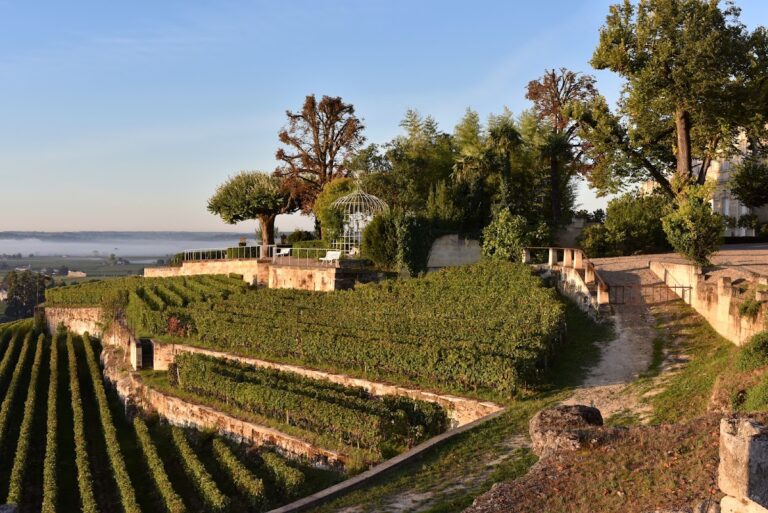
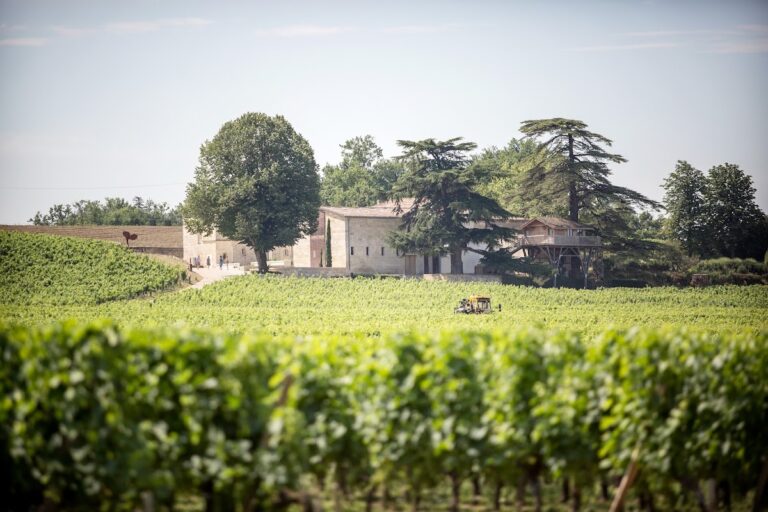
Château Canon occupies a 34-hectare estate on the mainly north-sloping limestone plateau of Saint-Émilion. About 13 hectares immediately surround the estate buildings and form the original clos, a vineyard enclosed by a wall. This stone enclosure extends for more than 3 kilometres. The wider property includes vineyards, the main residence or estate building, wine cellars, service buildings, farm workers’ houses, boundary walls, and extensive underground quarries.
The walled vineyard and estate grounds
The original clos
The original vineyard is enclosed by a long stone wall and occupies the area around the historic buildings. The plateau soils are predominantly clay-limestone, while the more southerly parcels have sandy-clay soils. Merlot makes up most of the plantings, with Cabernet Franc forming the remainder. Vine density varies between 5,500 and 6,500 plants per hectare, and the vines have an average age of approximately 25 to 30 years.
The vineyards are pruned according to the double Guyot system, which retains two fruiting canes to regulate grape-bearing shoots. One description identifies 19 hectares as productive vineyard, with an average yield of 35 hectolitres per hectare. These planted areas reflect successive replanting campaigns, including work following the frost of 1956 and the disease-related renewal undertaken after 1996.
The historic buildings
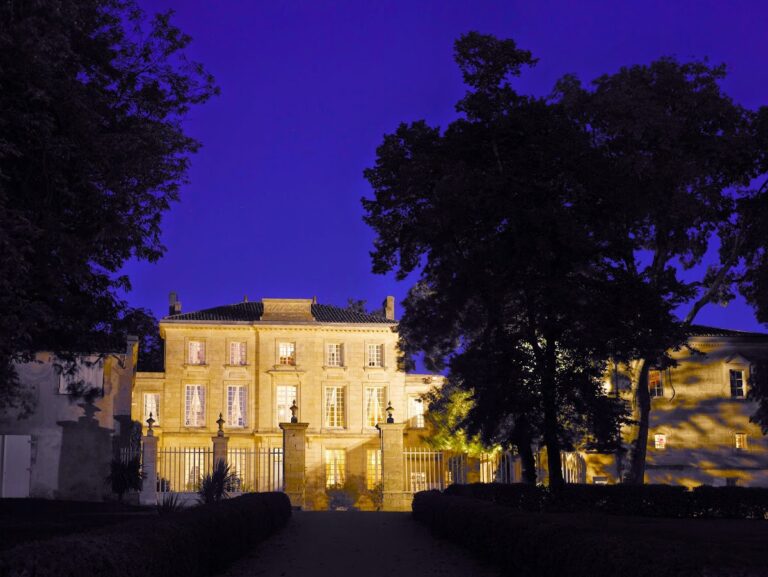
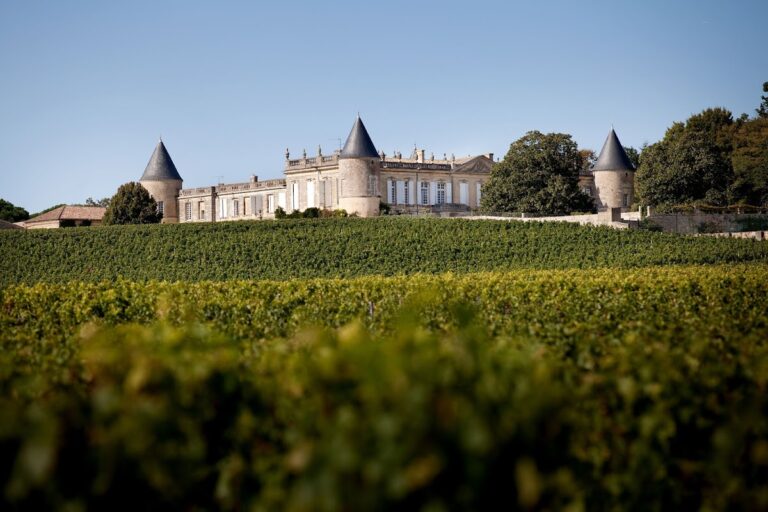
The main estate building and new cellars were completed in 1767. The historic protection covers the facades and roofs of the main building and cellars, together with the outbuildings, farm workers’ houses, enclosure walls, and quarries. Modern sections are excluded from that protection. Restoration of the estate building was completed in 1985, while the main building underwent a further renovation completed in 2015.
Underground quarries and wine production
The limestone quarries
Château Canon stands above a former underground limestone quarry. Its galleries extend for approximately 30 kilometres through the rock at several levels and lead to vaulted halls covering about 13 hectares. The halls lie between 8 and 12 metres below the surface, forming a substantial subterranean part of the estate alongside the buildings and enclosed vineyard.
The cellars and wines
Grapes are harvested by hand, destemmed, and sorted repeatedly in the cellar. Individual parcels ferment separately in temperature-controlled stainless-steel tanks before blending. The wine then moves promptly into barriques, small oak aging barrels, where it remains for approximately 18 months. Depending on the vintage, between 50 and 70 percent of the oak is new, and malolactic fermentation, a secondary process that softens acidity, takes place in the barrels.
Château Canon produces the Grand Vin Château Canon and the second wine Croix Canon. Average annual production of the Grand Vin is approximately 7,500 cases.
Nearby sites