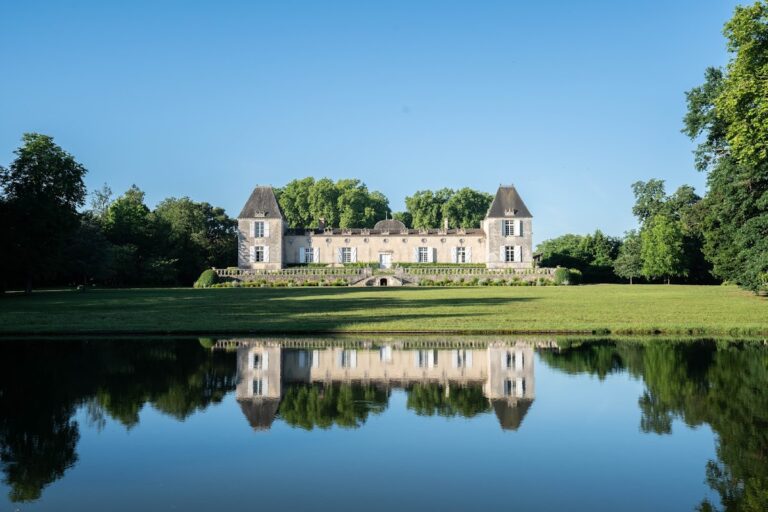
Château Ausone: A Historic Saint-Émilion Wine Estate in France


Site at a Glance
- Rating
- 4.6
- Popularity
- Very Low
- Country
- France
- Primary era
- Unclassified
- External website
- Open
- Eras represented
- Unclassified
- Civilizations
- Unclassified
- Site type
- Economic
- Remains
- Production Complex
On this page8 sections
History
Château Ausone is a French wine estate near Saint-Émilion in the Bordeaux region, whose present form probably took shape in the fourteenth century. The modern estate can be traced to the eighteenth century, when it was owned by Jean Cantenat. It later passed to the Lafargue family and was inherited by Edouard Dubois.
Ownership and development
Edouard Dubois guided the estate through the difficulties of the late nineteenth century. In 1916, he added the adjoining Château Belair to the holdings. The two châteaux remained separately managed, although both aged their wines in Ausone’s limestone cellars.
After Dubois died in 1921, management passed to his widow, Hélyette Dubois-Challon, and to his children from an earlier marriage. Their family connections with the Vauthier family shaped the estate’s later ownership. For several years, the Dubois-Challon and Vauthier families held Ausone jointly. A prolonged dispute eventually reached the courts, and in the mid-1990s the Vauthier family acquired the Dubois-Challon shares. This ended the joint ownership, with Alain Vauthier becoming managing director. Hélyette Dubois-Challon retained the right to live at the château until her death in 2003. Catherine and Alain Vauthier are the current owners.
Twentieth-century wine production
Ausone was among the few estates to escape the severe frost of 1956, which destroyed or damaged vines at neighboring properties. Wine quality later declined, until Pascal Delbeck became winemaker in 1976. Michel Rolland joined the estate as consulting oenologist in 1995. The Vauthier-Rolland team reduced yields to concentrate the wine and introduced malolactic fermentation, a secondary fermentation that converts malic acid into lactic acid, in small barrels rather than large steel tanks.
The estate produces its principal wine, the Grand vin, and a second wine called Chapelle d’Ausone. In Bordeaux terminology, Grand vin means the estate’s flagship wine. Together, the two wines average slightly more than 2,000 cases a year, equivalent to about 180 hectoliters.
Classification and the Ausonius tradition
From 1955 until the 2022 classification, Ausone was continuously ranked Premier Grand Cru Classé A, the highest category in the official Saint-Émilion wine classification, alongside Château Cheval Blanc. In 2021, the estate announced that it would not apply for the 2022 classification, criticizing the weight given to tourism and social media in the assessment. After the 2022 reclassification, it no longer held that rank.
The estate’s name is traditionally linked with Decimius Magnus Ausonius, a Bordeaux-born Roman poet and statesman who lived from AD 310 to 395 and is said to have owned extensive vineyards in the area. A large Roman villa survives nearby, and Ausone may occupy the foundations of his villa, although that attribution remains uncertain. Château Canon-La-Gaffelière has also claimed the historically important location.
Remains
Limestone slope and vineyard setting
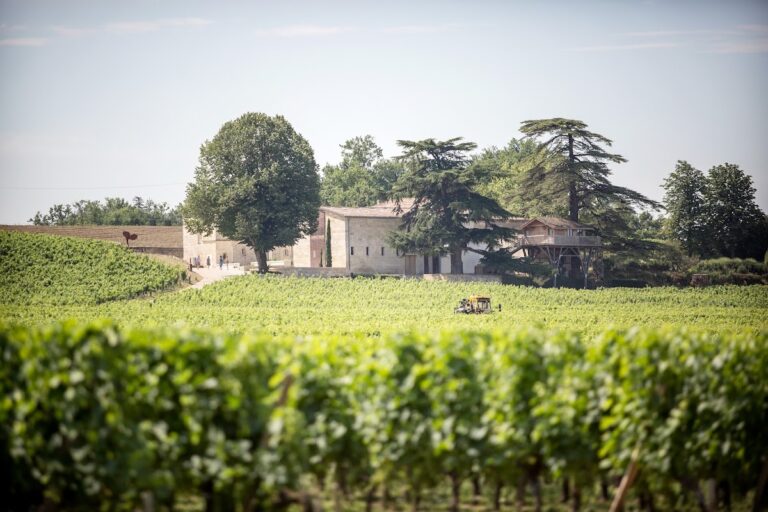
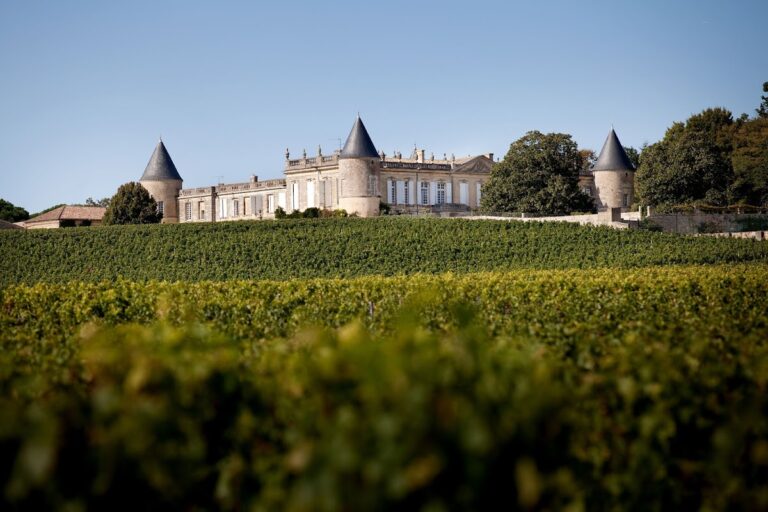
Château Ausone occupies a limestone slope below Saint-Émilion, on a plateau overlooking the Dordogne valley. The property lies at the southeastern edge of the Saint-Émilion appellation, a few hundred meters from the town. Its approximately 7.3 hectares of vineyards extend across the boundary between the Saint-Émilion limestone plateau and the gravel deposits of the Dordogne at its foot.
The slope and its base create an amphitheater-like setting oriented toward the south. A belt of rock walls encloses the vineyards and opens toward the south, giving the vines strong solar exposure while protecting them from cold northerly winds. The soil combines clay and sand over limestone. The vines average about 50 years of age, with planting divided equally between Merlot and Cabernet Franc at a density of approximately 6,500 vines per hectare.
Vineyards and production area
The small vineyard area allows harvesting at an optimal moment, usually over two afternoons. The wines’ character is associated with the site’s exposure and soil, together with the high proportion of spicy Cabernet Franc. Production remains in very small quantities.
Limestone cellars
The wine cellar is carved into the limestone cliffs beneath Saint-Émilion and has a domed form. These caves serve as the aging cellars for Château Ausone and, despite the separate management of the two estates, also for Château Belair.
Nearby sites