Château de Thouaré-sur-Loire: A Loire-Side Historic Château in France


Site at a Glance
- Rating
- 4.5
- Popularity
- Very Low
- Country
- France
- Primary era
- Medieval
- External website
- Open
- Eras represented
- Medieval, Early Modern, Modern
- Civilizations
- Duchy of Brittany, French
- Site type
- Domestic
- Remains
- Castle
On this page10 sections
History
Château de Thouaré-sur-Loire is a historic château in France, beside the Loire, whose site appears to have been inhabited since the Bronze Age. Its position near the river gave it strategic importance. The original residence was an earlier feudal motte, a fortified medieval settlement centered on a mound, built in the tenth century, possibly over the remains of a Gallo-Roman villa. At that time, the site depended on the Duchy of Brittany.
Medieval foundations and lordship
The château and lordship of Thouaré are traditionally attributed to Guillaume de Thouaré, a knight and lord of La Motte. He is said to have founded them in 1254 under the jurisdiction of the bishopric of Nantes. During the Middle Ages, the settlement grew around the château. Its chapel became the first church of Saint Vincent of Thouaré and served the parish before demographic growth led to the church’s transfer to the present town center. Houses and a presbytery stood beside the church, while a central road divided the château and church from nearby dwellings.
The châtellenie, a territorial lordship administered from a château, changed hands through marriage and inheritance. Jeanne d’Ussé, also recorded as Jeanne d’Ucé, of Touraine brought it to her husband, Briant IV de Montjean, in their marriage of 1343. Jeanne was recorded as its holder in 1378. In 1393, Gilles d’Elbiest, a Flemish knight serving Jean V, was said to have received the château for services rendered. His children died without issue, and his paternal aunt Marguerite d’Elbiest inherited the estate in 1505. Through her marriage to Jean de Saint-Amadour, lord of Lisé, the châtellenie entered the Saint-Amadour family.
Renaissance and early modern owners
Jean de Saint-Amadour, a knight of Charles VIII, obtained the lordship of Guignen in the viscounty in 1519. He transferred Thouaré to his daughter Philippe de Saint-Amadour, who married Charles de Bretagne, count of Vertus and baron of Avaugour. Their daughter Antoinette de Bretagne inherited the lordship and married Pierre d’Escoubleau de Sourdis. Their daughter, Anne d’Escoubleau, became its holder and married François de Simiane, marquis of Gordes. In 1657, Anne d’Escoubleau sold the lordship to Anne Descartes, widow of Louis d’Avaugour and half-sister of the philosopher René Descartes.
Anne Descartes rendered homage to the king for Thouaré on 13 January 1673. This formal act acknowledged allegiance to a superior, in this case the monarch. She sold the château to the Mosnier family in 1704. Joseph Mosnier de Thouaré, lord of La Valtière and a master of the Chamber of Accounts of Brittany, held it with his wife, Marie Langlois. The Chamber of Accounts was responsible for overseeing Brittany’s financial administration. The couple rendered homage to the king for the château in 1713. Their son Jacques Mosnier, lord of Thouaré, transferred it to his son Louis Mosnier in 1774.
Thouaré also entered the record of a royal journey through France. During Charles IX’s grand tour, undertaken between 1564 and 1566, the king stopped at the château on 11 October 1565. Charles de Bretagne d’Avaugour and his wife, Philippe de Saint-Amadour, received him for dinner. Charles then continued to Nantes, where he stayed for three days at the Château des Ducs de Bretagne.
Revolutionary damage and later ownership
During the French Revolution, Louis Mosnier was dead and his children had emigrated. The château was pillaged in 1792. After the Revolution, Louis Mosnier’s widow, Geneviève Bougrenet, recovered the property after it had been sold as national property, then sold it to the Cézard family.
Nicolas Sigisbert Cézard, an industrialist and shipowner from Nancy who owned the Launay and Chantenay refineries, acquired the château in either 1864 or 1873. The Cézard family later became bankrupt and sold it in 1880. The Mathieu de Vienne family acquired the property in 1882. The château remains privately owned and was listed as a historic monument in 1982, a French legal protection granted to buildings and sites recognized for heritage significance.
Remains
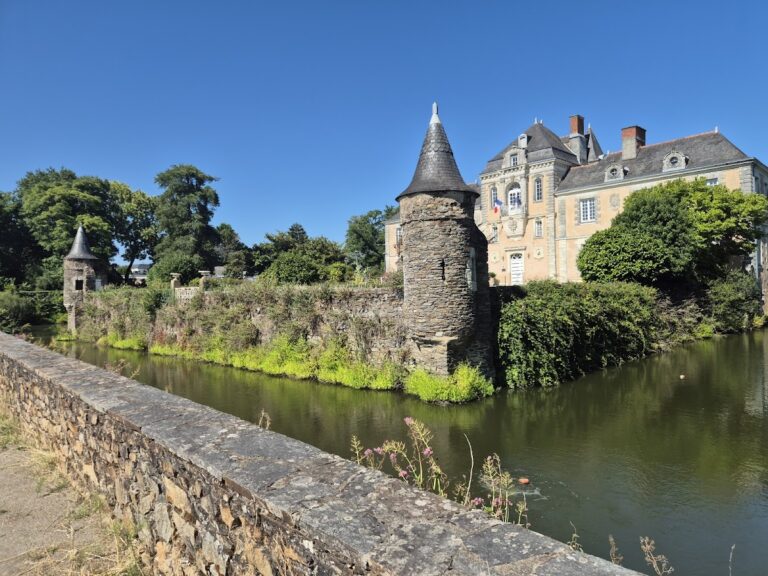
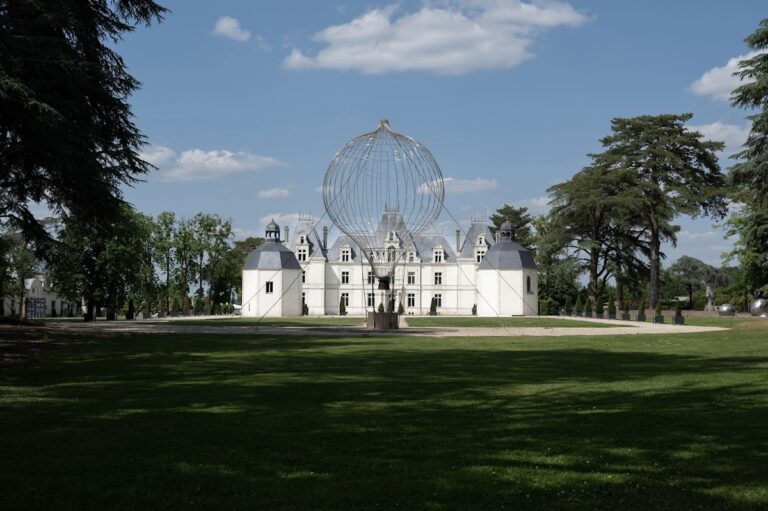
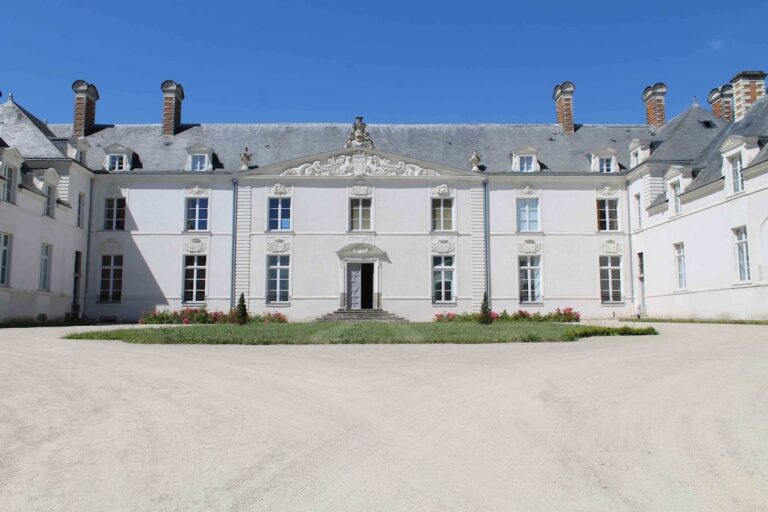
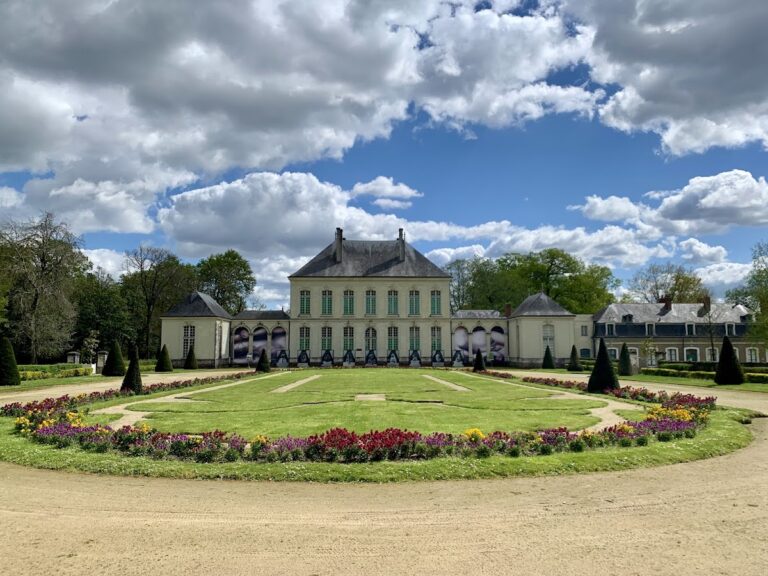
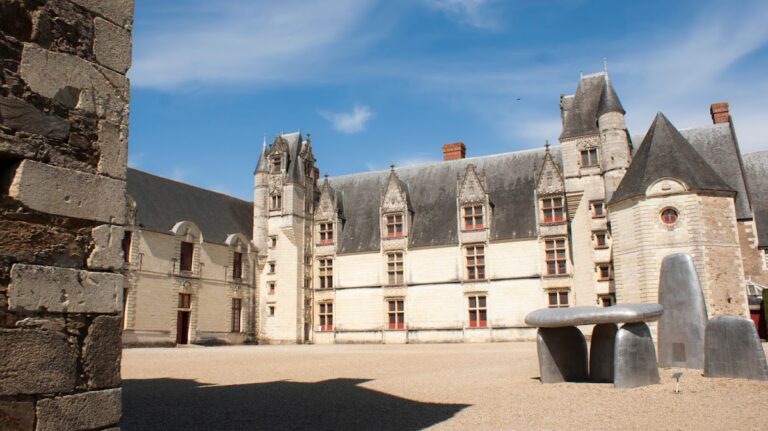
The château stands beside the Loire in a large green park with mature trees. Its complex is arranged in two wings and brings together fabric from several periods. The present configuration is generally dated to the fourteenth century, while a seventeenth-century construction date is also associated with the château. The surviving ensemble includes the main residence, a Renaissance lantern tower, adjacent dependencies, stables, tenth-century moats, and a fifteenth-century dovecote.
Château and defensive fabric
Main residence
The main château is organized in two wings. Its façade incorporates elements from different historical periods, including medieval battlements. A Renaissance lantern tower forms part of the building. A lantern tower is a raised structure with openings near its upper section that admit light. The windows, with double mullions, date from the second half of the nineteenth century, adding a later layer to the façade’s architectural fabric.
Moats, dependencies, and stables
The moats date from the tenth century and belong to the early fortified phase of the site. Adjacent dependencies and stables form part of the château complex, extending the surviving architectural group beyond the principal residence.
Agricultural and seigneurial features
Fifteenth-century dovecote
The fifteenth-century dovecote is built of stone and tuffeau, a soft, light-colored limestone widely used in western France. It is covered by a slate dome topped with a sculpture of a pigeon. Inside are 1,189 niches. The number of niches was formerly regarded as a sign of the power of the local lords, linking the building’s practical function with the status of the estate.
Nearby sites