Château de Goulaine: A Renaissance Château and Historic Wine Estate in France


Site at a Glance
- Rating
- 4.4
- Popularity
- Medium
- Country
- France
- Primary era
- Early Modern
- External website
- Open
- Eras represented
- Medieval, Early Modern
- Civilizations
- Duchy of Brittany, French
- Site type
- Domestic
- Remains
- Castle
On this page12 sections
History
Château de Goulaine is a Renaissance château in Haute-Goulaine, France, rebuilt in the late fifteenth and early sixteenth centuries for the Goulaine family. Its history reaches back more than a thousand years through that family and an estate near the Goulaine marshes, where a fortified residence probably stood by the twelfth century. The château combines the defensive legacy of a medieval stronghold with the more residential character of Renaissance architecture, a style that revived classical forms while often retaining elements of earlier fortification.
Medieval Origins and Renaissance Rebuilding
The date of the first fortification is uncertain, but it was probably established in the twelfth century for Jean de Goulaine, captain of Nantes. The marsh-surrounded estate offered a defensible position, and the fortification’s role was connected with the threat of Norman attacks. The medieval château was later extensively rebuilt as a Renaissance residence. This transformation took place in the late fifteenth and early sixteenth centuries under Christophe I de Goulaine, who died in 1492, and Christophe II de Goulaine, who died in 1540.
The estate belonged historically to Brittany. Its position, family connections, and fortified character placed it within the political and military world of the region, while the rebuilding campaign gave the residence a more refined architectural form. The Renaissance design has been compared with the central Loire residences of Château de Blois and Château de Chambord, although Château de Goulaine was built earlier and followed a more conservative style.
Religion, Lordship, and Later Ownership
During the Wars of Religion, the conflicts that divided France between Catholic and Protestant forces in the sixteenth century, members of the Goulaine family supported the Catholic League. This militant Catholic alliance opposed Protestant influence and defended Catholicism. Gabriel de Goulaine led fifty lancers, while his brother Jean, Baron du Faouët, captured the châteaux of Trogoff and Kérouzéré in 1590.
In the seventeenth century, Gabriel II de Goulaine enlarged and remodelled the château, nearly doubling its surface area and renewing its decoration. In October 1621, the lordship of Goulaine was elevated to a marquisate in his favour. A marquisate was a lordship whose holder possessed the rank of marquis, giving the territory a formally enhanced political and social status.
The château remained with the Goulaine family until 1666, when it passed by inheritance to the Rosmadec family and later to the Baillehache family. It was sold to a Dutch buyer in 1788. This change of ownership helped protect the building from destruction during the French Revolution. After a period of neglect in the nineteenth century, Château de Goulaine was classified as a French historic monument on 13 August 1913, and its owners undertook restoration work.
Restoration, Collections, and the Wine Estate
A cadet branch of the Goulaine family reacquired the estate in 1858. In 1956, Marquis Robert de Goulaine bought the château from his uncle and devoted about fifty years to restoring the building, rehabilitating the vineyards, and repairing the estate’s finances. From 1984 to 2016, a tropical-butterfly project operated there, adding a controlled equatorial environment to the estate’s uses. The former stables housed the art and advertising collection of the LU biscuit brand from 1999 until 2019. The collection was then removed by Mondelez as part of a broader project to present LU’s heritage.
A distant branch of the Goulaine family sold the château in 2022 to the industrialist Hervé Lecesne. The estate’s vineyard existed by the twelfth century, although the date when it began producing wine commercially rather than for household use is uncertain. Château de Goulaine wine is described as one of the world’s oldest wine enterprises and as the oldest European family-owned business, but no precise founding date for commercial production has been established.
The estate produces wine under the Château de Goulaine name, including Muscadet, Sancerre, Vouvray, and Rosé d’Anjou. It also grows Folle blanche, a white grape variety traditionally associated with western France, and is associated with a claim to the first commercial Chardonnay produced in the western Loire. A local tradition attributes the invention of beurre blanc to the cook Clémence Lefeuvre at Château de Goulaine in 1890. She is also said to have created the sauce at the restaurant she operated in Saint-Julien-de-Concelles.
Remains
Renaissance Residence and Fortified Setting
Principal Residence
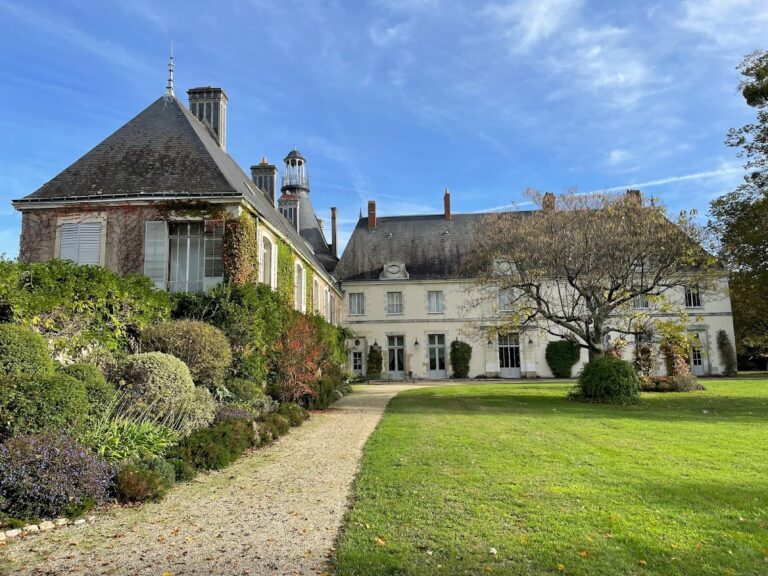
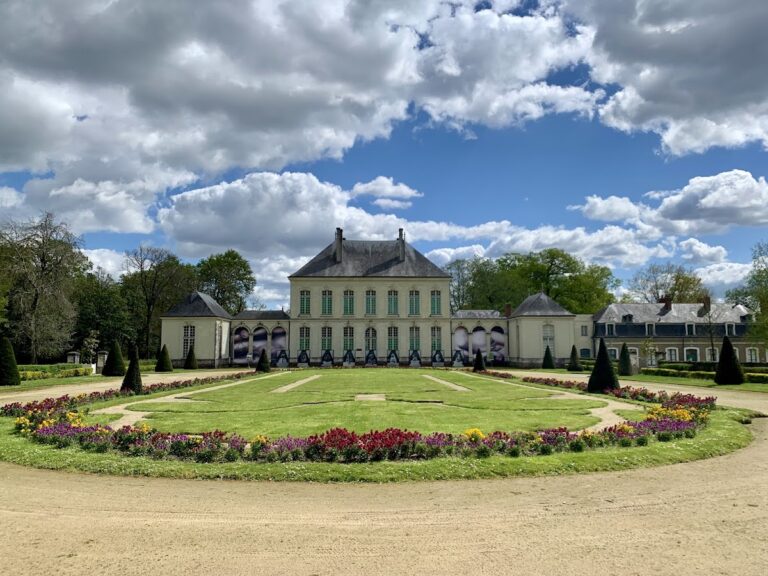
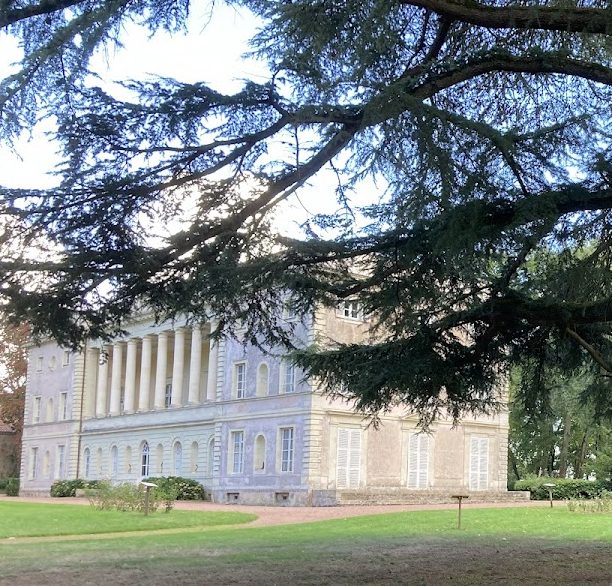
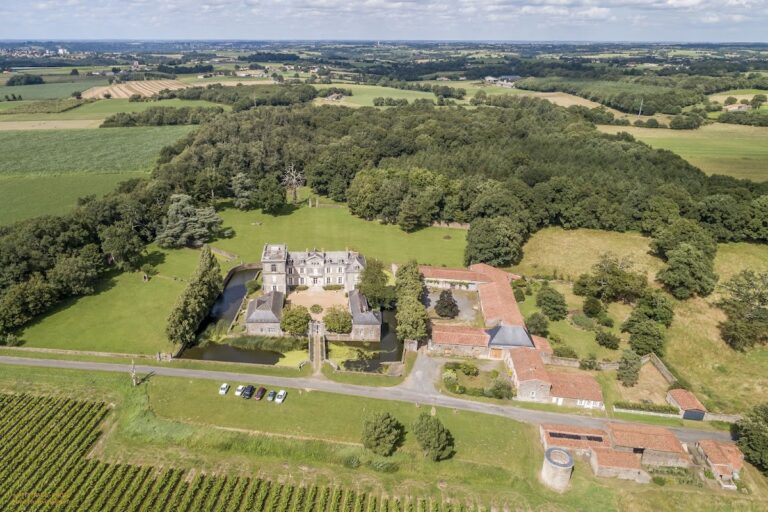
The château is built of tuffeau, a soft, pale limestone widely used in the Loire region, and is covered by steeply pitched slate roofs. Its Renaissance form preserves vestiges of the earlier fortified character. In the sixteenth century, the principal building consisted of a large residential block flanked by two pavilions containing staircases. The seventeenth-century enlargement substantially increased the building’s surface area while retaining the earlier residence as the core of the complex.
Interior Decoration
Inside, large sixteenth-century fireplaces remain alongside substantial seventeenth-century decorative work. The surviving features include monumental fireplaces, heraldic arms, and a coffered ceiling, a ceiling divided into recessed decorative panels. Together, these elements reflect the change from a medieval defensive residence to a more elaborate aristocratic household while preserving the building’s layered history.
Forecourt and Estate Buildings
Forecourt and Gates
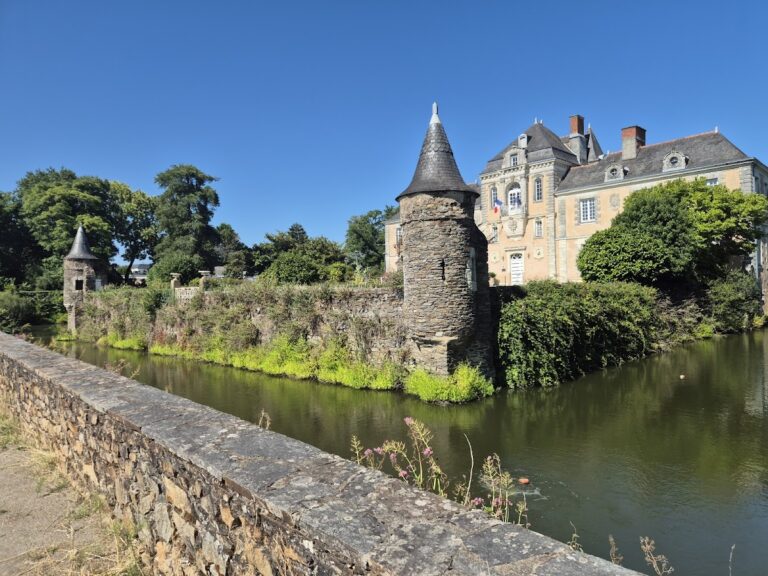
A large forecourt stands before the château. A perimeter wall encloses it and incorporates adjoining carriage and pedestrian gates. These gates meet the remains of an older keep, the fortified residential tower that formed the strongest part of a medieval castle. The arrangement links the approach to the later residence with the surviving evidence of the medieval stronghold.
Butterfly Aviary
An aviary, an enclosed structure designed for controlled flying animals, was built on the estate in 1984 for tropical butterflies. The greenhouse recreated an equatorial climate and contained tropical plants among which hundreds of butterflies flew freely. The installation operated until 2016, representing a later use of the estate’s buildings and grounds.
Former Stables and LU Collection
The former stables housed the LU collection between 1999 and 2019. It comprised several hundred works, including paintings, sculptures, and advertising material, as well as the original 1897 painting of the “Little Schoolboy” biscuit figure. The collection’s presence gave the former agricultural buildings a cultural use before it was removed as part of a wider presentation of LU’s heritage.