Château de Chassay: A Renaissance Manor in France


Site at a Glance
- Rating
- 4.6
- Popularity
- Very Low
- Country
- France
- Primary era
- Early Modern
- External website
- Open
- Eras represented
- Medieval, Early Modern
- Civilizations
- Duchy of Brittany
- Site type
- Domestic
- Remains
- Castle
On this page8 sections
History
Château de Chassay is a sixteenth-century manor in the Italian Renaissance style in Sainte-Luce-sur-Loire, France. Traditionally, a castle existed at Chassay from around 550 on the site of a Roman villa called Cariacum. The villa stood beside the region’s oldest Roman road, mentioned as early as the third century, which led to Nantes through Doulon, a settlement inhabited during the Gallo-Roman period, when Roman institutions and culture developed in Gaul alongside local traditions.
Early episcopal estate
A document from 1096 records a castle at Chasseil, an earlier name for Chassay, belonging to the bishops of Nantes. By the middle of the fifteenth century, Bishop Amauri d’Acigné had surrounded the property with moats. François II, the last duke of Brittany, seized it and turned it into a hunting lodge. The estate returned to the bishopric in 1500.
King Henri IV, who ruled France from 1589 to 1610, stayed at Chassay with his entourage on 13 April 1598. A declaration made in 1683 by Gilles de Beauvau, Bishop of Nantes, during the reformation of the bishopric’s estates distinguished between the “Petit château” and the “Grand manoir.” The smaller building served as the principal residence, while the larger manor appears to have been abandoned at an uncertain date.
Revolutionary sale and later ownership
The estate was sold as national property on 27 January 1791 to Dubois-Violette, a shipowner from Nantes, for 109,000 livres. National property was land or buildings transferred to the state during the French Revolution and then sold. The château changed hands afterward and remained abandoned until the Countess of Bondy purchased it in 1827.
The family of Fremond de La Merveillère later inherited the château. In 1956, it was sold to an agricultural cooperative union involved in livestock breeding and animal insemination. The estate subsequently belonged to an artificial-insemination center, during whose ownership the abandoned farm buildings of the former Grand manoir were demolished in the twentieth century.
Municipal use and protection
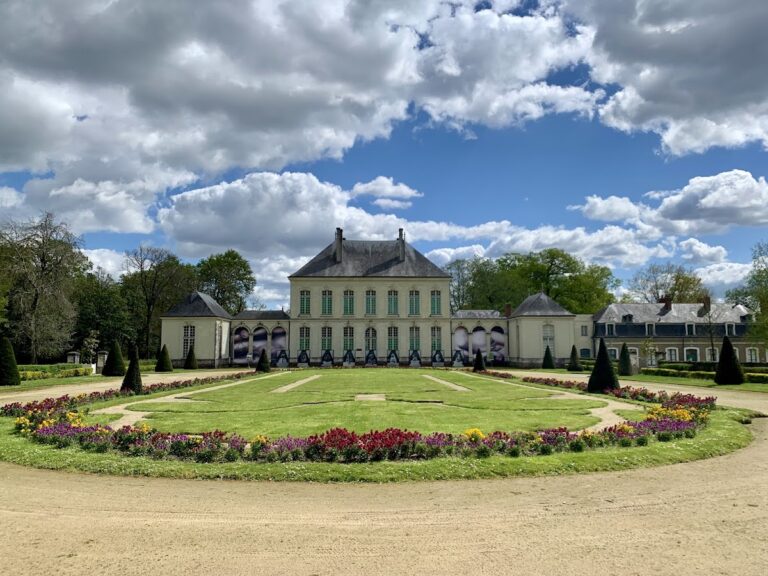
The commune purchased Château de Chassay in 1974 and installed the town hall there. Demographic growth made the historic building too small for all municipal services, so new buildings were constructed to its east in 1989, extending the complex. Until 2007, the château was also used during summer fireworks events as a large projection screen for pyrotechnic tales produced by the company Féerie.
An order dated 11 June 2024 listed Château de Chassay as a French Historic Monument, a designation protecting buildings, sites, or features because of their architectural, archaeological, or historical importance. The protection includes the château’s façades and roofs, its domed rotunda, the platform and its two northwestern and southwestern turrets, and several features in the surrounding grounds.
Remains
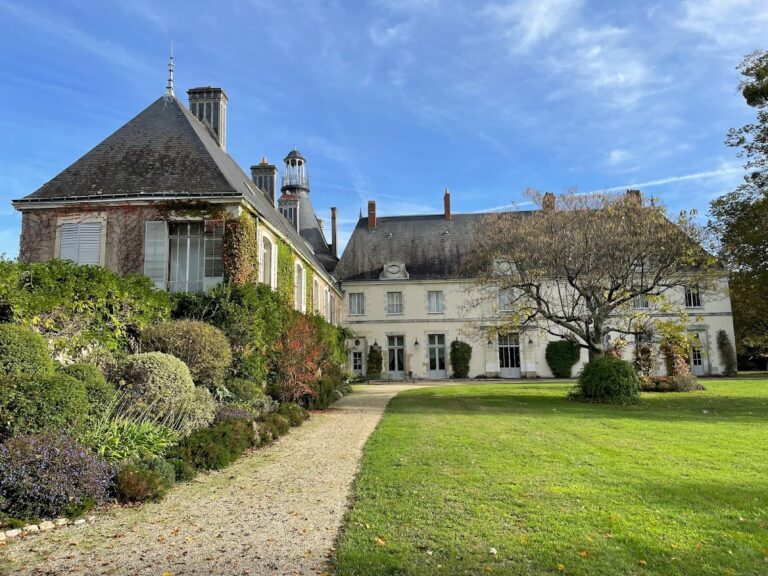
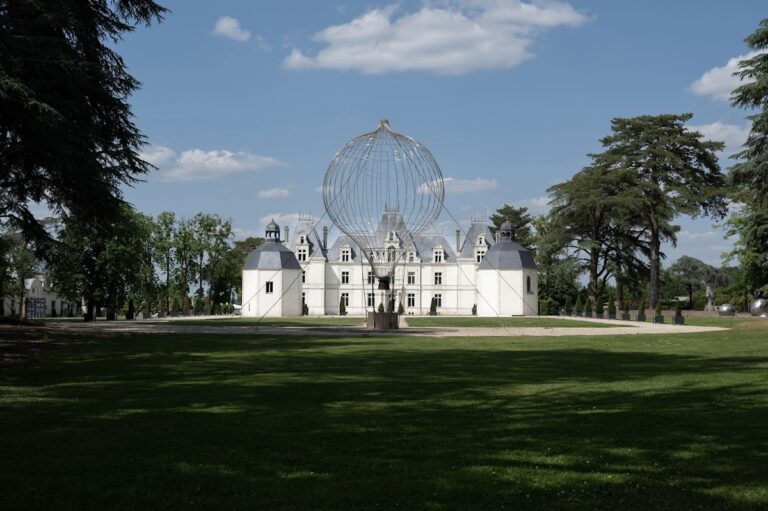
The present château is the former “Petit château de Chassay,” a sixteenth-century manor arranged in the Italian Renaissance style. The grounds include a raised platform, water features, enclosed terraces, and towers, while the former Grand manor stood to the north as a separate group of residential and agricultural buildings.
Main château
The manor includes a rotunda crowned by a cupola. Its platform is flanked by two turrets, positioned on the northwestern and southwestern sides. The façades and roofs, the rotunda, the platform, and the turrets form part of the protected historic fabric of the château.
Former Grand manor
The former “Grand manoir de Chessail” consisted of three adjoining residential buildings north of the smaller château. Its associated estate included gardens, a greenhouse, a farm, a wine press, cowsheds, and stables. After the manor was abandoned, its buildings were converted into farm structures before their demolition during the twentieth century.
Grounds and water features
The château grounds contain a shell fountain, a pond crossed by a fixed bridge, and a terrace bordered by walls. Moats and towers also form part of the estate’s surviving arrangement, linking the defensive landscape around the manor with its platform and principal buildings.
Nearby sites