Château de Neuville: A Sixteenth-Century Estate in France


Site at a Glance
- Rating
- 4.6
- Popularity
- Very Low
- Country
- France
- Primary era
- Early Modern
- External website
- Open
- Eras represented
- Early Modern
- Civilizations
- French
- Site type
- Domestic
- Remains
- Castle
On this page8 sections
History
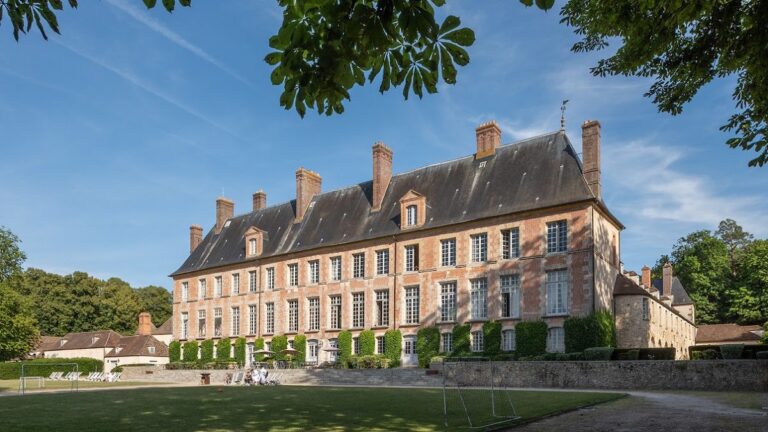
Château de Neuville is a sixteenth-century brick-and-stone residence at Gambais in France, built during the French Renaissance and associated with the Henri III style, the architecture linked to the reign of Henri III from 1574 to 1589. Joachim de Bellengreville, Grand Provost of the King’s Household, commissioned the château. This senior royal official oversaw security, policing, and order within the king’s court under Henri IV, who reigned from 1589 to 1610. The plan is attributed to Jacques I Androuet du Cerceau, a prominent Renaissance architect known for designs for aristocratic residences. The building is also classified as classicist.
From royal officials to a marquisate
In 1672, Neuville and Gambais were adjudicated to Jean-Baptiste Vallot, the brother of Antoine Vallot, chief physician to the court. A marquisate of Neuville, meaning a territorial lordship held by a marquis, was created for Jean-Baptiste Vallot. In 1690, he sold the marquisate to François de Nyert, first personal attendant to Louis XIV and governor of Limoges and the Louvre.
François de Nyert’s daughter, Catherine de Revol, undertook profound changes to the château’s interior and exterior in 1750. A plaque above the main entrance steps attributes the renewal and enhancement of the building to Agnès de Revol. In 1765, after falling into financial ruin, Catherine de Revol ceded the château to Clément Charles François de L’Averdy.
L’Averdy and the Revolution
L’Averdy was a professor at the Collège de France, the sixteenth-century institution of advanced teaching and scholarship, and served as Controller-General of Finances under Louis XV. This office was the principal ministerial responsibility for royal finances before the French Revolution. During the Revolution, L’Averdy was accused of contributing to popular hunger by throwing entire harvests into the pond at his château. The act apparently resulted from experiments involving the cultivation of black or diseased grains. He was guillotined in Paris in November 1793.
The château was then sold as national property. In 1795, it was repurchased by the Marquis de Labriffe, L’Averdy’s son-in-law and an ancestor of families who later owned the estate. Château de Neuville remains associated with the Labriffe and Jousseaume de La Bretesche families.
Twentieth-century decline and protection
During the twentieth century, German and American armies occupied the château, after which it was progressively abandoned. Major restoration began in 1966 and continues. The château, its farm, and the entire Neuville estate were classified as historic monuments in France in 1972. The remainder of the domain received registered protection in 1995. In France, classification and registration are forms of legal heritage protection, with classification generally providing the higher level of protection.
Remains
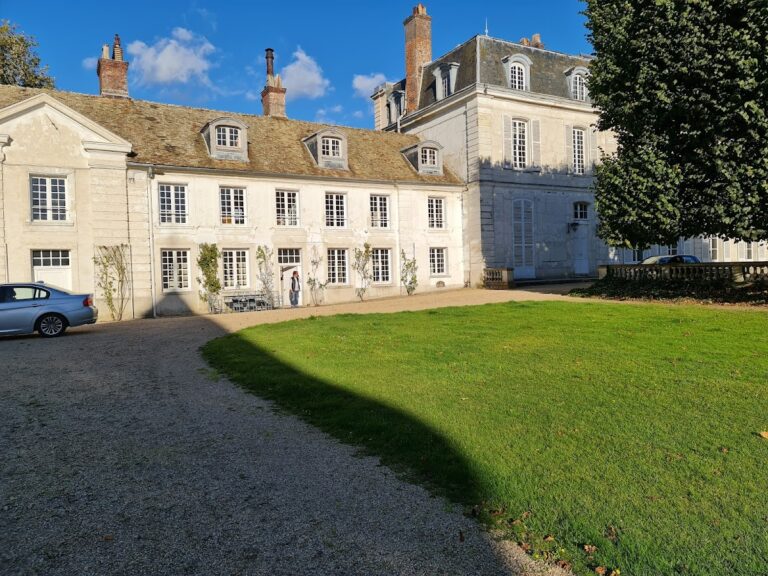
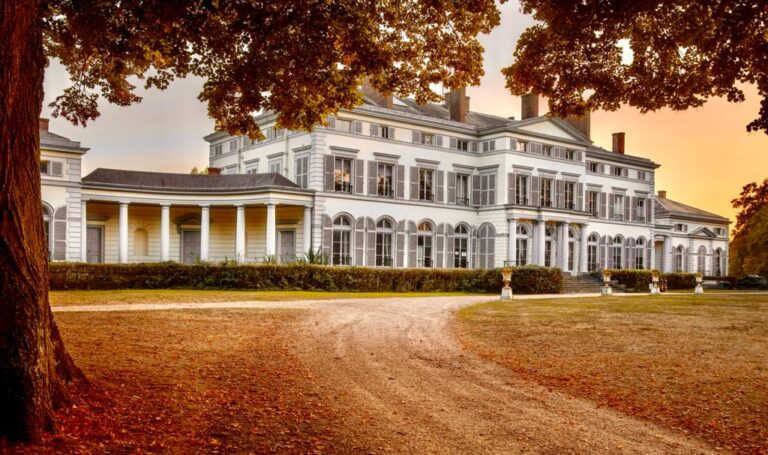
Château de Neuville is a brick-and-stone building within a 110-hectare wooded estate enclosed by walls. The grounds include an ornamental pond surrounded by giant rhododendrons, while the agricultural part of the domain is formed by a quadrilateral farm built between 1701 and 1702. Together, the residence, enclosed park, water feature, and farm express the estate’s long combination of residential and agricultural functions.
Château and park
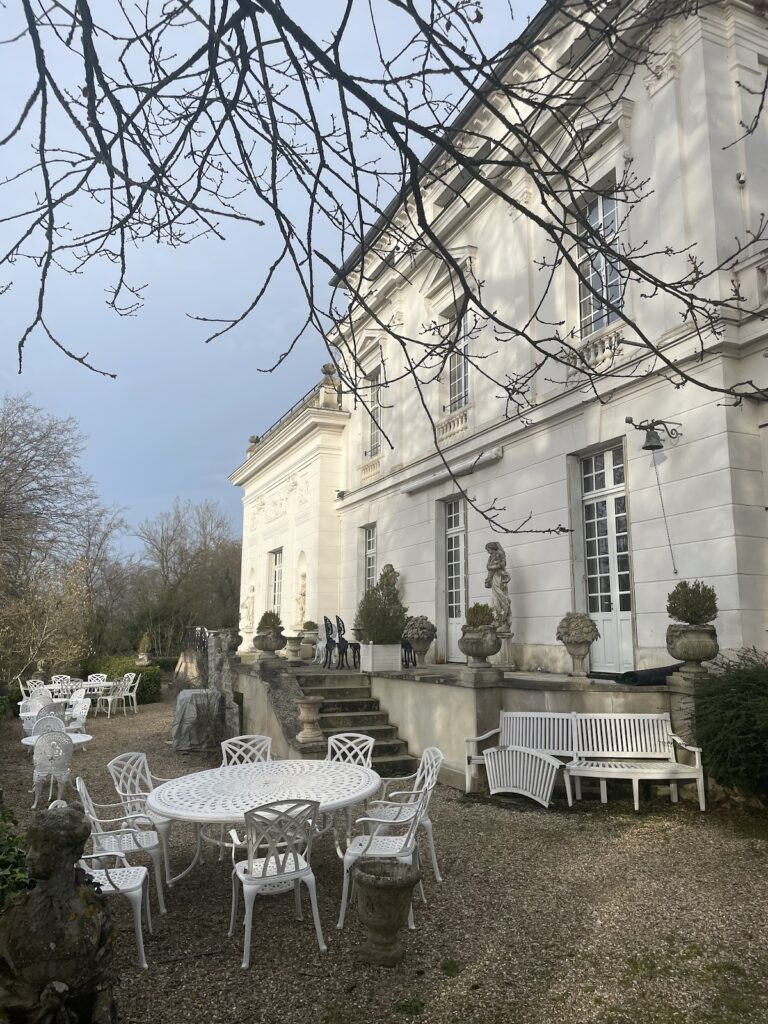
The château retains its sixteenth-century brick-and-stone construction, with later changes to both its interior and exterior made in 1750. Above the main entrance steps, a plaque carries a commemorative verse concerning the renewal of the residence by Agnès de Revol. The walled park extends across 110 hectares and contains the ornamental pond, whose setting includes giant rhododendrons.
Farm buildings
The estate’s quadrilateral farm dates from 1701 to 1702. Its form and position within the wider domain identify it as a distinct agricultural complex associated with the château and park.
Archaeological evidence from the park
In May 2015, archaeological excavation led by Olivier Weller of the French National Centre for Scientific Research uncovered the location of a hut used in the refuge scene of the 1970 film Peau d’Âne. In that scene, the princess hides in the hut before the prince discovers her.
Nearby sites