Örestens fästning: A Medieval Frontier Castle in Sweden


Site at a Glance
- Rating
- 4.2
- Popularity
- Very Low
- Country
- Sweden
- Primary era
- Medieval
- External website
- Open
- Eras represented
- Medieval
- Civilizations
- Swedish
- Site type
- Military
- Remains
- Castle
On this page4 sections
History
Örestens fästning is a medieval castle ruin in Sweden, established to defend the western frontier during the thirteenth and fourteenth centuries. It was probably founded shortly before 1366, alongside the frontier castles of Opensten in Kind and Elfsborg at the mouth of the Göta älv. Its history unfolded amid recurring wars between Sweden and Denmark, whose border lay about 20 kilometres away, south of Horred.
Frontier conflicts and Danish control
The surrounding area shifted between Swedish and Danish control until the Peace of Brömsebro in 1645, a treaty that ended a major phase of war between the kingdoms and transferred several territories to Sweden. Öresten was first recorded in 1366, when it was in Danish hands under Valdemar Atterdag, the Danish king who worked to consolidate royal power and territory.
The castle’s early commanders included the Danish military leader Tyge Puder, active from 1364 to 1384 or 1386 and named in Valdemar Atterdag’s letters. Peder Pedersen Ribbing was associated with Öresten from 1390 to 1421. He was the son of Puder’s stepdaughter, while the Ribbing family had come from Halland, then part of Denmark, around 1300. Niels Svarteskåning, recorded at Öresten from 1381 to 1410, came from a Scanian Danish family but remained in Västergötland.
Destruction and reconstruction
Peder Ulfsson Roos demolished Örestens fästning during the Engelbrekt uprising in 1435. This revolt was led by Engelbrekt Engelbrektsson against the political and economic domination of Denmark and its allies. Fourteen years later, the Swedish king Karl Knutsson Bonde ordered the castle to be rebuilt. In 1470, Sten Sture the Elder defeated the Danish king Christian I in a battle at the castle. Sture was a Swedish regent who opposed Danish influence, while Christian I was a Danish king who also ruled Sweden and Norway through the Kalmar Union.
Fighting over Öresten continued throughout the first half of the sixteenth century, and the castle was destroyed twice. In 1521, the inhabitants of Mark Hundred, worn down by the conflicts and Danish raids connected with the fortification, bought it and soon afterwards levelled it. A drawing by the German mercenary Paul Dolnstein depicts a Danish siege of Öresten in 1502.
A local legend recalls another Danish attack. It tells of the young son of a Swedish commander being captured while playing outside the walls. The commander refused to open the gate despite threats against the boy, who was then beheaded. According to the legend, heads roll down Slottsberget at night. The castle site is listed as an archaeological monument in Sweden’s Register of Ancient Monuments under the designation Örby 3:1.
Remains
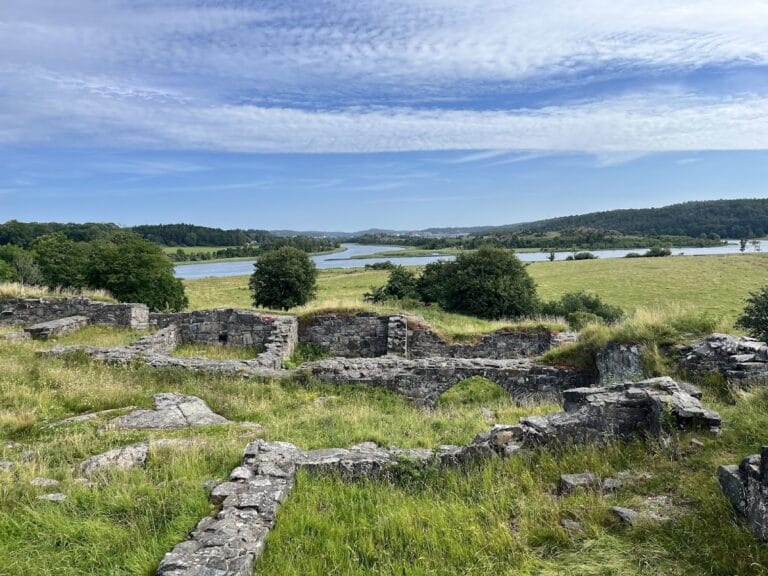
Örestens fästning survives as a castle ruin on a high cliff beside Slottsån in the Viskadalen. The watercourse is connected with the Viskan, and the fortification occupied the hill known as Slottsberget. This elevated position provided a strong defensive setting and made the castle difficult for an attacker to capture. The entrance to the ruin corresponds to the entrance shown in Paul Dolnstein’s drawing of the 1502 siege.
The surviving site is therefore closely defined by its cliff-top position, the adjacent watercourse, and the approach through the recorded entrance. These physical features preserve the relationship between the castle and the landscape it was intended to control, while the remaining ruin represents a fortification repeatedly affected by the Swedish-Danish conflicts of the medieval and early modern periods.
Nearby sites