Mondoubleau Castle: A Medieval Fortress in France
Site at a Glance
- Country
- France
- Primary era
- Medieval
- Eras represented
- Medieval
- Civilizations
- French
- Site type
- Military
- Remains
- Castle
On this page9 sections
History
Mondoubleau Castle is a fortress in Mondoubleau, France, built by Hugues Doubleau a few years before the fortified settlement was first mentioned around 1028–1031. Its lordship later became entangled in changing ties among Blois, Anjou, Vendôme, Châteaudun, and the French crown.
Foundation and early lordship
Hugues belonged to the Doubleau family, whose members were viscounts of Châteaudun, a noble rank below that of count. He supported Eudes II, count of Blois, and established a collegiate church within the castle. Served by a community of clergy, the church was dedicated to Notre-Dame and placed under Tuffé Abbey.
Around 1077, Notre-Dame was reorganized as a priory, a religious house governed under an abbey, and made dependent on Saint-Vincent Abbey of Le Mans. After Hugues died, his son Hugues III was still a minor. Geoffroy Martel, count of Anjou and Vendôme, then took the superior lordship over the castle from the count of Blois.
Châteaudun and royal power
Around 1119, Hugues III’s daughter Helvise married Geoffroy III, viscount of Châteaudun. The marriage brought the lordship into Dunois, the historic territory centered on Châteaudun. Their son Hugues IV later made the castle available to Philip Augustus during his war against Henry II Plantagenet, king of England and ruler of the Angevin lands. The strongholds secured for Philip in southern Maine included Mondoubleau, Trôo, La Chartre, Montoire, and Les Roches-l’Évêque. In 1189, Geoffroy de Lavardin, son of the count of Vendôme, attacked the castle and died there.
After the Plantagenet-Capetian wars, the conflict between the ruling dynasties associated with England and France, Geoffroy V, viscount of Châteaudun, recognized Jean II, count of Vendôme, as Mondoubleau’s superior lord in 1205 in return for additional lands. Jean had been rewarded for supporting the Capetian cause. Geoffroy VI held Mondoubleau from 1218 to 1249 and probably oversaw major refortification in the 1230s. In 1238, he moved the castle priory to Guériteau, in present-day Choue. In 1242, he ended Vendôme’s superior lordship and Blois’s traditional claim, making formal homage to the king instead. Anjou’s grant to Charles I of Anjou in 1247, as an appanage, or grant of land or revenues to a member of the ruling family, brought Mondoubleau into the sphere of Anjou’s ruling house and ended Vendôme’s claims.
Inheritance and royal administration
When Geoffroy VI died in 1249, his younger daughter Clémence inherited Mondoubleau and brought it to her husband, Robert I de Beu. Their eldest daughter, heiress to the lordship, married Raoul de Clermont, Constable of France, the kingdom’s senior military officer. Their eldest daughter in turn married Guillaume I de Termonde.
Philip the Fair temporarily confiscated the castle after Guillaume rebelled alongside his father, the count of Flanders. During the confiscation, a royal bailiff, an official who administered a district and exercised local royal authority, oversaw fortification work costing 85 livres tournois, a medieval French unit of account. In 1334, Guillaume’s granddaughter Marie de Flandre-Dampierre transferred the lordship to Ingelger I d’Amboise through their marriage. Their daughter Jeanne brought it to the counts of Dammartin by marrying Count Charles de Trie, who was recorded as lord of Mondoubleau in 1394.
Vendôme ownership and later condition
In 1406, Louis I de Bourbon, count of Vendôme, bought the lordship from the then count of Dammartin, the eldest son of Bureau de La Rivière. The castle’s history during the Hundred Years’ War, the prolonged conflict between England and France, is uncertain. In 1484, a royal order of Charles VIII formally incorporated the lordship into the county of Vendôme, separating it from Maine.
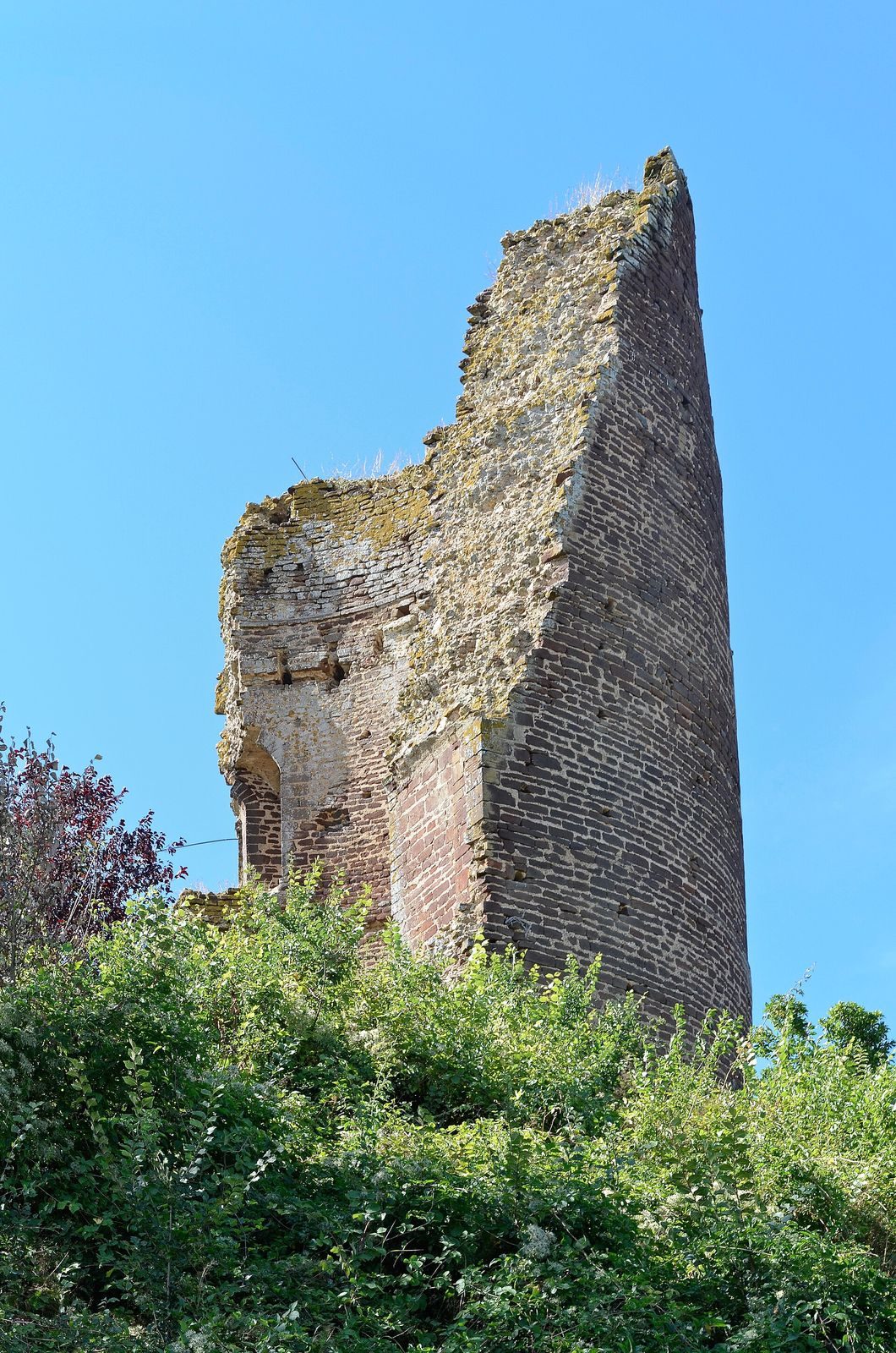
The castle was eventually abandoned but not dismantled. By the late 18th century it was in advanced ruin. Its keep remained intact until a partial collapse in 1812, then collapsed further in 1873 when the mound beneath it was excavated, leaving the structure inclined. The municipality of Mondoubleau owns the castle, which was registered as a French historic monument in 1926, a form of legal heritage protection.
Remains
Enclosure and courts
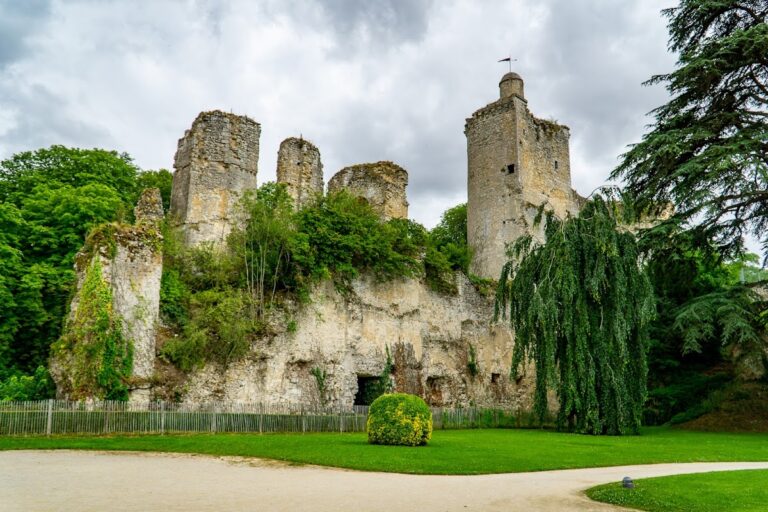
The ruins occupy the southern end of a broad plateau bordered by the Grenne to the west. A roughly quadrangular enclosure, about 150 by 120 metres, contained three parts: an inhabited lower court, a higher court for the nobility, and a motte, or raised earth mound, carrying the keep. The castle proper, made up of the upper court and motte, occupied the enclosure’s southeast quarter. It stood above the lower court and was separated from it by a second enclosure.
Towers and entrance
The complex had twelve towers, seven of which can still be clearly distinguished. Nine flanked the castle proper. The enclosure’s north and south fronts are identifiable; on the north front, a tower stood beside the entrance gatehouse.
Motte and keep
The keep stood on top of the motte and remains inclined above it.