Karlskrona Admiralty Church: A Naval Parish Church in Sweden
Site at a Glance
- Country
- Sweden
- Primary era
- Early Modern
- Eras represented
- Early Modern, Modern
- Civilizations
- Swedish
- Site type
- Religious
- Remains
- Church
On this page15 sections
History
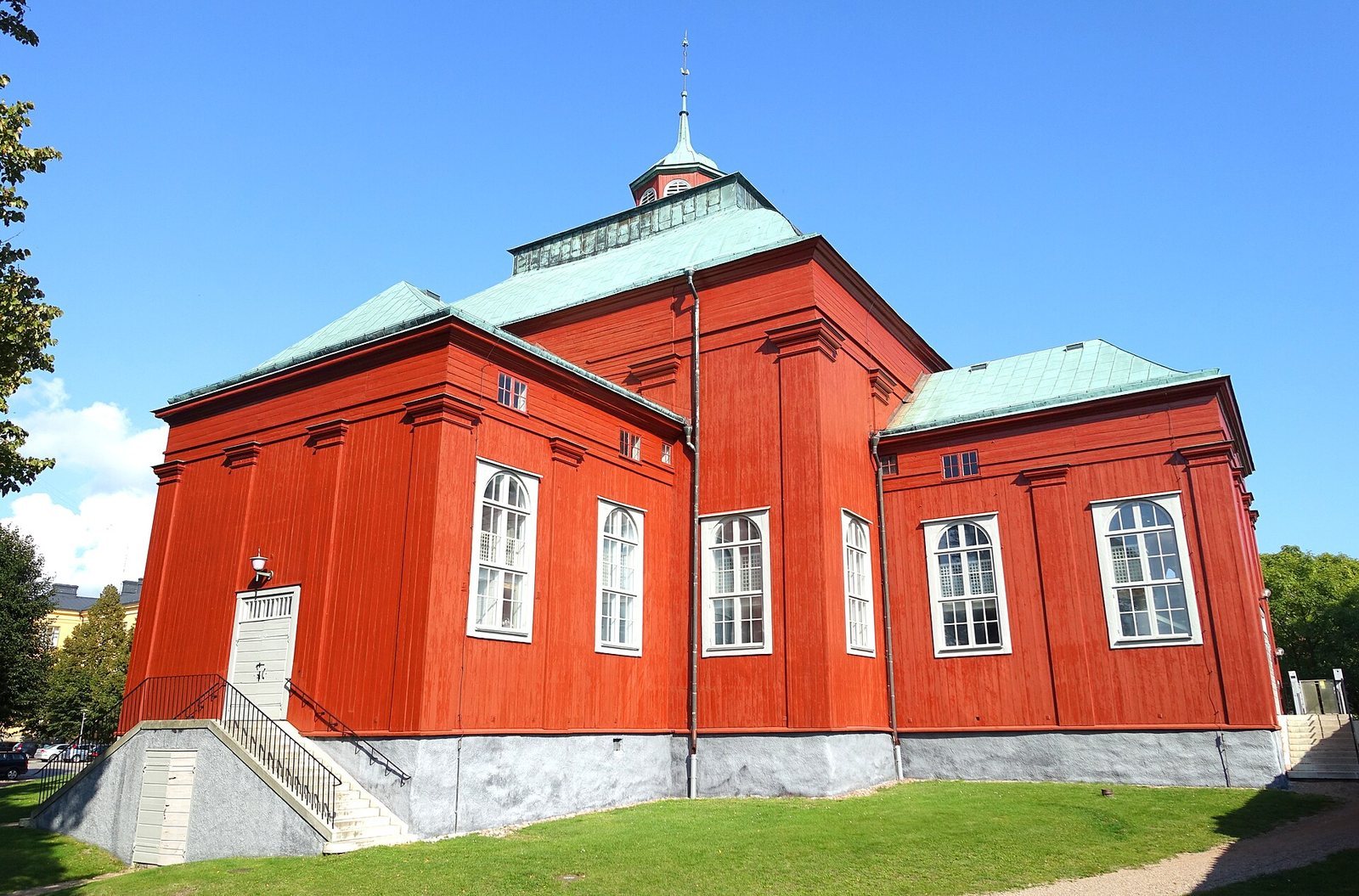
Karlskrona Admiralty Church is a timber church in Karlskrona, Sweden, built for the Royal Karlskrona Admiralty Parish and consecrated in 1685. Karlskrona and its naval shipyard were founded in 1679, and the parish followed in 1681. The church site, on the southeastern point of Trossö, appeared in the town’s first plan in 1683. Named Ulrica Pia for Queen Ulrika Eleonora the Elder, wife of King Charles XI, the church’s name used pia, the Latin feminine form of “pious.” Its architect is uncertain, and the timber was brought from Riga. The church belongs to the Church of Sweden, Sweden’s Lutheran church, and its Royal Karlskrona Admiralty Parish is in the Diocese of Lund, a larger church district. The church forms part of the Naval Port of Karlskrona, inscribed as a UNESCO World Heritage property in 1998.
The plan for a stone church
The timber building was conceived as a temporary church, to be replaced by a larger structure in stone. A foundation stone for the proposed church was laid near the Admiralty bell tower in 1760. It was to be called Adolf Fredrik Church, after the Swedish king. The parish holds two copper-engraving plates depicting designs for the project.
Funding failed to keep pace with construction. After about 20 years, the walls had risen to only 14 Swedish ells, an older unit of length. A royal letter ended the project, and the unfinished building remained in ruins. Around 1850, the ruins were demolished when it was clear that the stone church would not be completed.
Repairs and changing appearance
The church underwent a major renovation in 1822–1824. Around 1850, workers replaced the exterior boarding, painted it yellow and added Baroque-style details intended to make the timber building resemble a stone church. After a period of deterioration, it was repaired in 1864. A renewed campaign to replace it with a stone church began in 1875 and continued for about 30 years. When the naval defence department rejected the parish’s funding request, the king provided money for renovation instead. Work in 1908–1909 brought electricity and a metal roof; copper replaced that roofing in 1958, and a new main staircase followed in 1959.
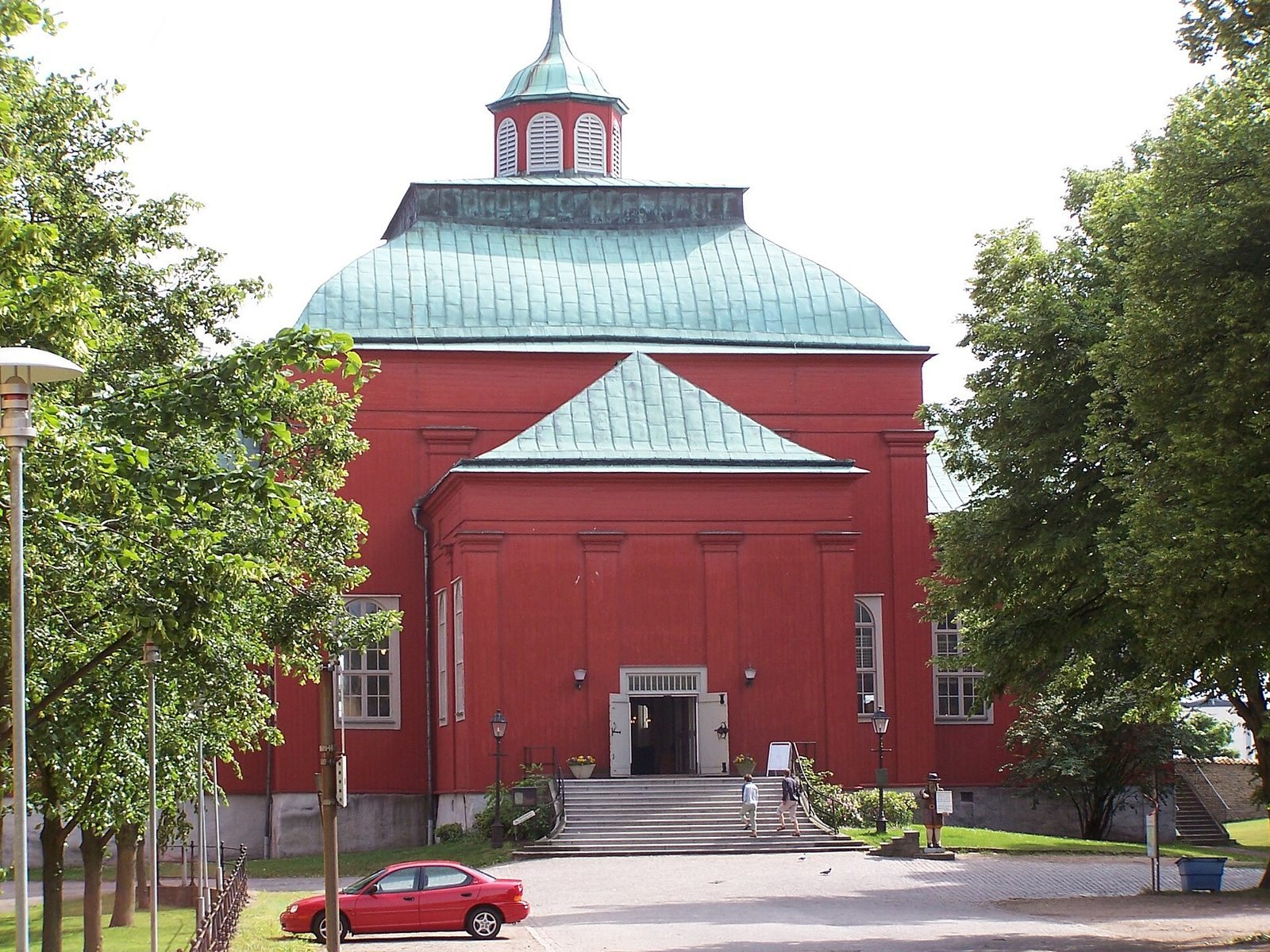
The church originally stood within a wall that separated the civilian town from the naval base and shipyard. In the nineteenth century, part of the wall near the church was demolished and replaced with a less substantial barrier between the church and the naval base. A restoration in 1943–1949 altered the building further. In 1974, the Swedish Fortifications Agency, which owns the church, decided to repaint the exterior red to recover its original character. The National Heritage Board opposed the change, but the church was painted red in 1985.
Remains
The church is built of timber on a raised base of large stone blocks. Its Greek-cross plan has four arms extending from a central space. The central part measures about 20 by 20 metres, and each arm measures 20 metres. The building could originally seat 4,000 people.
Structure and interior
Plan and exterior
The central section rises as a square block beneath a broad, manor-house-style roof, with an octagonal upper structure topped by a curved, moulded hood. The lower arms project as porches and have hipped roofs, which slope down on all sides. Red timber panels cover the exterior. Shallow upright strips resembling columns divide the façades, and the round-arched windows sit within rectangular surrounds. Entrances on the north, west and south sides have rectangular double doors set in the central gables of their arms. The eastern arm contains the choir and sacristy, a room for clergy and church furnishings.
Interior structure
Inside, the timber is painted light blue and light green. Four large timber columns, linked by horizontal beams, support the central roof structure and define a smaller square beneath it. A raised ceiling over this space is not original and was probably added in 1822–1823; the aisle around it has flat timber ceilings. The north and south arms have galleries and flat ceilings, while the choir has a curved, barrel-shaped timber ceiling. In the west arm, the organ occupies a shallow, curved recess.
A 20-centimetre cavity separates the inner and outer walls. The inner wall seems to have been completed only in 1691, and cold remained a problem for clergy and congregants even afterward. A green stove was built into the sacristy. The original upper galleries were removed during a later restoration. Work on the building also added small entrance lobbies in the cross arms and limestone steps at the south and west entrances. A porch erected at the north gable in 1845 was later removed.
Altar, pulpit and memorials
Altar and pulpit
The classical-style altar structure, decorated with a radiant sun, probably dates to 1822–1823. Its maker is uncertain, though Admiralty sculptor Johan Törnström may have created it or assisted with its design. The side columns belong to the same period. Painted architectural effects were added to the altar structure and columns in 1908–1909. The altarpiece is a copy of Peter Paul Rubens’s The Spear Thrust; the original is in Antwerp Cathedral.
The octagonal pulpit, probably installed during the 1864 repairs, has a canopy above the speaker. It is grey with gilded details. Six of its sides have brown panels bearing Christian symbols: the tablets of the law, a Bible, a chalice, a sword, a shield and an anchor. Together, these symbols represent the Christian’s spiritual armour.
Funerary memorials
Epitaphs and funerary coats of arms are displayed in the church, including the coat of arms of Captain Carl Raab. Beneath it, the burial crypt contains 283 coffins arranged in 23 burial chambers. A large plaque on the south wall commemorates sailors who died in the two world wars. The church also holds a model of the corvette Carlskrona, which sank in a hurricane off Florida in 1846. Of the 131 people aboard, 114 died.
Crucifix and other furnishings
The church’s cedar crucifix is inlaid with mother-of-pearl, ivory and ebony. Made in Jerusalem, it was placed on Christ’s tomb in 1728. That year, Captain Raab received it from the Patriarch of Constantinople, a senior bishop, while the patriarch was travelling aboard Raab’s ship from Palestine to Constantinople. Raab donated the crucifix to the church in 1744.
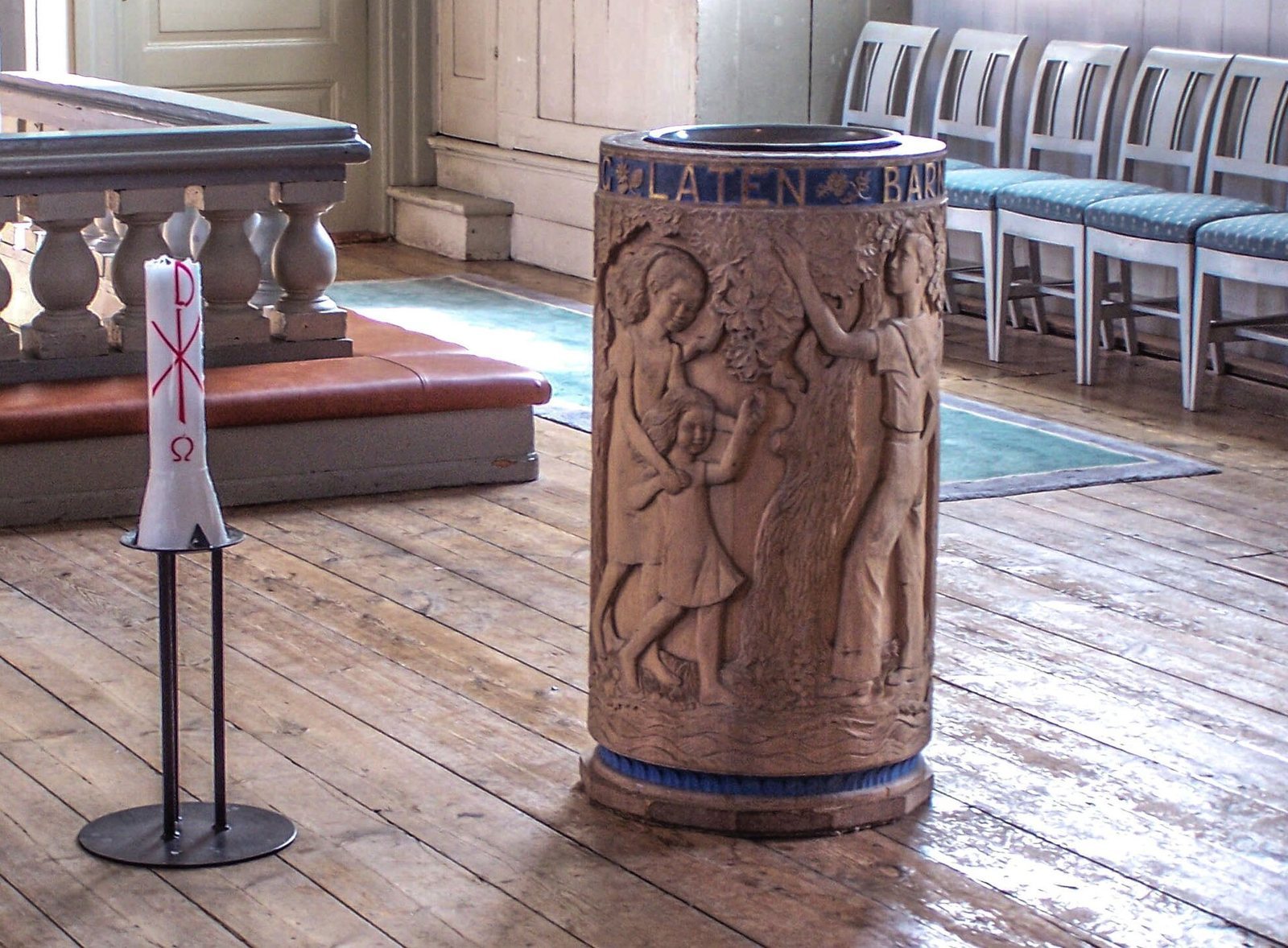
A silver cabinet in the church’s northwestern part holds silver items and some of the parish’s books. The church also has a baptismal font. Its original Rosenbom figure, a life-size wooden poor box, stood outdoors by the church by at least the late eighteenth century; its location was first recorded in 1793. The original was moved indoors in 1956 and is now kept behind glass. A copy stands outside, where donations can be made by lifting its hat.
Organs and bells
Pipe organ
The parish installed its first pipe organ in 1883. Built by Salomon Molander of Gothenburg, it had 23 stops, two hand keyboards and a pedal keyboard. Its keys and stops operated mechanically, with a pneumatic mechanism assisting the first keyboard. The organ’s replacement, built in 1932, had 26 stops and three hand keyboards. It retained much of the earlier pipework but used a pneumatic system. The instrument’s arrangement was revised in 1938 and 1947.
In 1963, an electric system replaced the pneumatic action, a new console was installed and the organ was enlarged to 34 stops. In 1980, its 16-foot trombone stop was replaced by a 16-foot bassoon stop. Tostared Organ Factory reconstructed the instrument in 1998 using the 1883 organ as its model.
Cabinet and choir organs
The parish bought a cabinet organ in 1857. Made by Fourneaux of Paris, it is a cabinet-shaped harmonium that produces sound by driving air through reeds. Its doors have pipe-shaped fronts, and musical instruments decorate the top. The instrument was later moved to the parish school, then spent several years at Blekinge Museum before returning to the church. It has been displayed there since 1979 and is not playable.
A choir organ acquired in 1975 is a small organ built by Olof Hammarberg’s workshop in Gothenburg. It has five stops and was later fitted with a pedal keyboard.
Bells and bell tower
The church’s bells were cast in 1699 and harmonize with the bells of the Admiralty bell tower, also erected that year. The tower stands in Admiralty Park and originally served the naval shipyard as a meal bell, marking working times.