Château de Lussac: A Reconstructed Wine Estate in France


Site at a Glance
- Rating
- 4.6
- Popularity
- Very Low
- Country
- France
- Primary era
- Modern
- External website
- Open
- Eras represented
- Modern
- Civilizations
- French
- Site type
- Domestic
- Remains
- Manor House
On this page9 sections
History
Château de Lussac is a 30-hectare wine estate in France, founded in 1876 in the classical architectural fashion of nineteenth-century France. It lies in Lussac, Gironde, within the Lussac-Saint-Émilion appellation, a legally defined wine-growing area governed by geographical and production rules around the Saint-Émilion region. The estate was established for Gaston Montouroy, a vintner and vine grower, and became a long-lived family property.
Foundation and family ownership
Montouroy later transferred the property to his son-in-law, the Marquis de Sercey, a French nobleman. The marquis’s descendants managed the estate until the 1980s, preserving its role as a working wine property through several generations.
The fire of 1898
During the night of 19–20 September 1898, the château was completely destroyed by fire. The family survived, and the wine cellars were saved, but the building and its contents, including furniture, jewelry, family archives, and commercial books, were lost. The financial damage was estimated at 380,000 francs.
Mathieu Puyancher, a 17-year-old coachman and valet recently dismissed by Montouroy, was convicted of setting the fire. He received a sentence of 20 years of forced labor, followed by a 20-year ban on residence after completing the sentence. The château was rebuilt after the disaster, producing the form that survives today.
Later management and renovation
After the family period, Olivier Roussel managed the property for approximately 15 years. Griet and Hervé Laviale acquired the estate in 2000 and carried out substantial renovation work. A circular vat room formed part of this work, while a new bottling and storage hall was completed north of the older complex in 2001.
In 2022, Frédéric Stévenin, chief executive of the investment firm PAI Partners, purchased Château de Lussac. He also owns Château La Fleur Gazin, Château Vieux Maillet, and Château Saint-Pey. The château now combines the estate’s administrative functions with a small hotel.
Wine production
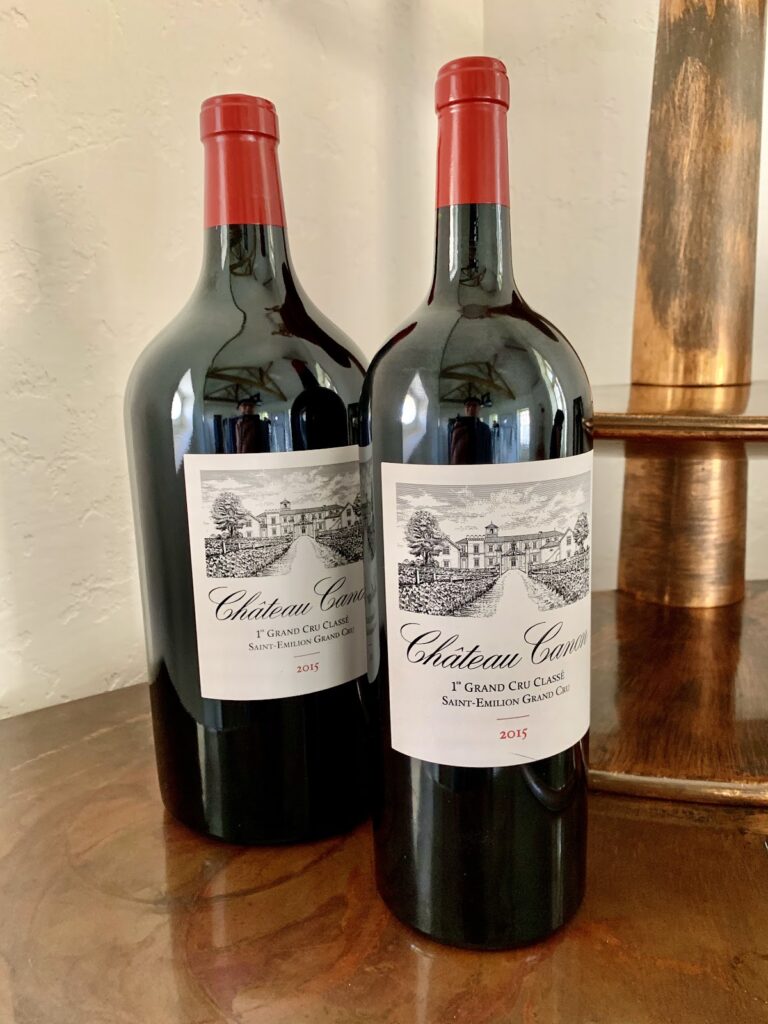
The estate produces Château de Lussac as its first wine and Le Libertin de Lussac as its second wine. Grapes are harvested both manually and mechanically, then sorted by hand. The work is managed by vineyard plot, followed by fermentation in vats and maturation in French-oak barrels. Château de Lussac is made from approximately 80 percent Merlot and 20 percent Cabernet Franc. Le Libertin de Lussac is a white wine made from Sauvignon Blanc, Sauvignon Gris, and Semillon.
Remains
The reconstructed château and grounds
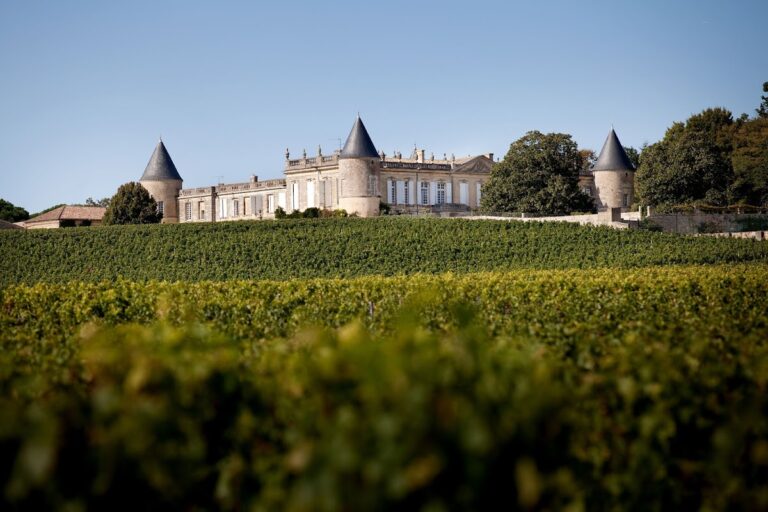
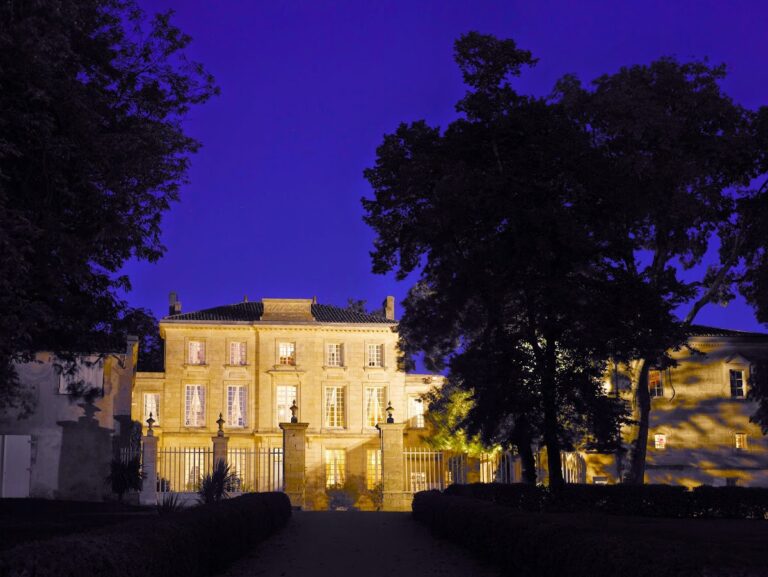
The château stands in the heart of Lussac beside the village church. Its central building follows the classical architectural language adopted in France during the nineteenth century, while two flanking pavilions frame the main body. A monumental pediment crowns the central building, with a design inspired by Renaissance architecture. Because the present house was reconstructed after the 1898 fire, its surviving form belongs to the rebuilding that followed the destruction. A French garden extends eastward behind the house.
Winery buildings
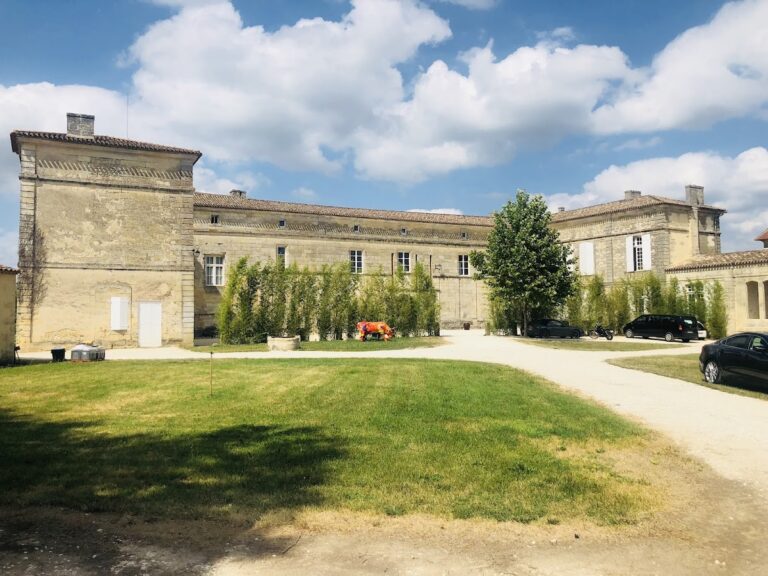
The renovated estate includes a circular vat room designed by the Bordeaux architect Philippe Mazières, together with a barrel cellar for aging wine in wooden barrels and a climate-controlled storage cellar. North of the older building complex, the bottling and storage hall built in 2001 was designed by Mazières and the Flemish landscape engineer Guido Spruyt. Its design was carefully integrated with the older architectural language and incorporated references to earlier elements.
Vineyards
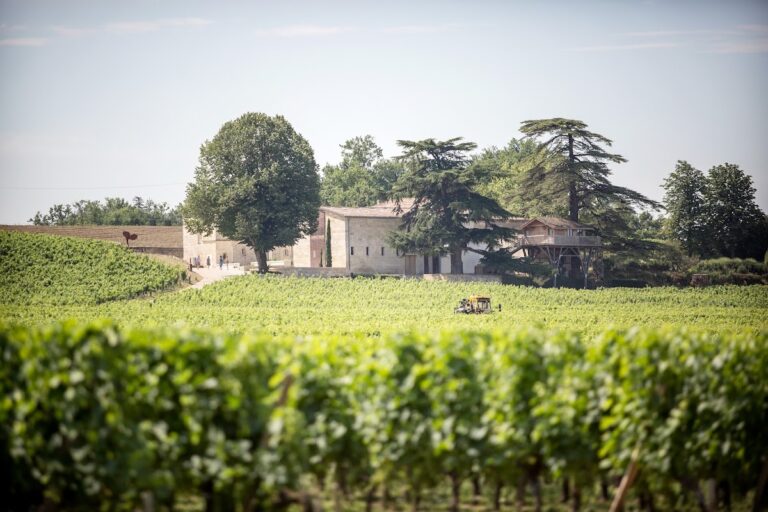
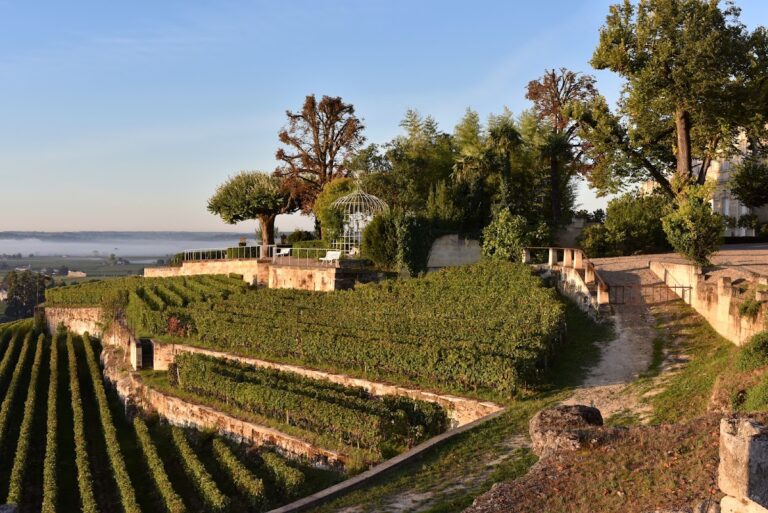
The estate’s 30 hectares of vines are planted on naturally well-drained, exposed clay-limestone rises. The vines have an average age of about 30 years. Approximately 77 percent of the planting is Merlot and 23 percent Cabernet Franc, providing the red varieties used for Château de Lussac. The property’s white second wine draws on Sauvignon Blanc, Sauvignon Gris, and Semillon.