Lastouzeilles Castle: A Historic Residence in Palleville, France
Site at a Glance
- Rating
- 4.2
- Popularity
- Very Low
- Country
- France
- Primary era
- Medieval
- Eras represented
- Medieval, Modern
- Civilizations
- French
- Site type
- Domestic
- Remains
- Castle
On this page8 sections
History
Lastouzeilles Castle is a historic château in Palleville, France, whose site has been occupied since at least Antiquity. Roman remains found there point to an earlier period of settlement, while the present castle probably dates from the end of the fifteenth century, when it first appears in written references. Built near the Mouline stream on the border between Albigeois and Lauragais, it stood in a frontier zone later contested during the Wars of Religion, the sixteenth-century conflicts between Catholics and Protestants in France.
Early Occupation and Medieval Tradition
The name “Touzeilles” may derive from a phrase meaning “old towers,” perhaps recalling an earlier castle. A tradition maintained by the current owner holds that a castle already stood here during the Albigensian Crusade, the medieval campaign against Cathar communities and their supporters in southern France. According to the same tradition, Cathars took refuge at the site for a time, and the present keep dates from that period. The tradition also states that Cardinal Richelieu, the chief minister of King Louis XIII, ordered the keep reduced from 30 metres to 15 metres. These claims concern the castle’s earlier history and the later alteration of its keep.
The Wars of Religion
During the Wars of Religion, Lastouzeilles was initially held by Catholics. In 1587, Henri de La Tour d’Auvergne, Vicomte de Turenne, a major Protestant military leader, captured the château after a siege. It then passed to the Huguenots, the French Protestants, who used it while resisting Catholic forces led by Duke Anne de Joyeuse. A cannonball impact on the west façade survives from this period.
The château was restored at the end of the sixteenth century and remained in the possession of a Protestant lord. After the revocation of the Edict of Nantes in 1685, which ended the limited legal protection previously granted to French Protestants, his descendant converted to Catholicism. Before doing so, he had the words “despite me” engraved on a lintel, preserving a brief expression of the pressure surrounding that change of confession.
The Gouttes Family and Later Changes
Jean-Louis de Gouttes bought the château in 1806, after the French Revolution. He had served as a cuirassier captain in the Grande Armée and was a Knight of the Legion of Honour. He was one of the children of Jean-Louis de Gouttes, a royal councillor and royal judge of the town and bailliage of Revel, a royal administrative and judicial district. The present owners are his descendants. The family came from Revel, where it lived and owned a cotton mill.
Nineteenth-century building work added buttresses to support walls constructed without foundations, while leaving the general appearance of the château unchanged. A water tower or bath pavilion was also installed in the park during the nineteenth century. The Gouttes family still owns the property, which functions as a private residence. Part of the château was listed as a historic monument by an order dated 17 March 1999.
Remains
Main Building and Towers
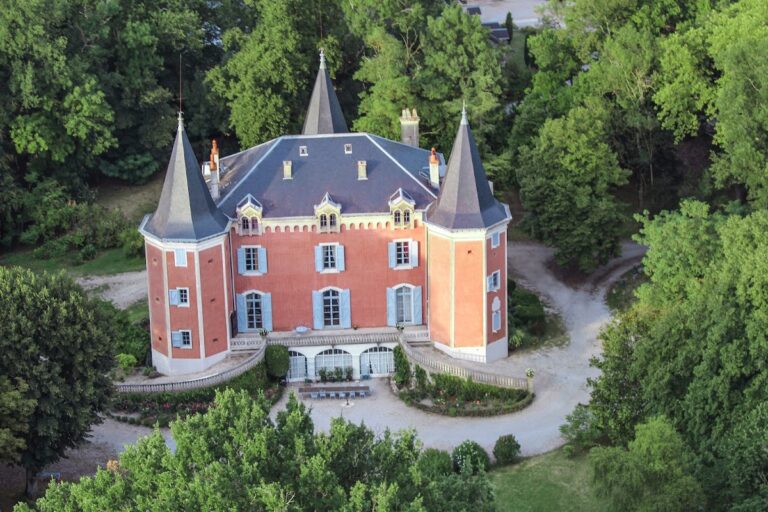
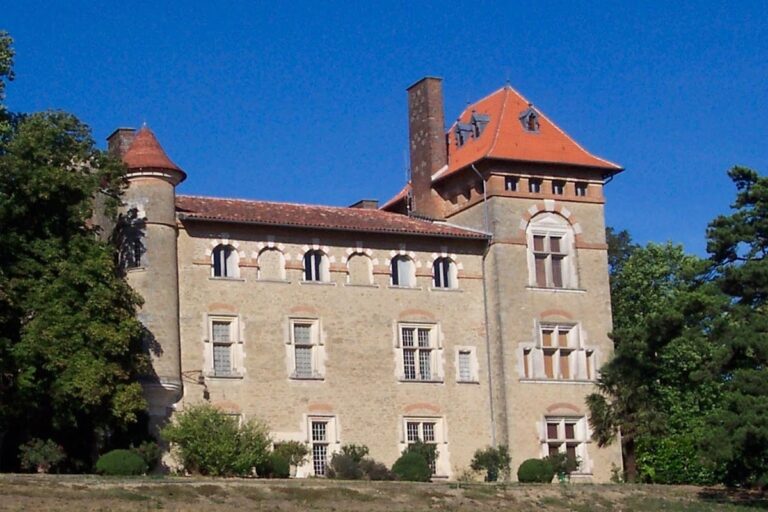
The château is arranged around a long residential building running from east to west, with a return wing extending northward. It is built almost entirely of foraine brick, the traditional fired brick widely used in southwestern French architecture, apart from some facing materials. Two small square towers frame the south façade. This elevation rises through three storeys and contains mullioned windows, whose sections are divided by stone or masonry bars and whose forms display Renaissance features. Another tower, identified as the former keep, stands beside the return wing.
Park and Defensive Features
The park contains a nineteenth-century water tower or bath pavilion that supplied water to the toilet rooms. On the west side, part of the moat and the enclosure wall remain. Together with the towers and the former keep, these elements preserve aspects of the château’s earlier defensive arrangement, while the residential building reflects its later domestic use.
Judicial and Military Remains
Inside the château are oubliettes, confinement chambers designed for prisoners to be “forgotten” and often reached through an opening above. They are associated with the period when the lord exercised judicial rights. The west façade also retains the visible mark of a cannonball fired during the 1587 siege, linking the surviving fabric directly to the château’s role in the Wars of Religion.
Nearby sites