Garrevaques Castle: A Fortified Residence in France


Site at a Glance
- Rating
- 4.7
- Popularity
- Low
- Country
- France
- Primary era
- Modern
- External website
- Open
- Eras represented
- Medieval, Modern
- Civilizations
- French
- Site type
- Domestic
- Remains
- Castle
On this page8 sections
History
Garrevaques Castle is a former fortified castle in France, in Garrevaques, whose first construction began around 1470 to protect the village. The site later became involved in the Wars of Religion, the sixteenth-century conflicts between Catholics and Protestants in France, before evolving into a rebuilt private residence.
Foundation and the Wars of Religion
The original castle belonged initially to a Catholic lord who was reputed to prevent Protestant pastors from reaching the Protestant Academy of Puylaurens. In 1580, Calvinist troops commanded by Henri de La Tour d’Auvergne, Vicomte de Turenne, a leading French Protestant military commander, captured several nearby Catholic strongholds, including Sorèze, and then besieged Garrevaques.
After three days, a breach opened in the ramparts and the castle fell. Several dozen defenders were massacred. Garrevaques subsequently became one of the principal Huguenot strongholds in Lauragais. Huguenot was the historical term for French Protestants. Henri III of Navarre, who later became King Henri IV of France, stayed at the castle for a period.
The de Gineste ownership
The castle later passed to the Protestant de Gineste family, which has owned it since the seventeenth century and continues to do so. Damage sustained during the religious wars led the family to remodel the building. In 1815, at a marriage held at the castle, the family acquired twelve panels made by the Parisian Dufour and Leroy manufactory.
Rebuilding and twentieth-century occupation
Revolutionaries set fire to Garrevaques during the French Revolution. Count Philippe de Gineste and his son Henri, whose fortune came from the sugar-beet trade, rebuilt the castle shortly afterward in the early nineteenth century under the First Empire, Napoleon Bonaparte’s imperial regime. The building was restored again in 1862.
German occupying forces requisitioned the castle in 1943 during the Second World War. With assistance from village residents, the owners evacuated most of the valuable furniture before the occupation. The building became a headquarters, and the occupiers damaged it while converting the kitchen into an armoury.
The occupying forces left after the Provence landings on 15 August 1944. Before their departure, they placed explosives in the cellars to prevent the owners from recovering the property. Jules Gasc, the gardener and a veteran, found six bombs and disarmed them, saving the building. Garrevaques remains a private residence inhabited by the sixteenth, seventeenth, and eighteenth generations of the de Gineste family. An order dated 30 May 2016 partially listed the castle as a historic monument, protecting the salon containing the twelve Dufour and Leroy panels.
Remains
The château structure
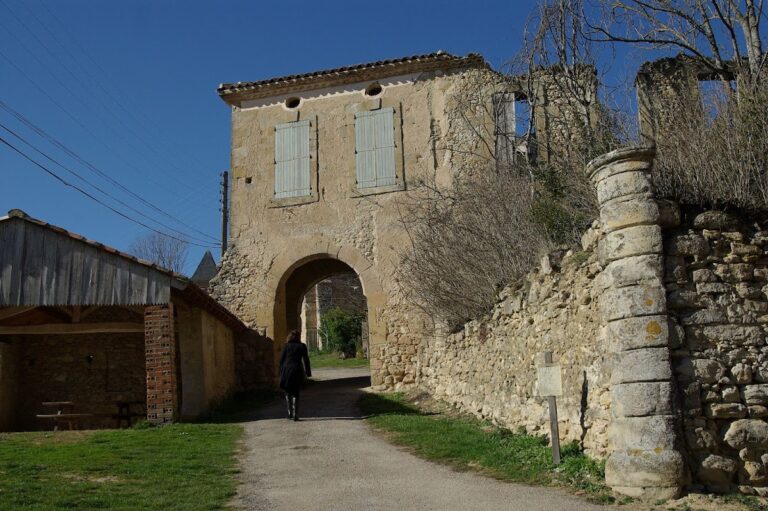
The original castle was a large fortified building with four towers, an enclosing wall, and several moats supplied by diverting the Sor. Only limited parts of that structure survive, including the remains of a doorway and a tower.
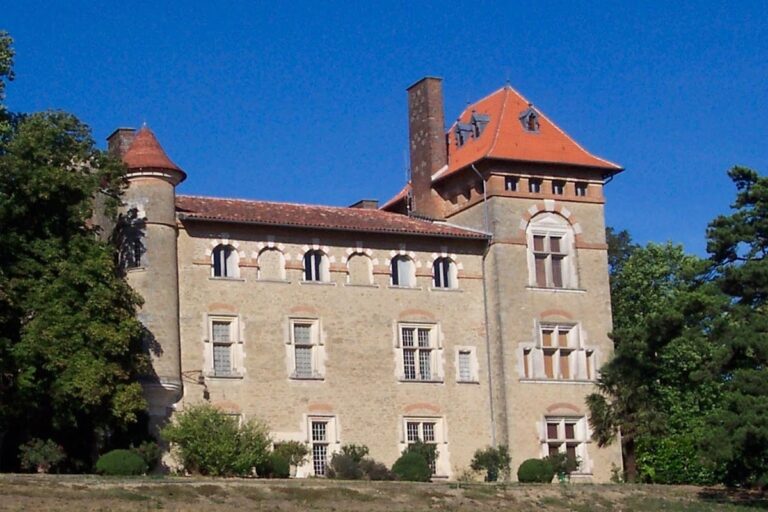
The present château stands in the Sor valley as a two-storey residential building. Polygonal towers flank both ends of the principal façade, while another polygonal tower rises at the centre of the rear façade. The front has three bays and an attic level with double dormer windows. Its walls are faced with imitation brickwork, and slate roofs rest above a row of imitation machicolations, projecting defensive features whose openings were intended to protect the base of a fortification but are decorative here.
The protected salon
The protected salon contains a panoramic wallpaper ensemble made in 1815. Twelve panels produced by the Dufour and Leroy manufactory are worked in grisaille, a technique that uses shades of grey to create the appearance of relief. Together they depict the love story of Cupid and Psyche.
Estate and grounds
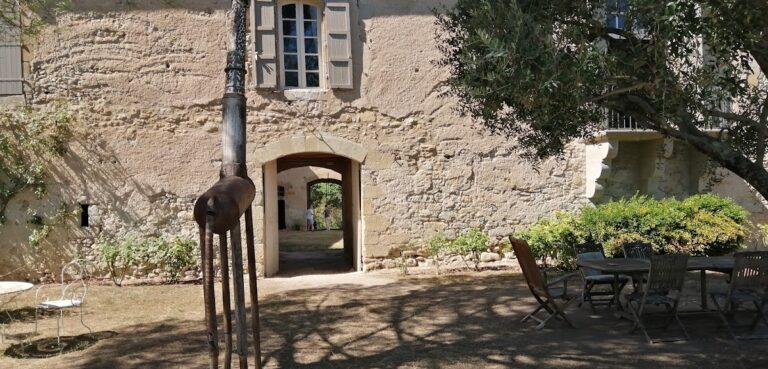
André Leroy replanted the château estate in 1878. The grounds include numerous outbuildings, among them former stables converted into a hotel-restaurant. A pedunculate oak, Quercus robur L., stands opposite the château. The tree is estimated to be 550 years old and classified as a notable tree. Château de Montgey is visible from the park.