Château de Malesherbes: A Historic Château and Estate in France
Site at a Glance
- Rating
- 3.9
- Popularity
- Very Low
- Country
- France
- Primary era
- Early Modern
- External website
- Open
- Eras represented
- Medieval, Early Modern
- Civilizations
- French
- Site type
- Domestic
- Remains
- Castle
On this page14 sections
History
Château de Malesherbes is a historic château in France, whose principal residential building was constructed between 1720 and 1724 in the classical style. Its history reaches back to medieval fiefs, wartime destruction, royal politics, and the Lamoignon family’s connection with the defence of Louis XVI.
Medieval origins and reconstruction
In 886, King Charles III granted the lands of Soisy and Pinson to the chapter of Saint-Gatien Cathedral in Tours. Around 1100, Malesherbes was divided into three fiefs, Soisy, Bois, and Malesherbes. Medieval holders included the families of Soisy, du Bois, du Tournel, Malesherbes, and Pasté.
The château was pillaged and burned in 1358 during the Hundred Years’ War, the prolonged conflict between the English and French crowns. Jean Pasté owned the ruins in 1367. In 1373, Étienne de la Grange, President of the Parlement of Paris and lord of Malesherbes through his marriage to Marie du Bois, rebuilt the château.
Jacqueline de La Grange’s marriage to Jean de Montagu in 1388 connected the property with the Montagu family. Jean de Montagu, superintendent of finances to Charles VI, acquired Bois-Malesherbes by 1398 and obtained the remaining rights to Malesherbes in 1399. Jean sans Peur, Duke of Burgundy and a major rival of the French royal government, later ordered Montagu’s execution.
War and the Balzac d’Entragues inheritance
The property subsequently passed through the families of Graville and Balzac d’Entragues. During the English occupation, Jean VI Malet de Graville held Bois-Malesherbes. The English captured it in 1432, and the Constable of Richemont retook it in 1437. Malesherbes became a full fief in 1450 after Jean VI acquired Manchecourt.
Louis Malet de Graville, Admiral of France and governor of Picardy and Normandy, was lord of Malesherbes in 1497. His daughter Anne de Graville married her cousin Pierre de Balzac d’Entragues in 1508, bringing the property into the Balzac d’Entragues family. It then passed to Guillaume de Balzac d’Entragues and François de Balzac d’Entragues.
François married Marie Touchet, formerly the mistress of King Charles IX, in 1578. Their daughter Catherine Henriette de Balzac d’Entragues became the mistress of Henry IV, king of France from 1589 to 1610. At Malesherbes on 1 October 1599, Henry IV gave her a written promise of marriage. After he failed to honour it, Catherine Henriette and her father joined a plot intended to place her son, Henri de Bourbon-Verneuil, on the throne. François was arrested at the château, condemned to death, pardoned, and confined to residence at Malesherbes. Henri de Bourbon-Verneuil later became Bishop of Metz.
A Protestant army commanded by the Duke of Bouillon seized Malesherbes in 1587. The château was pillaged and burned again in 1589. It later passed to the Balzac d’Illiers branch, including Léon I d’Illiers, who became Marquis d’Entragues in 1634, followed by Léon II d’Illiers and Alexandre d’Illiers.
The Lamoignon transformation
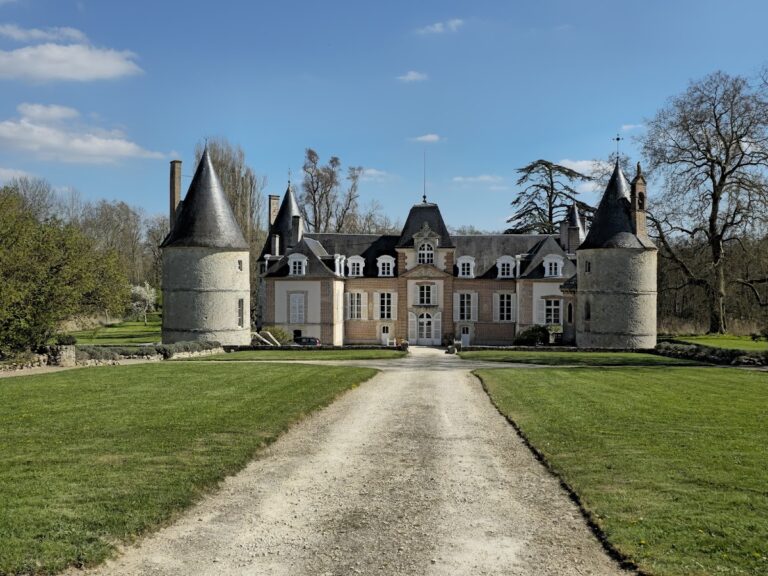
On 20 January 1718, the château and its lands were sold in a severely deteriorated condition to Guillaume de Lamoignon de Blancmesnil, Attorney General of the Parlement of Paris. Under his direction, the ditches were filled and a classical façade was built while the medieval corner towers were retained.
Guillaume’s son, Chrétien Guillaume de Lamoignon de Malesherbes, was a French magistrate, statesman, and advocate of freedom of expression. During the government of Chancellor Maupeou, he was exiled to the château from 1771 to 1774. A passionate botanist, he devoted considerable attention to planting trees and ornamental avenues on the estate. Extensive plantings near the château were later noted by Thomas Jefferson and the traveller Arthur Young.
Revolutionary associations and later ownership
Malesherbes defended Louis XVI before the Revolutionary Tribunal, the court that tried the king during the French Revolution. The château consequently became a place of pilgrimage for royalists seeking memories of the king. In December 1793, it was searched, and members of Malesherbes’ family were taken to Paris and guillotined.
After the Revolution, the estate passed to Louis and Christian de Chateaubriand, nephews of François-René de Chateaubriand and great-grandsons of Malesherbes. It was particularly active during the Bourbon Restoration, the return of the Bourbon monarchy after Napoleon’s fall. Louis de Chateaubriand was closely associated with the neighbouring lawyer Berryer.
The property later passed through the Chateaubriand, Beauffort, and Levis Mirepoix families. From the late 1990s until 2007, a hotel chain operated the château; since 2007 it has been privately owned. The château’s archives are held by the National Archives in sub-series 399 AP.
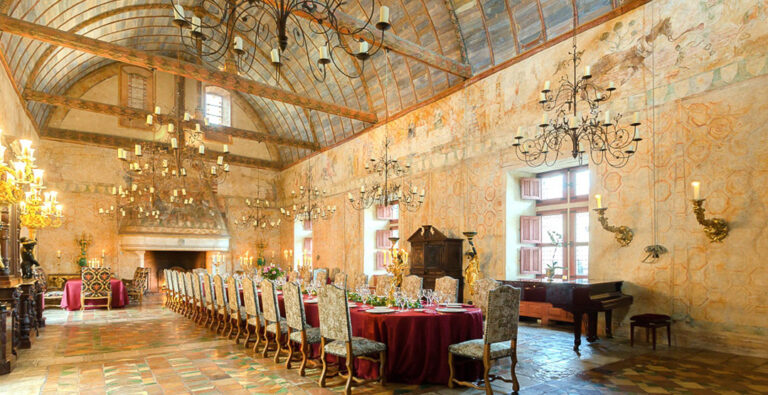
Château de Malesherbes is a partially protected historic monument. Protection granted in 1965 covers the granary buildings and park, Henriette d’Entragues’ bedroom, the reception room, grand salon, library, and dining room. Protection granted in 1988 covers the château’s façades and roofs, the Chateaubriand house, chapel, gatekeeper’s lodge, pigeon loft, moats, and icehouse. The wider site also has landscape protection dating from 1982.
Remains
The château stands within a wooded park of approximately 100 hectares. A sanded courtyard surrounds the buildings, while the former moats are now dry. An obelisk in the park is linked to the château by a paved causeway, forming part of the estate’s planned landscape.
Residential and medieval buildings
Main château
The main residential building was constructed between 1720 and 1724 by Pierre Vigné de Vigny, an architect who collaborated with the king’s architect Robert de Cotte, with assistance from Denis Jossenay. Its classical façade was designed within the earlier fortified arrangement, retaining the corner towers.
Medieval tithe barn
A large tithe barn from the late fourteenth century survives on the estate. A tithe barn was an agricultural building used to store the portion of produce traditionally owed as a tithe. The barn belongs to the medieval phase of the property and forms part of the group of granary buildings.
Chateaubriand house
The building known as the Chateaubriand house is a long pavilion where the writer and diplomat François-René de Chateaubriand lived. His family inherited Malesherbes after the death of the Lamoignon line.
Religious and estate features
Chapel
The fifteenth-century chapel is built in the Flamboyant Gothic style, a late Gothic manner characterized by elaborate, flame-like tracery and curving decorative forms. It contains the tombs of François de Balzac d’Entragues and his wife.
Pigeon loft
The estate includes a large pigeon loft with 1,800 niches and capacity for more than 8,000 pigeons. Such a structure, also called a dovecote, was used for raising domestic pigeons.
Icehouse and Neolithic stone slab
An icehouse forms part of the park and estate features. This purpose-built structure stored ice and helped preserve food before mechanical refrigeration. The park also contains a Neolithic stone slab from Les Marsaules, installed there in 1976.
Nearby sites