Château de Hauteville: An Unfinished Eighteenth-Century Estate in France
Site at a Glance
- Rating
- 5
- Popularity
- Very Low
- Country
- France
- Primary era
- Early Modern
- Eras represented
- Early Modern
- Civilizations
- French
- Site type
- Domestic
- Remains
- Elite Residence
On this page9 sections
History
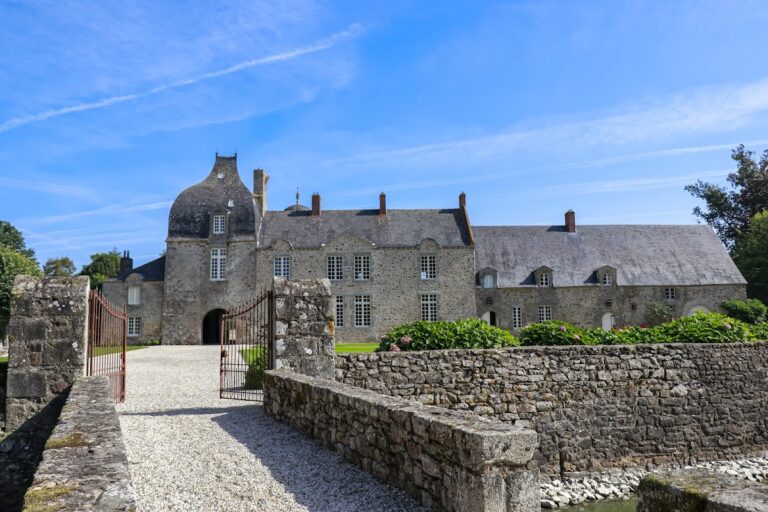
Château de Hauteville is a historic château in France, located at Hauteville near Charchigné in the former province of Maine. It stands on seigneurial land that depended on Lassay, about 1,200 metres from Charchigné. The present residence was commissioned at the end of the eighteenth century, with construction beginning in 1783, but it remained unfinished when the French Revolution began in 1789.
Medieval and Renaissance Lords
The earliest recorded lords of Hauteville belonged to the Livet family. Before 1350, the knight Jean de Livet, lord of Hauteville, granted a rent to the monks of Beaulieu in return for burial at their abbey in Languédias. Jean d’Hauteville held the domain in 1407. Gilles de Hauteville, lord of Charchigné, died in 1478, and his son Jean II died in 1501.
In 1508, Jean III d’Hauteville endowed the castle chapel with three Masses each week and dedicated it to the Virgin. Before 1526, Samson d’Hauteville married Marguerite de Loré, a relative of Ambroise de Loré. In 1526, Lancelotte d’Hauteville, Jean III’s only heir, brought Hauteville into the d’Arquenay family through her marriage to Antoine d’Arquenay. Their son Claude likewise had only one heir, Julienne d’Arquenay.
Around 1577, Captain François de Moré lived at Hauteville as a tenant or military occupant. He was lord of La Blanchardière and commanded the garrison at Lassay when the town was captured by the Huguenots, French Protestants involved in the religious conflicts of the sixteenth century. In 1581, Julienne d’Arquenay married Nicolas d’Angennes, lord of Rambouillet, making Hauteville his property.
The du Hardas Estate
Around 1586, Thomas du Hardas, from an Angevin family associated with the Hardas estate at Louvaines, purchased Hauteville from Nicolas d’Angennes. Thomas was lord of Hauteville in 1609. In 1623, he transferred the domain as part of the marriage settlement for his son Claude du Hardas and Julienne de Vaux. Claude died without children in 1642, and ownership passed to Thomas’s brother Jacques du Hardas.
Jacques, lord of Hauteville from 1642, was married to Louise Henriette du Liscouët. His elder son, Charles du Hardas, became Marquis of Hauteville, an infantry colonel, and a knight of Saint-Louis. He died without issue in 1763, after which the succession passed to his nephew Charles du Hardas, son of Count Pierre du Hardas.
Charles du Hardas married Françoise Perrine Madeleine de la Corbière, Marquise of Juvigné, in 1769. He held lordship over Charchigné, Chevaigné, Les Chapelles, La Roche, La Maleindrière, Guchaignier, Lelaisy, Courgady, Landres, and other places. On 17 June 1788, he represented the nobility at the district office of Lassay.
The Unfinished Château and the Revolution
Charles du Hardas commissioned a new residence from the architect Pierre Pommeyrol, who was associated with the châteaux of Craon and Bel-Air and the former Hôtel Piquois at Laval. Construction had begun in 1783, and the masonry was well advanced when the Revolution began. Economic hardship, grain shortages, a severe winter, and unrest in Mayenne prevented the building from being completed.
The French Revolution began in 1789 and brought attacks on aristocratic estates and the destruction of feudal records in many rural areas. On 31 July 1789, about 1,500 armed insurgents marched from Chevaigné to Hauteville after pillaging and burning the châteaux of La Motte de Madré and Vaugeois. They searched for the estate’s chartrier, an archive of title deeds and feudal records proving a lord’s rights and property, and burned the documents. Those responsible were arrested and sentenced to death, but were later released.
Hauteville narrowly escaped the fire of 30 July 1789 but was pillaged. Furniture, doors, and windows that had not yet been installed were sold cheaply. The château was threatened again on 14 November 1790. National Guard detachments under Beauvais and Durand searched it on 26 June 1791, forcing open the remaining cupboards, breaking wine bottles in the cellars, and taking seven hunting guns. Another search took place on 14 July 1793.
During the revolutionary period, the château was converted into a saltpetre works, a manufactory producing saltpetre. On 27 July 1799, Chouans, royalist insurgents active in western France during the revolutionary and post-revolutionary conflicts, removed one cartload of lead from the building. Another seven or eight cartloads were taken to Lassay.
Nineteenth-Century Ownership
After Charles du Hardas died without direct descendants in 1819, his widow, Françoise de la Corbière de Juvigné, transferred the château and its lands during her lifetime to her grandson Charles Alexis du Hardas and his wife, Mélanie Françoise Prudhomme de la Boussinière. In 1847, police searched the estate during investigations into alleged Legitimist plots. The arrest of Madame d’Hauteville and the searches led Paul Boudet to denounce alleged Legitimist activity in the Laval and Mayenne districts before the National Assembly.
Charles Alexis du Hardas died at Hauteville on 31 December 1873 without direct descendants. In 1882, Mélanie Prudhomme de la Boussinière left the château to her great-niece Émilie de Pérusse des Cars and Émilie’s husband, Count Bertrand de Montesquiou-Fézensac, a French naval officer who became a rear admiral.
Émilie died at Hauteville on 1 March 1901, and Bertrand died in Paris on 24 July 1902. They were buried together in the Hauteville chapel at the cemetery of Charchigné. Their only daughter, Mathilde de Montesquiou-Fézensac, was a minor and was placed under the care of her aunt Hélène Standish. Hélène and her husband, Lord Henry Noailles Widdrington Standish of Standish, also managed the estate.
Fire, Decline, and Restoration
After reaching adulthood, Mathilde became owner of Hauteville. She married the organist and composer Charles-Marie Widor at Charchigné on 26 April 1920. At its height, the estate employed about fifty domestic servants, contained 99 rooms, and supported several families on its lands. Farmers worked under sharecropping agreements, an agricultural system in which cultivators give the landowner an agreed share of the produce. The estate steward exercised strict authority, and tenants were not assured the same farms from one year to the next.
On 13 November 1922, shortly after 3 a.m., an accidental fire destroyed the château. It began in the attic at a beam beside a pipe serving the central-heating system’s large wood-fired furnace. A mason had warned the previous day that the fire was smouldering, but no action followed. The flames spread rapidly through the unprotected woodwork. The right wing was partly preserved, while the fire stopped at the chapel in the left wing.
Several firefighting companies used hand pumps as firefighters and villagers carried furniture and other contents to the large outbuildings. The alarm bell sounded for more than 36 hours, and the château burned for nearly three weeks. Many valuable furnishings and works of art were lost. Five people were injured, including three firefighters, the château keeper, and a resident of Charchigné.
Mathilde Widor returned to Hauteville in June 1940 while fleeing Paris and stayed there until the end of the Second World War with a butler and five servants. She considered rebuilding the château but concluded that she lacked the necessary means. The estate’s farms were later sold individually, largely as postwar tenancy-law changes allowed sharecroppers to become tenants and later purchasers.
The beech hedge along the avenue was cut down in 1961, and a nearby sand quarry later damaged the setting. After roughly forty years as ruins, Hauteville became the property of Roger Bordelet in the 1960s. His son Éric Bordelet took over the family enterprise in 1992 and remains the owner. Éric and Céline Bordelet subsequently undertook restoration work. A grant from the Mayenne departmental council supported a processing and packaging building in 2013, while the château interior was cleared and its openings structurally supported in 2014.
Remains
The Avenue and Main Residence
An avenue about 800 metres long leads toward the château. It is attributed to André Le Nôtre, the chief landscape designer of Louis XIV’s France, and was formerly bordered by two rows of beech trees. The avenue was once described as the third in France. The residence designed by Pierre Pommeyrol had a 40-metre-long facade, three storeys, and numerous windows. Its central triangular pediment carried the coats of arms and initials of the du Hardas family and was crowned by a belvedere.
Irregular pavilions flanked the principal building and formed part of an ensemble described as solidly and seriously constructed. The entrance was reached by a five-step perron, or raised flight of steps. Inside, a large central vestibule was arranged around columns whose capitals were decorated with twisted foliage. The vestibule opened onto a large salon with carved wood panelling and onto high-ceilinged reception rooms, while the upper floor contained private apartments.
Chapel, Ruins, and Cellars
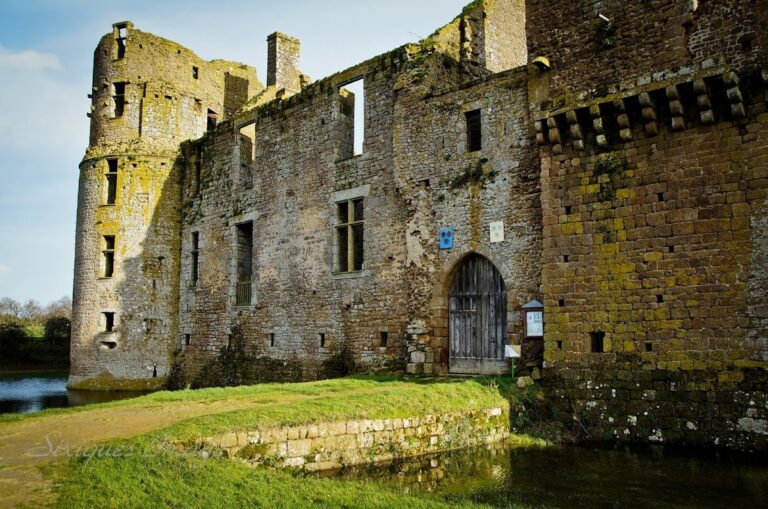
The chapel stood in the left wing, where it halted the spread of the 1922 fire. The right wing was partly spared, and extensive dependencies remained standing for decades among the ruins. Restoration work later revealed deteriorated walls and vaulted cellars, with the cellars still in good condition. These cellars cover about 400 square metres and are intended for the production of calvados, an apple- or pear-based spirit produced in Normandy and neighboring areas.
The restoration project includes the proposed transfer of production, cellars, storage, processing, packaging, and tasting facilities from the outbuildings into the château. In this form, the surviving masonry and underground spaces are being incorporated into the continuing use of the estate.
A nineteenth-century chapel in the cemetery at Charchigné contains the Hauteville family burial place. It has stained glass attributed to a master glassmaker from Tours and a copper-covered roof. Charles Alexis du Hardas and Bertrand and Émilie de Montesquiou-Fézensac are associated with burials there.
Nearby sites