Château du Frêne: A Sixteenth-Century Château in France


Site at a Glance
- Rating
- 4.7
- Popularity
- Very Low
- Country
- France
- Primary era
- Early Modern
- External website
- Open
- Eras represented
- Medieval, Early Modern
- Civilizations
- French
- Site type
- Domestic
- Remains
- Castle
On this page14 sections
History
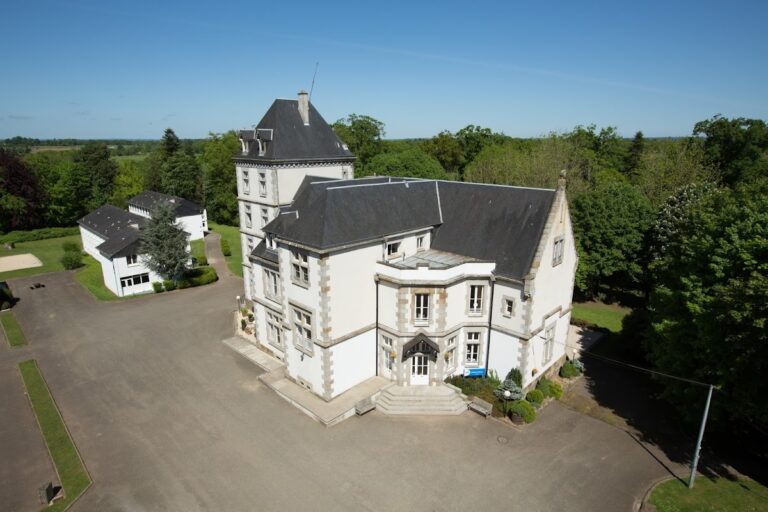
Château du Frêne is a sixteenth-century château in France, at Champéon in Mayenne, approximately 2,500 metres southwest of the village. The present building was constructed in 1589, then rebuilt during the seventeenth century and altered and decorated in the eighteenth. Its surviving chapel, interiors, and unusual dovecote reflect the long development of an estate whose medieval origins reach back several centuries.
Medieval fief and lordship
The estate was a fief held from Lassay and Mayenne. A fief was a feudal holding dependent on a superior lord and subject to obligations in return. In 1469, Louis-Charles de Beauregard declared that he held the fiefs, men, and subjects of Champéon, Poulay, and Montreuil, also called Landepoutre, from the lord of Lassay. These holdings may have been separate fiefs rather than parts of one seigneury.
The place appears in medieval records under forms including Fraxino and Fresne, in 1245, 1254, and 1312. Georges, or Gorgon, of Fresne was named in 1245, Hamelin of Fresne in 1254, and Bourgouin of Fresne in 1312, when he leased the fief of Garenne in Champéon. The lordship later passed through Jean du Fresne and the d’Anthenaise family. Pierre I d’Anthenaise married Marie du Frêne in 1416, followed by Jean III d’Anthenaise, who married in 1440, Aimery III, recorded from 1480, Jacques, recorded in the early sixteenth century, and Jean IV, who was buried in 1564.
The d’Anthenaise and Beauregard families
Honorat-Benjamin de Beauregard, son of René de Beauregard and Jacqueline du Bouchet, married Madeleine d’Anthenaise. The Beauregards subsequently held Frêne. François de Beauregard, husband of Renée de la Dufferie, was associated with the estate, and their children were born there between 1622 and 1634.
René de Beauregard lived at Frêne in 1724. His daughters from an earlier marriage became Calvairian nuns at Mayenne. The Calvairians were a Catholic religious community devoted to a contemplative tradition associated with Calvary. René died on 14 November 1732, and Louis-Charles de Beauregard became his direct heir. Charles-François de Beauregard died at Frêne on 11 February 1777. The property then passed to his brother René-Charles-Magloire and their sister Marie-Françoise, who accepted a life annuity in 1779. René-Charles-Magloire died on 1 January 1784, after which the estate was divided among several heirs, including members of the de la Grandière, Jacquelot, Pouyvet de la Blinière, Billard de Lorière, de Moré, and Le Clerc de la Ferrière families.
Revolutionary upheaval and later ownership
René Pouyvet de la Belinière, a cavalry captain married to Madeleine-Marie de Moré, belonged to the family that inherited the Beauregard property. Their son René-Nicolas-François Pouyvet, an officer in the Cambrésis Regiment, was killed at Versailles during the September Days of 1792. Another son, Charles-Henri-Marie, served in the Royal-Cravate Regiment, emigrated, and died at Frêne in 1813.
The château and Métairie-Neuve were acquired as national property in 1792 by François Ricou for 24,252 livres. The estate later passed to M. Launay of Ernée, the husband of Marie-Renée Pouyvet, and then to René-Gabriel-Romain Bouchard de la Poterie, who was born at Château-Gontier in 1790 and became a commander of a marine-artillery battalion. The heirs of Mlle de Jourdan sold the property to M. Poirier of Mayenne in 1890.
The French Revolution also brought religious and military activity to the estate. Michel Cibois, formerly a vicar at Le Horps and Champfleur, withdrew to Château du Frêne in 1798 and was usually escorted by Gillot of the village of Churin. René Morice, a Chouan known as Monte-à-l’assaut, lived at Petit-Frêne on 2 September 1799.
Chapel foundation and protection
The chapel’s endowment for three masses was established through the testamentary acts of Henriette and Marie-Catherine de Beauregard on 19 and 20 July 1680. The sisters made religious vows with the Calvairians at Mayenne, but legal proceedings delayed the foundation until 1688, when it was secured on the Chouanne farm.
The chapel and dependencies were listed as historic monuments on 17 April 1986. The two decorated ground-floor rooms and the dovecote were classified as historic monuments on 8 September 2008. These protections recognize several parts of the estate while preserving the relationship between its residential, religious, and agricultural elements.
Remains
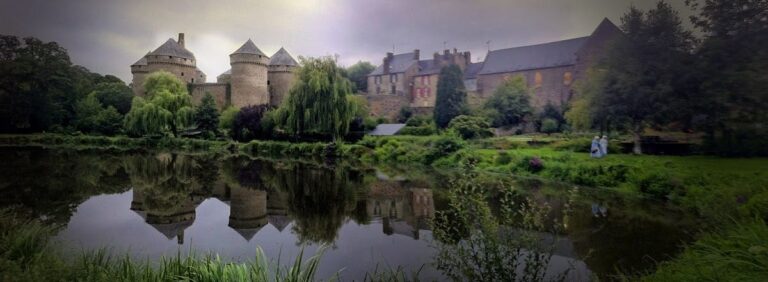
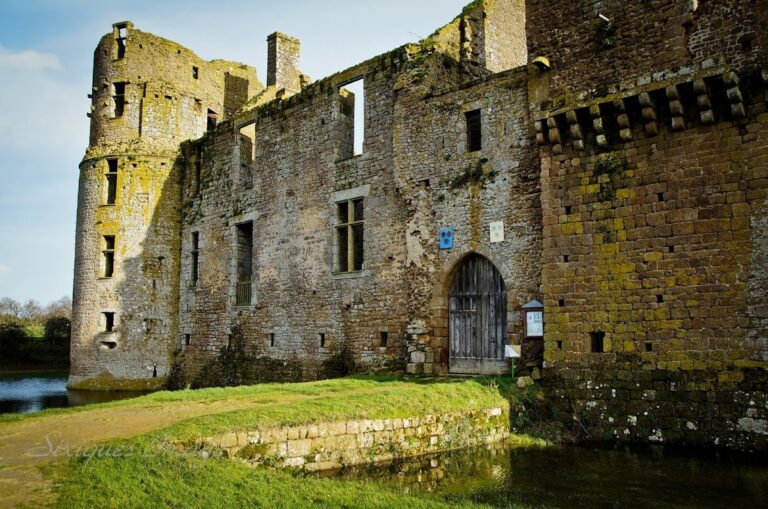
Château du Frêne stands on a granite platform enclosed by a moat, with an artificial pond and gardens associated with the water system. The château, chapel, and dependencies form the principal surviving elements of the estate, while the moat establishes a defined setting around the platform.
Moat and island dovecote
Dovecote
A dovecote stands on an island in the middle of the moat. Built to house pigeons, it is raised on eight columns and is described as a rare surviving example of this type of structure. Its position within the water enclosure makes it a distinct element of the château’s wider estate layout.
Château interiors
Decorated hall
The château contains a large hall decorated with wood panelling and paintings. The surviving decoration belongs to the interior development of the building, which was rebuilt in the seventeenth century and altered during the eighteenth.
Judgment of Solomon room
Another wood-panelled room contains a painting of the Judgment of Solomon on the chimney overmantel, the central area above the fireplace. The painting forms part of the room’s architectural decoration and remains associated with the château’s preserved interiors.
Chapel
Chapel structure
The chapel has a tall gable, a pointed-arch doorway, and a fourteenth-century stepped window. It is built in courses of dressed stone. The bell remains in place and bears the names of François de Beauregard and Renée de la Dufferie.
Historic landscape evidence
Historical descriptions associate the site with a chapel and an inn on the road to Lassay. A village is also marked at the location on the Cassini map, adding evidence for the estate’s place within the surrounding settlement landscape.