Château de Gavaudun: A Medieval Defensive Castle in France


Site at a Glance
- Rating
- 4.4
- Popularity
- Low
- Country
- France
- Primary era
- Medieval
- Eras represented
- Medieval
- Civilizations
- French
- Site type
- Military
- Remains
- Castle
On this page11 sections
History
Château de Gavaudun is a medieval defensive castle in France, built between the twelfth and thirteenth centuries above the village of Gavaudun. Constructed on the principal route between Périgord and Agenais, it controlled an important passage toward the Lot valley. Its keep dates from the thirteenth century, placing the surviving principal tower within the period when the castle served as a fortified residence and strategic stronghold.
Origins and royal administration
The castle existed by the mid-twelfth century. Jean d’Assida, bishop of Périgueux, besieged, captured, and demolished it during an effort to expel brigands or heretics from the area. The stronghold was later rebuilt. In 1271, it was mentioned during the French king’s assumption of power over the lands of the count of Toulouse. Members of a Gavaudun family were associated with the site in 1279 and 1293.
Gavaudun during the Hundred Years’ War
During the Hundred Years’ War, the prolonged conflicts between the English and French monarchies from 1337 to 1453, Gavaudun held strategic importance in the struggle for southwestern France. Amstang de Baleinx was identified as lord of Gavaudun in 1324 and also as lord of Cahuzac in 1341.
By 1398, Bernard de Durfort held Gavaudun and Laroque-Timbaut. A power of attorney from 1401 records that Gavaudun supported the French king while English forces surrounded it. Aymeri de Durfort had inherited the possessions of several families, and his second son Bertrand received the lordships of Gavaudun and Laroque-Timbaut.
The Lustrac inheritance
The lordship passed to the Lustrac family around the beginning of the fifteenth century. Arnaud de Lustrac, known as Naudonnet, was lord of Gavaudun in 1430. A Gascon captain who fought the English, he often stayed at Gavaudun and gathered troops there. After his death, his brother François rendered homage for the lordship in 1470, followed by Naudonnet’s son Antoine de Lustrac.
Bertrand de Lustrac inherited the castle after Antoine but died without children in 1524. The property then passed to Antoine II de Lustrac, who was married to Françoise de Pompadour. In 1544, Antoine arranged the marriage of his only daughter, Marguerite de Lustrac, to Jacques d’Albon de Saint-André. Marguerite probably inherited the property soon after her father’s death, shortly after 1557.
Religion and aristocratic succession
After her first husband died in 1562, Marguerite married Geoffroy de Caumont at Gavaudun in 1568. Geoffroy was assassinated in 1574. Marguerite, who was then seven months pregnant, gave birth to their daughter Anne de Caumont on 10 June 1574, probably at Gavaudun.
At the beginning of the Wars of Religion, the sixteenth-century conflicts between Catholics and Protestants in France, the village of Gavaudun became Protestant. The castle was connected with the military actions of Geoffroy de Vivans. In 1580, Henry of Navarre placed it at Marguerite de Lustrac’s disposal for her protection. Vivans also recovered there after he was wounded at the Battle of Coutras.
Anne de Caumont married François d’Orléans, Count of Saint-Pol, in 1595. Marguerite died that year at Château des Milandes. In her will, she named the Duke of La Force, Geoffroy de Caumont’s nephew, as her universal heir and disinherited Anne. Nevertheless, Anne was described as the female holder of Gavaudun after her marriage. Her only son was killed near Montpellier in 1622, and her husband died in 1631. To pay their debts, she sold part of her lands, but continued to render homage for the baronies of Caumont and Gavaudun until her death on 17 June 1642. She left her estate to her nephew Henri d’Orléans, Duke of Longueville. A bequest to the Auray family was apparently exchanged for the lordship of Gavaudun.
The Auray and Belsunce families
Jean Baptiste d’Auray de Brie became lord of Gavaudun and unsuccessfully tried to exchange it for the viscounty of Châteauneuf in the Haut-Limousin in 1644. His son René was styled Marquis of Gavaudun in a marriage contract of 1669. The estate later passed to Jacques-Armand d’Auray, who inherited it from his grandmother Françoise de Souillac.
The Auray de Brie family was heavily indebted, and Parliament ordered the sale of the lordship. Armand I de Belsunce bought it on 30 July 1686 for 64,000 livres. The sale became definitive after another parliamentary judgment in 1690. Armand probably never lived at Gavaudun, keeping his residence at Château de Born instead. After his death in 1728, the inheritance passed through his family to Charles-Gabriel de Belsunce, then to Antonin-Armand de Belsunce and his infant son Louis-Antonin. Louis-Antonin was still styled Baron of Gavaudun in 1779.
Revolutionary destruction and protection
Louis-Antonin emigrated to London during the French Revolution and died there in 1796. The land and lordship had probably been sold to the Fumel family shortly before the Revolution. When Philibert de Fumel-Monségur emigrated in 1792, his property was seized.
The castle and its furnishings were sold in separate lots over two years and changed hands several times between 1795 and 1796. Much of the castle was destroyed in 1796. The commune of Gavaudun bought the remains toward the end of that year. The tower was classified as a protected historic monument in 1862. The rest of the castle, apart from the already protected tower, received the same status by decree on 30 December 1987.
Remains
Rocky setting and castle layout
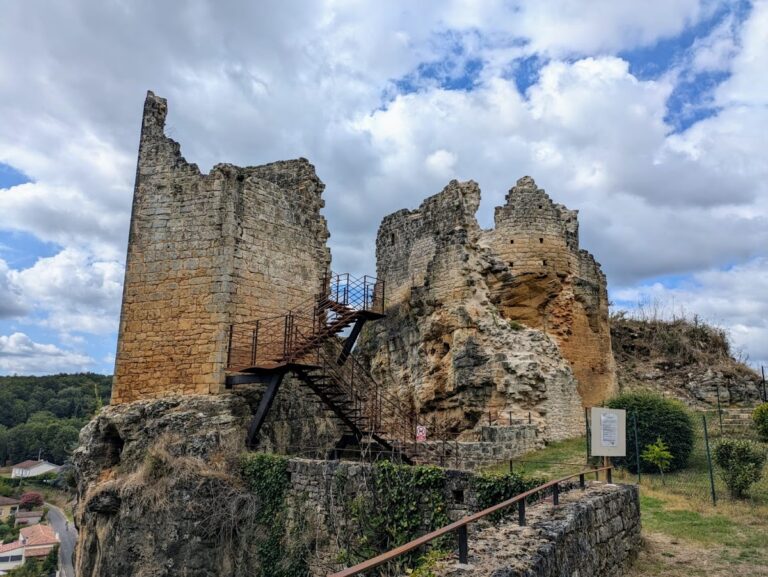
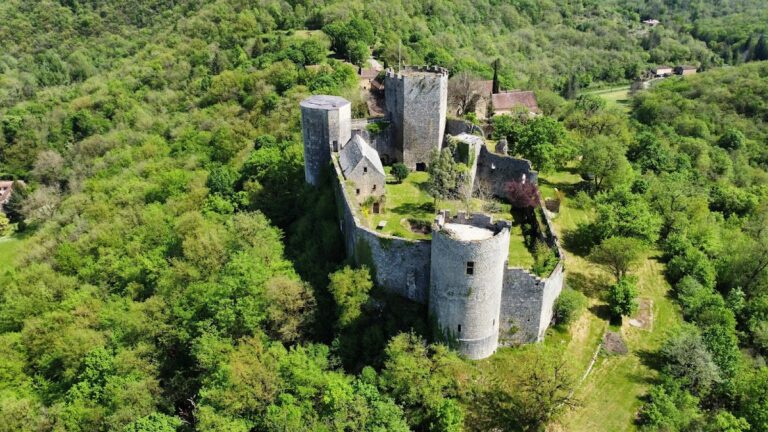
The ruined castle occupies the summit of a long limestone rock above the deeply cut valley of the Lède, about 40 metres above the valley floor. The site overlooks a route descending from southern Périgord toward the Lot valley. Sheer drops surround the summit, while the rocky spur continues toward a reshaped isthmus on the opposite side.
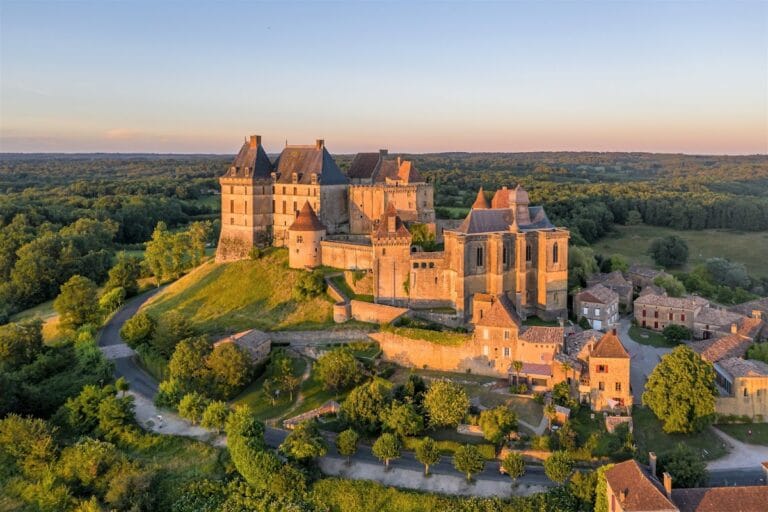
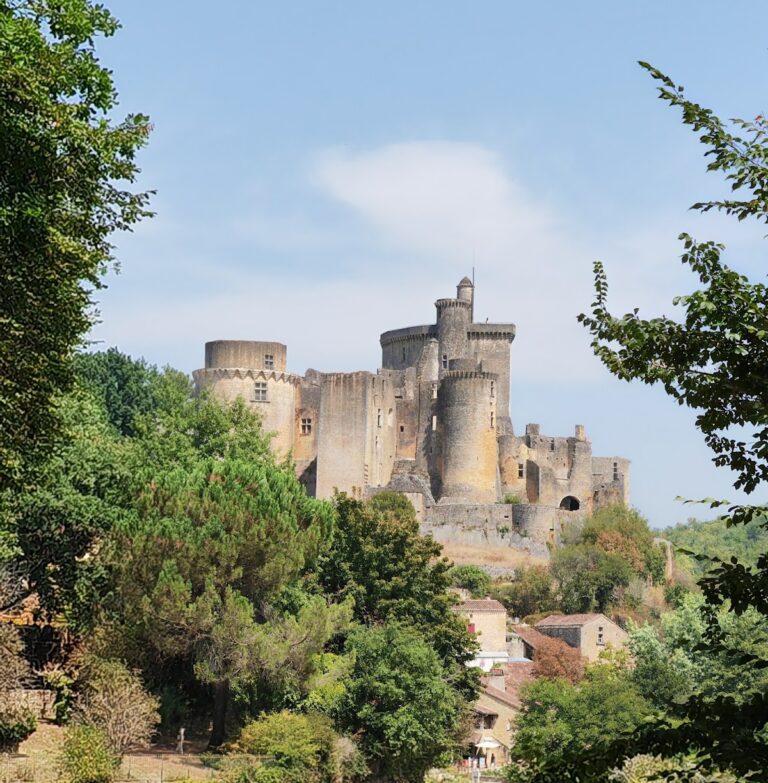
The summit forms a narrow terrace about 75 metres long and between 6 and 15 metres wide. The keep stands at its upper end, toward the head of the valley. Other castle buildings once extended behind it in a naturally protected position, but these structures have been razed. The village developed below the cliff along the Lède, and the castle lies near the Périgord Noir and the Château de Biron and Château de Bonaguil.
The keep
The keep, the principal fortified tower of a medieval castle, dates from the thirteenth century and was heightened in the fourteenth. It rises about 25 metres and contains five storeys. Its position at the upper end of the narrow rock terrace formed the dominant surviving element of the stronghold.
Access through the rock
Access to the summit was possible only by a ladder set within a vertical shaft cut into the rock. This approach connected the naturally defended summit with the castle’s restricted entrance system and formed part of the site’s surviving physical character.