Castle of Biron: A Medieval Fortress and Renaissance Residence in France

Site at a Glance
- Rating
- 4.5
- Popularity
- Medium
- Country
- France
- Primary era
- Medieval
- External website
- Open
- Eras represented
- Medieval, Early Modern
- Civilizations
- English, French
- Site type
- Military
- Remains
- Castle
On this page15 sections
History
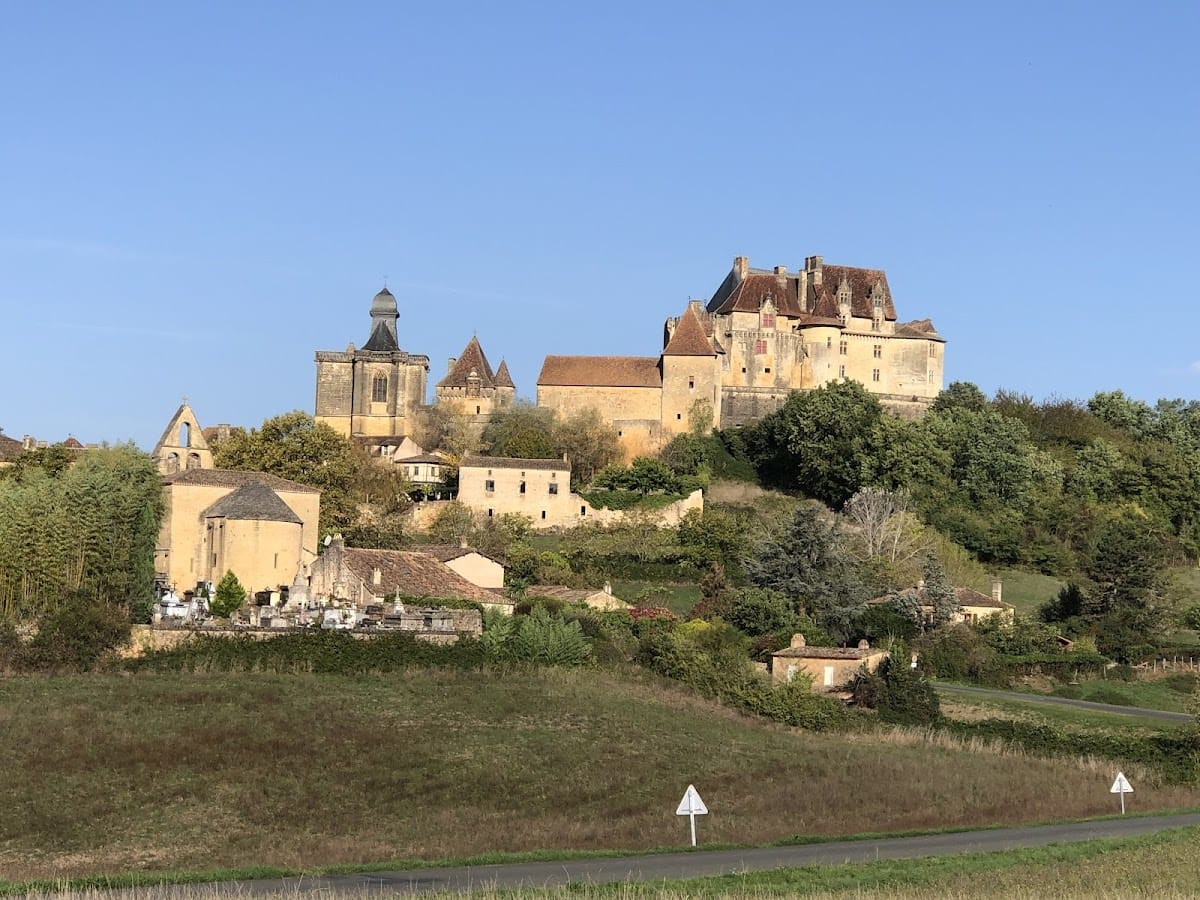
Castle of Biron is a historic fortress and residence in France, standing above the town of Biron in the Lede valley. Built and developed by local lords and later the Gontaut-Biron family, it became the seat of one of the four ancient baronies of the Périgord, alongside Beynac, Bourdeilles, and Mareuil. Archaeological evidence places activity at the site around the year 1000, between the late tenth and mid-eleventh centuries.
Early stronghold and Plantagenet rule
Lords of Biron appear in written records by the late eleventh century as vassals of the count of Toulouse. During the second half of the twelfth century, under Henry Plantagenet, Duke of Aquitaine and King of England, they erected a substantial tower. The Plantagenets were a royal dynasty whose rulers held the English crown and extensive territories in France, including Aquitaine.
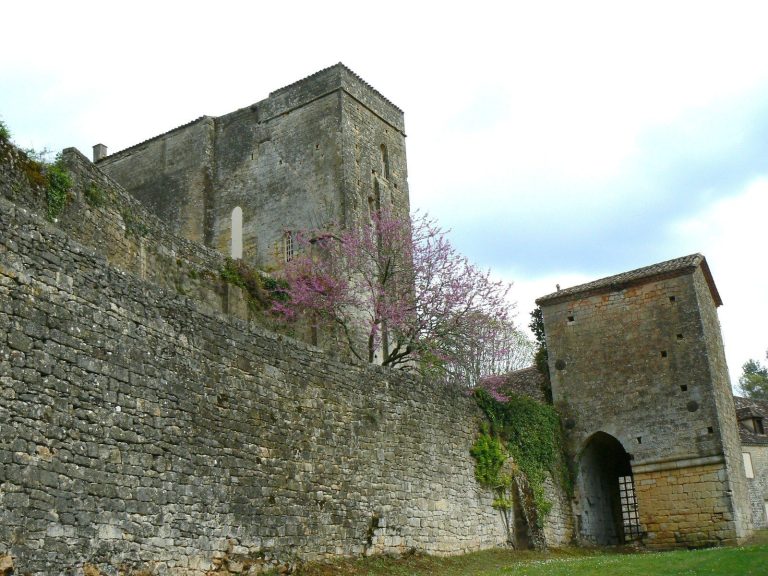
By the end of the twelfth century, the lords of Biron had abandoned the site for Montferrand-du-Périgord. There they transformed an existing residence into a castle, while the Gontaut-Biron family acquired Biron. Under Plantagenet and Gontaut patronage, the stronghold was extensively altered. Its lower court was enclosed by a curtain wall, an enclosing defensive wall, with projecting towers, and the settlement below was fortified.
The Albigensian conflict
During the Albigensian conflict, a thirteenth-century campaign against the Cathars, a Christian movement condemned as heretical by the Catholic Church, the castle was captured in 1211. It was given to Martin Algais, a Spanish captain and mercenary who had served the English king and then Simon de Montfort, the principal military leader of the crusading forces.
Algais later defected to the count of Toulouse. Simon de Montfort then seized Biron, had Algais hanged, and entrusted the stronghold to Arnaud de Montagu. A separate tradition places a group of Cathars at the castle in 1221 as they fled Simon de Montfort’s army. In 1222, King Henry III sold the castle to Henri de Gontaut, establishing the Gontaut family’s long possession of the site.
Gontaut-Biron power and transformation
The Gontaut-Biron family retained the castle from the thirteenth century until the late 1930s. English forces captured and plundered it during the fourteenth and fifteenth centuries. After recovering his fortune, Pons de Gontaut-Biron converted the medieval fortress into a more comfortable residence. He also built a two-level dynastic chapel for the tombs of himself and his brother Armand, and married Marguerite de Montferrand, a relative, in an effort to restore his family’s former standing.
Pons’s son, Jean de Gontaut Biron, was introduced at court and married into the Bonneval family, but later fell from favor with Francis I. Jean’s son Armand de Gontaut Biron, Marshal of France, supported the Valois and Catholicism in a region largely aligned with the Reformation. The Valois supplied the kings of France from 1328 to 1589. Armand was killed during the Wars of the League, conflicts connected with the French Wars of Religion and opposition to Henry IV, before he could complete the transformation of the castle. His son Charles was later disgraced and executed under Henry IV, leaving the work unfinished.
Charles Armand de Gontaut-Biron modernized the castle during the eighteenth century. His son, Charles Antoine de Gontaut Biron, the seventh Duke of Biron, died without heirs in 1798 and was the last descendant of the senior branch. During the French Revolution’s Reign of Terror, a period of intensified revolutionary repression, the castle was plundered.
Later ownership and preservation
In the early nineteenth century, the Saint-Blancard branch of the Gontaut family bought the castle. This branch had separated from the ducal branch in the early seventeenth century and retained Biron until 1938. The Copper-Royer family then acquired the complex and held it for about forty years.
In 1978, the severely deteriorated castle was sold to the Department of Dordogne, which undertook its restoration. In 1980, the Friends of the Castle of Biron and Béatrice Gonzalez de Andia, a relative of the Gontaut-Biron family, secured Ministry of Culture funding for urgent repairs. Restoration of the roof framework of the Marshals’ Wing began in 2012.
The castle has been partially protected as a French historic monument since 1928. The gardens, park, two western fountains, and several associated garden and ruin areas were added to the historic-monument register in 1992. In the twenty-first century, the castle has been used for exhibitions and performances. In 2024, it served as a setting for the television program Les Traîtres.
Remains
Fortified courts and medieval structures
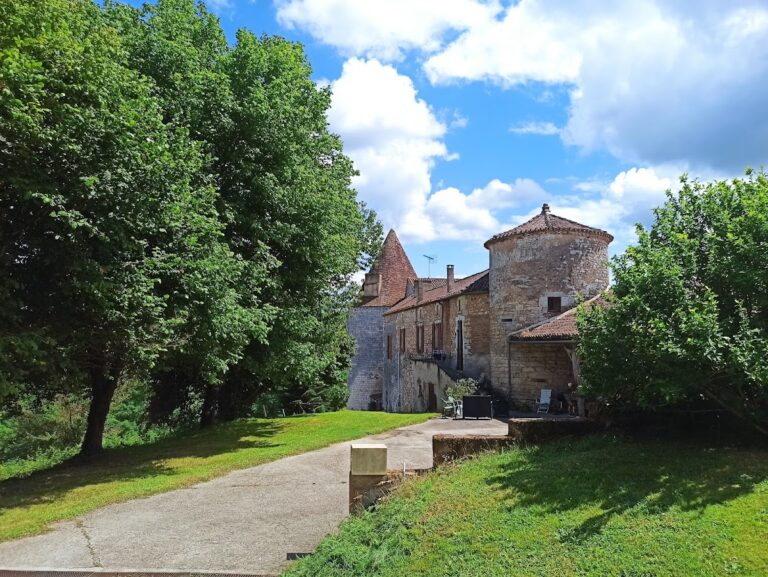
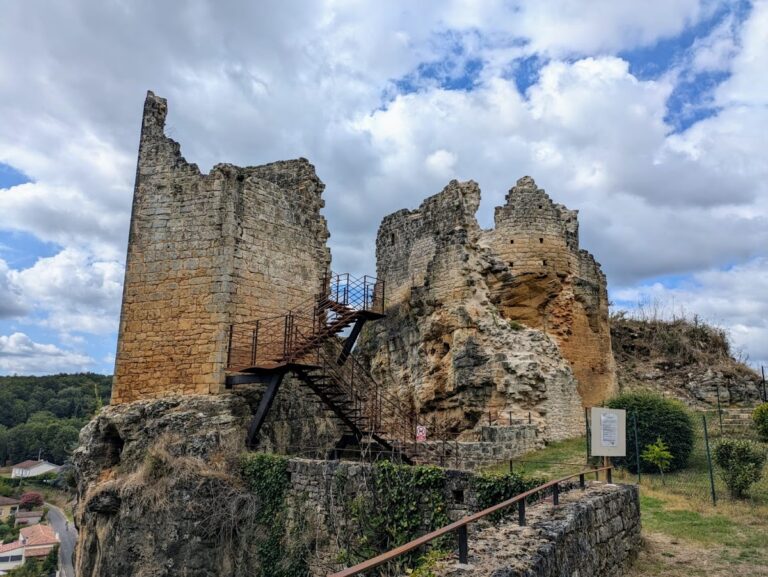
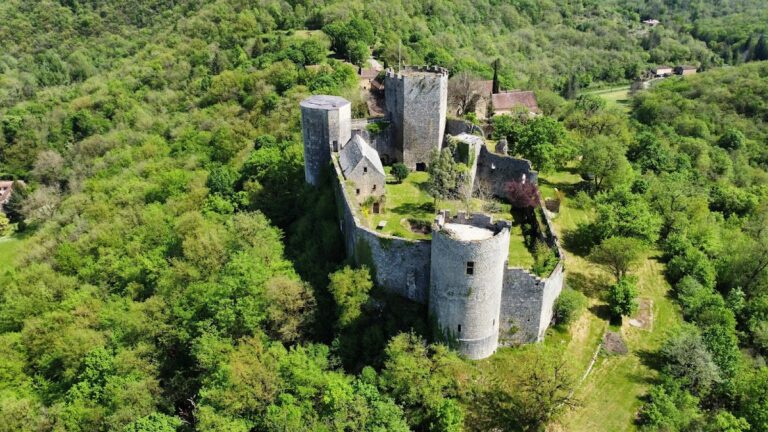
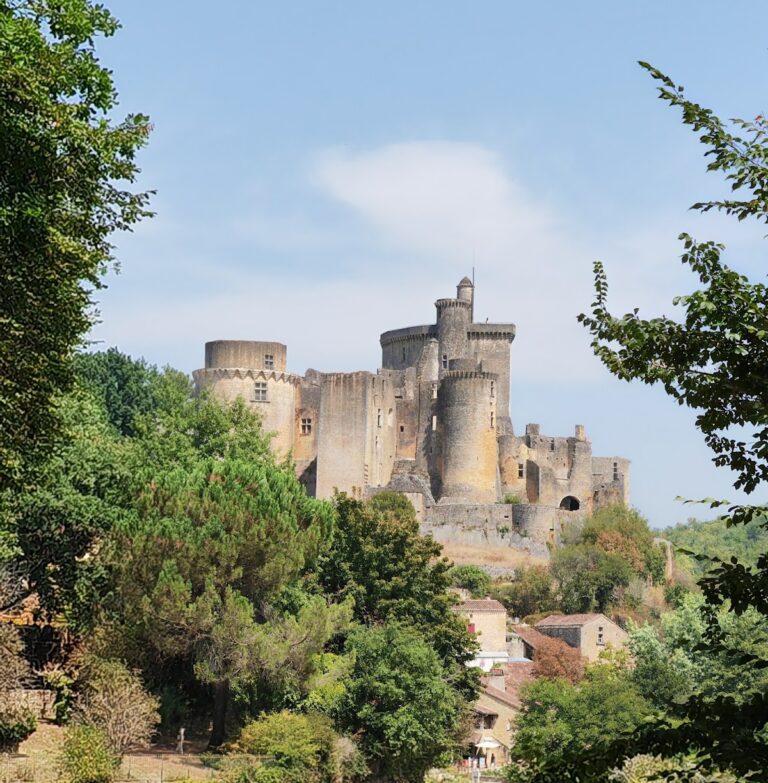
The castle occupies a natural rocky eminence above Biron. Its summit platform is isolated by a broad ditch and preceded by a lower court forming a glacis, a sloping defensive surface intended to expose attackers. A smaller ditch encloses the lower court. The visible buildings were constructed or altered between the twelfth and seventeenth centuries, while the wider complex contains changes extending from the twelfth through the eighteenth century. Together, the buildings combine a medieval fortress with Renaissance residential architecture.
Keep and high court
A twelfth-century keep, the principal fortified tower of a medieval castle, forms part of the complex. The high court is surrounded by noble residential buildings, preserving the spatial arrangement of the fortified summit and its later residential development.
Lower court and northern court
The lower court contains the two-level chapel and was enclosed by defensive works. A northern court opens through a large round-headed arch cut into a wall. The arch leads to a covered terrace with paired columns and an iron balustrade above a substantial flight of steps. The feature probably belonged to ornamental gardens, but it remained unfinished, possibly because of unstable ground.
Chapel and commemorative sculpture
Two-level chapel
Dated to 1515, the two-level castle chapel served both the household and the villagers whose houses clustered at the foot of the hill. Its upper level served the castle household, while its lower level served the village. The chapel contains the tombs of Pons de Gontaut, Baron of Biron, who died in 1524, and his brother Armand, Bishop of Sarlat, who died in 1531.
The heads of the tomb effigies were hammered off, possibly during the Wars of Religion or the French Revolution. The cause remains uncertain. The chapel formerly contained an Entombment of Christ and a Pietà with donors. Until the end of the nineteenth century, it also held a dead Christ on the Virgin’s knees, displayed as an altarpiece above the altar, and a Descent from the Cross. These works were sold and had been in New York’s Metropolitan Museum of Art since at least 1914. A full copy made with three-dimensional technology was planned for installation in the chapel.
Residential and administrative buildings
Renaissance apartments
The complex includes Renaissance apartments and two rooms above the northern arcade. These rooms retain eighteenth-century natural walnut paneling and parquet floors. A large stone staircase has an early eighteenth-century wrought-iron balustrade, reflecting the continued adaptation of the fortress as a residence.
Justice hall and kitchens
A justice hall occupies the western side of the castle. On the eastern side are substantial vaulted kitchens with cisterns, tanks used to collect or store water. The Hall of the States of Guyenne measures approximately 20 meters long and 11 meters wide.
Grounds and associated features
The protected grounds include the glacis and its retaining wall, the Cavaliers’ Walk, a lower terrace, a small kitchen garden, a small garden, and a large garden. They also contain a former fishpond, ruined buildings, the park, and two fountains west of the castle. These spaces form the wider landscape around the fortified courts and residential complex.