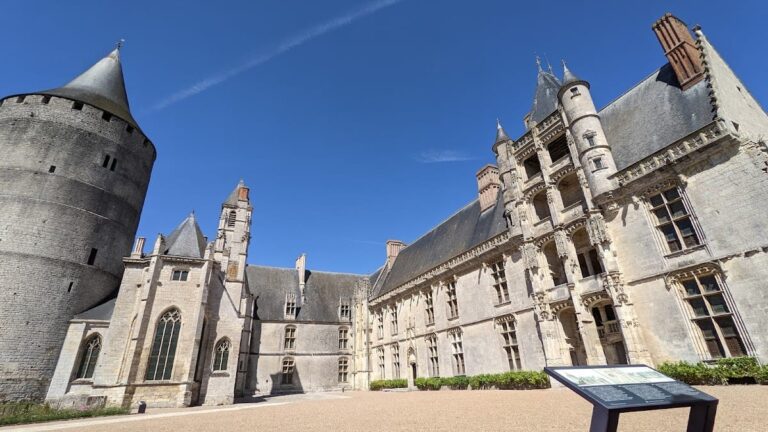
Château de Fréteval: A Medieval Frontier Fortress


Site at a Glance
- Rating
- 4.3
- Popularity
- Very Low
- Country
- France
- Primary era
- Medieval
- Eras represented
- Medieval
- Civilizations
- French
- Site type
- Military
- Remains
- Castle
On this page9 sections
History
Château de Fréteval is an eleventh-century medieval fortress in France, built during the first half of the eleventh century by Nivelon I, a seneschal, or senior administrative officer, of the Count of Blois. It rose on the remains of the Carolingian village of Saint Victor and became a frontier stronghold controlled by the Counts of Blois.
A Frontier Lordship
The castle stood within the struggle between the Counts of Blois, the Counts of Vendôme, and the Angevin interests associated with Anjou. The Angevins were the ruling house and political interests linked to western France, and the Plantagenet dynasty that ruled England from the twelfth to the fifteenth century developed from this Angevin background. Fréteval consequently became involved in the unstable relations between the Plantagenets and the French kingdom.
Thomas Becket, the English churchman who became Archbishop of Canterbury and clashed with Henry II over political and religious authority, met the king at Fréteval in 1170. In 1194, the Battle of Fréteval was fought between Richard the Lionheart, Henry II’s son and successor, and Philip Augustus, the Capetian king of France. Philip lost the royal seals of France during the battle.
Although the castle was the seat of the lordship, its administrative center remained at Meslay-le-Vidame near Chartres. Meslay-le-Vidame was the principal fief of the Meslay family, which held the lordship of Fréteval until the end of the thirteenth century.
Decline and Later Fortification
Château de Fréteval lost military importance during the thirteenth century and gradually declined. Its defenses were improved during the Hundred Years’ War, the prolonged series of conflicts between the English and French crowns from the fourteenth to the fifteenth century. English forces attacked the castle twice in 1418.
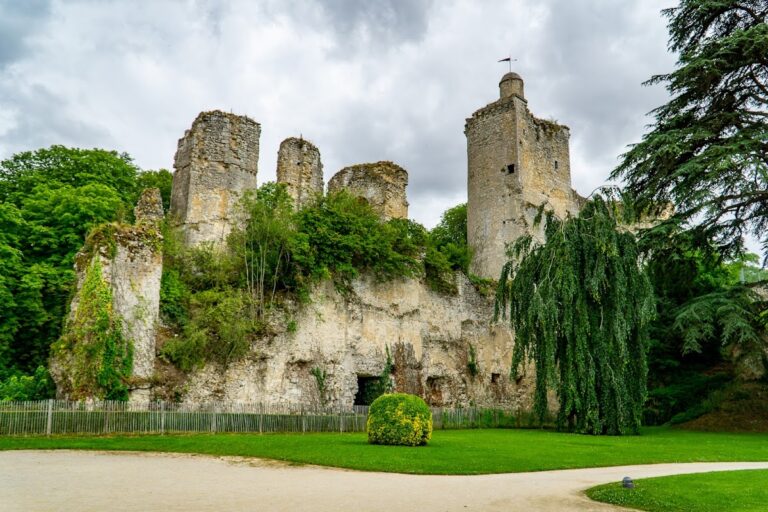
The attacks damaged the fortress, but it remained inhabited until 1487, the date indicated by the latest coins found there. Afterward, the buildings were used as a source of stone, contributing to the ruinous condition visible today. Archaeological excavations and preservation work have taken place since 1968. The remains of the keep were entered on France’s register of historic monuments by decree on 13 February 1926. The estate is currently owned by Armand Sosthène de La Rochefoucauld, 8th Duke of Doudeauville.
Remains
Site and Defensive Layout
The castle occupied approximately 4.50 hectares in the angle formed by the Loir valley and an adjoining valley, south of Fréteval. The ruins stand on the opposite side of the Loir from the town and overlook it from elevated ground. This position allowed the fortress to monitor traffic from Chartres toward Vendôme and Tours, together with the older cross-country route between Orléans and Le Mans.
The stronghold was arranged in three defensive lines. The keep stood within a surrounding wall called a chemise, an enclosure built around the principal fortified tower, and this inner defense was itself protected by a second enclosing wall. The second enclosure was defended by a deep, semicircular ditch.
The Keep and Inner Works
Circular Keep
Built around 1100, the keep is regarded as one of the oldest circular keeps in France. It belongs to the first generation of circular stone keeps and was constructed in flint. During the Hundred Years’ War, attackers undermined the tower, which was definitively ruined around 1425 to 1428.
Keep Interior
A bread oven was installed inside the keep toward the end of the fourteenth century. It remained in use until approximately 1425 to 1428, while grain was apparently stored on one of the keep’s floors. These features preserve evidence of the castle’s domestic and practical use during its final fortified period.
Settlement and Wall Sculpture
An early settlement was attached to the slope below the castle before being replaced by the settlement on the banks of the Loir. A bas-relief known as the Lady with the Serpent remains visible on the fortress walls, adding a distinctive sculpted feature to the surviving masonry.
Nearby sites