Château de Château-Renault: A Medieval Fortified Castle in France


Site at a Glance
- Rating
- 4.4
- Popularity
- Very Low
- Country
- France
- Primary era
- Medieval
- External website
- Open
- Eras represented
- Medieval, Early Modern
- Civilizations
- French
- Site type
- Military
- Remains
- Castle
On this page9 sections
History
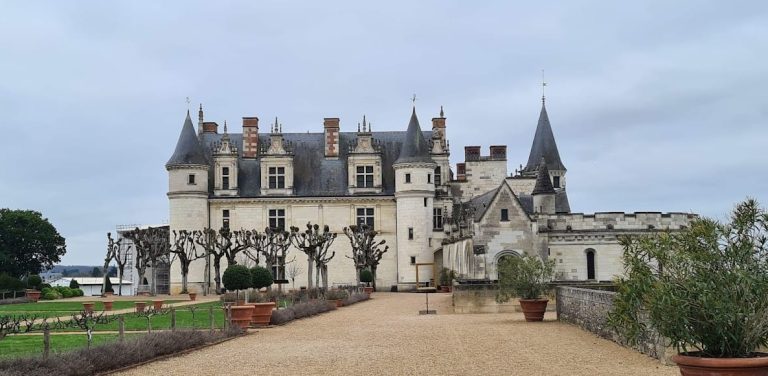
Château de Château-Renault is a former fortified castle in France, founded at the beginning of the eleventh century above the edge of the Brenne valley. It overlooks the town that developed below, northeast of Tours, and reflects the political rivalries of the medieval lords who controlled the region.
Early lords and rival factions
The castle was probably established by the Château-Gontier family, which supported the Angevin side. Renaud I of Château-Gontier was active in the decades after 1000 under Fulk Nerra, count of Anjou, an important ruler who helped consolidate Angevin power and fortified sites in the region. His sons Alard I and Renaud II were active in the 1060s. Renaud II was killed at Angers in 1067 during a popular uprising, while he was involved in a conspiracy against Count Geoffrey the Bearded in support of Fulk IV.
The later Château-Renault lineage appears to have descended from Guicher I, who was active from the 1040s and may have been connected to the Blois faction. His identity and relationship to the Château-Gontier family remain uncertain. He may have been a son of Renaud I, although it has also been proposed that Guicher I and Guicher II were the same person. Guicher II was restored after 1067 and died around 1102. He is described as the father of Renaud III of Château-Renault, active around 1100–1110, and Renaud IV, who died around 1140.
The Blois and Orléans inheritance
Around 1140, Count Thibaut IV of Blois erected a cylindrical keep on the castle mound after an earlier castle had burned. The site then entered the family of the counts of Blois through Renaud IV’s heiress, Sibylle, who married Thibaut V, count of Blois, Chartres, and Dunois. Sibylle died without children, but the counts of Blois descended from Thibaut V’s second marriage to Alix of France retained Château-Renault until Louis, Duke of Orléans, acquired the county of Blois in 1397.
Château-Renault subsequently passed to Louis’s son, Charles, Duke of Orléans, who was also a major French poet. In 1449, Charles entrusted the castle to his half-brother Jean, known as Dunois, a prominent military leader of the Orléans family. Dunois’s descendants founded the Orléans-Longueville line. The lordship became a barony, a hereditary rank of the French nobility, in 1525.
Gondi, Rousselet, and later ownership
In 1588, Charles de Gondi, general of the galleys and younger son of Albert de Gondi, first Duke of Retz and marshal of France, married Antoinette d’Orléans-Longueville, lady of Château-Renault. Through this marriage, the estate entered the Gondi family. A family arrangement transferred it to the Rousselets in 1618. Albert Rousselet became the first marquis of Château-Renault in 1620, and his son François Rousselet held the title until his death in 1677. The estate then passed through François’s descendants, including the marquises François-Albert and another son who died in 1704, before reaching his younger brother, Marshal François-Louis Rousselet, marquis from 1704 and father of Emmanuel Rousselet.
Emmanuel Rousselet’s daughter, Marie-Anne-Sophie Rousselet, brought Château-Renault to her husband, Admiral-Count Jean-Baptiste-Charles-Henri d’Estaing, whom she married in 1746. The marriage produced no children. After the French Revolution, the estate remained with the natural Rousselet line descended from the legitimized illegitimate son Dreux-René Rousselet. Sophie-Gabrielle Dreux de Rousselet married François-Marie-Louis Barrairon in 1794. In 1822, the estate passed to Barrairon’s niece, Marie-Rose Delcamp, and her husband Jean Calmon, a deputy and councillor of state. The Calmon family retained the domain into the twentieth century. A later owner was Marc-Antoine Calmon, a parliamentarian who lived from 1832 to 1890.
Protection of the historic site
Protection under the French monuments historiques system developed through designations issued in 1942, 1949, and 2024. The 1949 protection covered the castle and its dependencies, together with a seventeenth-century gate that had been dismantled and reassembled in the western annex. The later protection extended to the enclosing walls and earthworks, the ruins of the northern residential wing, the terrace, the keep’s surrounding wall, the motte, the ground within the enclosure, and the fixed bridge. An earlier protection was superseded by a partial classification issued on 10 March 2026.
Remains
Position and defensive enclosure
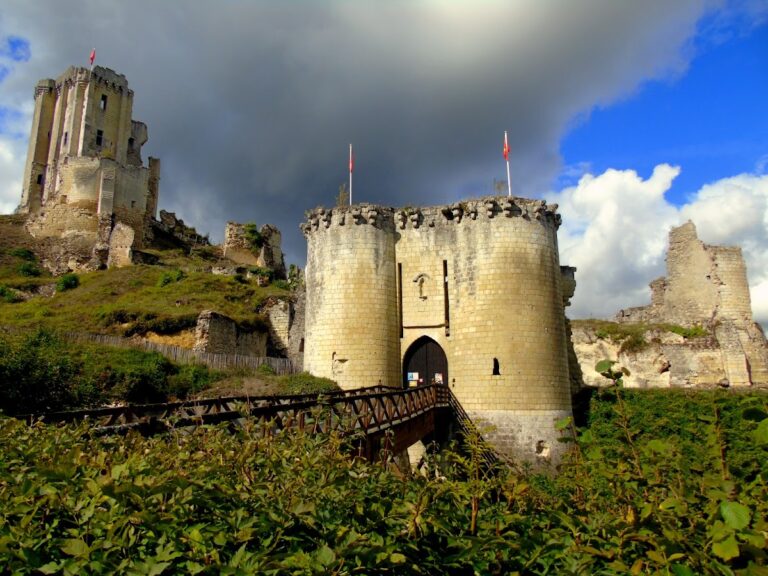
The castle occupies elevated ground above the town and the edge of the Brenne valley. A ditch protected three sides of the site, while the southern long side followed a cliff. Access was from the east. The masonry enceinte, or enclosing defensive perimeter, measured approximately 170 metres by 90 metres. Its surviving protected elements include retaining walls and ramparts, as well as the adjoining eastern and northern ditch. The ditch has an escarp, the inner slope, and a counterscarp, the outer slope.
Keep and motte
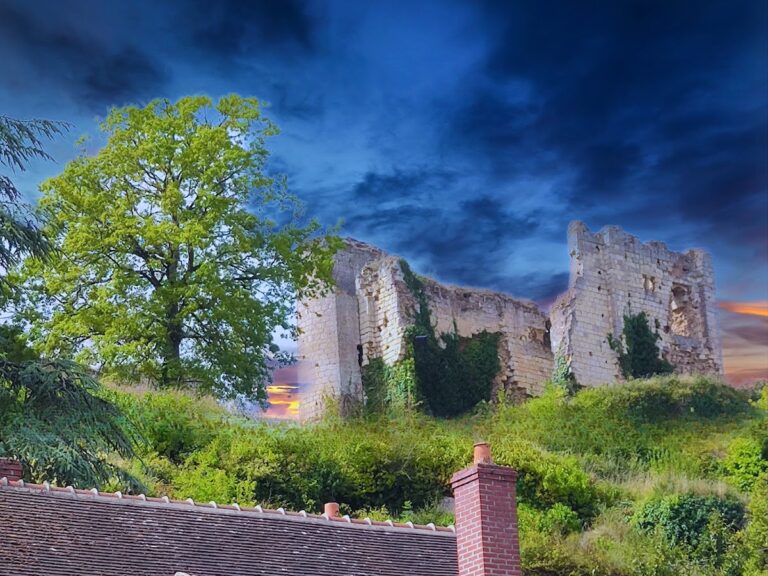
The medieval keep is a cylindrical tower erected around 1140 on the castral motte, a raised earthen mound built to carry a fortified structure. It is associated with a chemise, or close defensive wall surrounding the keep, and with the mound itself. The keep’s construction followed the burning of an earlier castle and formed the central fortified element within the larger masonry enclosure.
Residential buildings and later gate
The site includes a terrace and the ruins of the northern wing of the residential building, or logis. This wing incorporates the former chapel. In the western annex stands a seventeenth-century gate that was dismantled and reassembled there. The protected ground also includes the area within the enceinte and a fixed bridge leading to the castle.
Nearby sites