Château de Baudry: A Historic Estate and Residence in France


Site at a Glance
- Rating
- 4
- Popularity
- Very Low
- Country
- France
- Primary era
- Early Modern
- External website
- Open
- Eras represented
- Medieval, Early Modern, Modern
- Civilizations
- French
- Site type
- Domestic
- Remains
- Castle
On this page13 sections
History
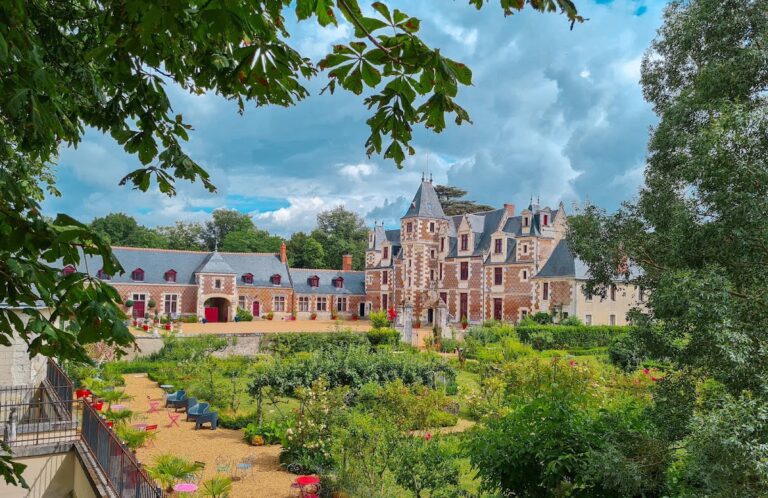
Château de Baudry is a historic château and private residence in Cerelles, France. Its visible lower structures incorporate a thirteenth-century fortified house, while the present complex grew through Renaissance rebuilding and successive enlargements. The wooded estate extends across Cerelles, Chanceaux-sur-Choisille, and Nouzilly, and its gardens were praised in the nineteenth century as “the Versailles of northern Touraine.”
Medieval and Renaissance origins
The earliest surviving part of Baudry belongs to a fortified house of the thirteenth century. At that time, the fief belonged to Saint-Julien Abbey and was dependent on the châtellenie of Châtenay, a territorial jurisdiction centered on a castle or lordship. Guillaume Juton is the first known owner.
The residential building was probably rebuilt and enlarged during the Renaissance, a European cultural and architectural period that revived classical forms and proportions. The work is associated with Guillaume Bohier, mayor of Tours, or with his son Claude Bohier. In 1585, César Forget received royal authorization to surround his house at Baudry with ditches, turrets, and a drawbridge. Forget served as Treasurer General of France in the administrative district of Tours and became mayor of Tours from 1592 to 1594. He also hosted Henri IV, king of France from 1589 to 1610, at the château.
The Taschereau family, 1633 to 1824
After César Forget, the property passed to Charles Forget, an écuyer, or member of the lesser nobility, and lord of Baudry. It then went to Jean Forget, treasurer of the Church of Tours, and his co-heirs. Bankruptcy and the cost of maintaining the estate led to a judicial sale in 1633. Jean Taschereau, a Tours bourgeois, alderman, and wholesale cloth and silk merchant, purchased the lordship.
Six generations of the Taschereau family held Baudry from 1633 to 1824. The first four generations reshaped the residence while retaining part of the Renaissance building. Jean Taschereau began this process, followed by his son Gabriel Taschereau des Linières and de Baudry, his grandson Jean Taschereau II, born in 1645, and Jean’s son Gabriel Taschereau de Baudry, who lived from 1673 to 1755. Their work restructured, enlarged, and embellished the château.
Jean Taschereau II is traditionally credited with creating the formal French park around 1685. This type of garden uses geometric symmetry, straight axes, patterned beds, canals, basins, and controlled views. In 1754, Gabriel Taschereau de Baudry’s wife, Philippine Taboureau, commissioned the restoration of the estate’s water network and further improvements to the park.
In 1777, their daughter Marie-Angélique, wife of Charles-Nicolas de Malon de Bercy, added the La Bédouère estate to Baudry. Their granddaughter Alexandrine de Malon de Bercy, wife of Aymard-François, Comte de Nicolaï, inherited both properties. After her death around 1824, the Cerelles properties were sold as an estate covering 1,126 hectares.
The Masséna and Reille ownership
François Victor Masséna, son of the Napoleonic marshal André Masséna, bought part of the property in 1825. La Bédouère was not included in that purchase. In 1828, Comte Honoré Charles Reille, a divisional general who lived from 1775 to 1860, acquired Baudry from his brother-in-law Masséna. The Reille family then held the estate for five generations.
Between 1850 and 1853, Honoré Charles Reille restored the château to plans by the Paris architect M. Pellechet. The unstable west wing was demolished, and the north and south façades were restored. His eldest son, General Comte André Reille, who lived from 1815 to 1887, installed new iron gates bearing the initials AR. He also partly redesigned the park by adding an English garden and a landscape garden.
André Reille’s nephew, Baron Polyeucte Victor Reille, who lived from 1851 to 1917, acquired the shares held by the other heirs and worked to recover the property’s former prestige. From 1896 to 1901, he collaborated with the landscape architect Édouard André. Between 1897 and 1900, the east wing was completely rebuilt, the north and south terraces were reconstructed, and many windows were changed into French doors. The resulting estate combined the earlier formal design with newer English and landscape gardens.
The estate in the modern period
In 1905, Victor Reille founded the Rallye Baudry, a popular gathering connected with hunting with hounds, a traditional form of hunting in which trained hounds track and pursue game. His son, Baron Karl-André Reille, later continued the association.
Château de Baudry remains a private residence. It is inhabited by Antoine Reille, Karl-André Reille’s youngest son and an ornithologist.
Remains
Château de Baudry occupies the Cerelles part of a wooded estate crossed by two arms of the Choisille. The wider property contains woodland, gardens, agricultural land, water features, and associated buildings distributed across three communes. Its surviving fabric brings together the lower remains of a medieval fortified house, Renaissance work, seventeenth-century enlargement, and nineteenth-century alterations.
Château and associated buildings
Fortified house and enclosure
The thirteenth-century fortified house survives visibly in the lower structural sections of the château. Later Renaissance rebuilding was incorporated into the enlarged complex rather than replacing every earlier element. The enclosure authorized in 1585 was to include ditches, turrets, and a drawbridge. Two small square towers on the north façade are probably attributable to César Forget.
Main body and wings
The enlarged château consists of a principal body with two wings set at right angles. Each wing is flanked by irregular pavilions. The long building of brick and dressed stone, dated 1640, belongs to the first Jean Taschereau and forms part of the seventeenth-century transformation of the residence.
Chapel and farm complex
The west wing contained a chapel described in the eighteenth century as richly furnished. Its fittings included a large altarpiece and a coffered vault, a ceiling divided into recessed panels, decorated with heraldic motifs and coats of arms.
Much of the extensive outbuildings and farm complex dates from the seventeenth century. A washhouse on the Choisille is described as the oldest in Touraine. The estate listed in 1828 included the château, a main courtyard, an estate manager’s house, a guard’s dwelling, terraces, vegetable gardens, ornamental beds, and ponds. It also contained farms at Baudry, La Sillonnière, and Moulin-Neuf in Chanceaux, the Vauléard mill farm in Nouzilly and Cerelles, houses at Linières, La Faute, and La Renauderie, and more than 350 hectares of coppice, mature forest, and young woodland.
Late nineteenth-century alterations
During the rebuilding of the east wing from 1897 to 1900, a cylindrical tower was added at the inward angle of the courtyard. The north and south terraces were remade, and many openings were converted into French doors. These changes formed part of Victor Reille’s effort, carried out with Édouard André, to bring the château and park into a unified ensemble.
Formal park and gardens
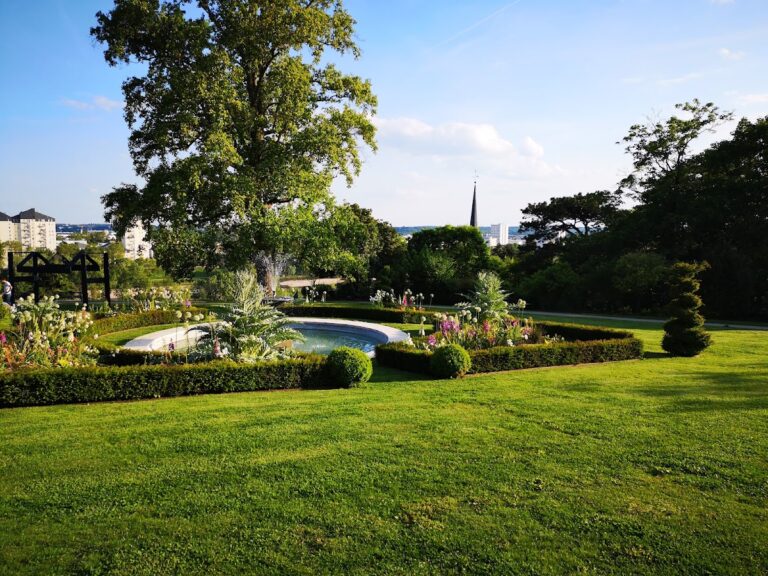
The park attributed to Jean Taschereau II was laid out with straight, right-angled canals, ornamental beds arranged in intricate embroidery-like patterns, kitchen-garden plots, basins, fountains, and a reflecting pool. Its water system was restored in 1754, when the park was also embellished. Later work combined the formal geometry with an English garden and a landscape garden.
Édouard André worked with Victor Reille from 1896 to 1901 to harmonize the residence and its grounds. The earlier formal structure therefore remained part of a park that also included more naturalistic designs. The wooded areas are dominated by oak, hornbeam, and chestnut, with beech stands and woodland edges containing wild cherry and service trees.
Plants and wildlife
The park contains introduced trees and shrubs including Lebanon cedar, Atlas cedar, ginkgo, Virginia tulip tree, American walnut, purple beech, rose of Sharon, sweetgum, Japanese yew, Callery pear, Myrobalan plum, and Andalusian fir. A Lebanon cedar reaches a recorded height of 38 metres. The herbaceous flora has not been systematically inventoried, but mountain speedwell, which is protected regionally, and long-leaved and small-leaved helleborines have been recorded.
The forest supports honey buzzard, goshawk, sparrowhawk, and possibly hobby, together with five woodpecker species: black, green, middle spotted, great spotted, and lesser spotted. Wryneck occurs in spring and hawfinch is also present. Grey-headed woodpecker was formerly present but appears to have disappeared for about a decade.
Open country around the estate supports certain breeding Montagu’s harriers and possibly breeding hen harriers, while marsh harriers occur occasionally and merlins appear in winter. Stone-curlew probably breeds there, and red-backed shrike, hoopoe, and corn bunting are also recorded. Golden plover occurs in winter, generally with lapwings. Yellowhammer and cirl bunting were formerly common but appear to have disappeared.
The Choisille and its wetlands support kingfisher, grey heron, occasional purple heron, occasional great crested grebe, and little grebe. Little grebe appears to have stopped breeding after coypu destroyed the reed beds, and water rail and aquatic warblers appear to have disappeared for the same reason. Little egret has appeared regularly in recent years, while great egret is observed particularly often. Ospreys pass during both migrations, and white and black storks have been seen very occasionally. Six white-tailed eagle observations, including two adults, were recorded during the winter of 2009 to 2010.
Roe deer and wild boar occur at high densities in the estate. Red deer have been present for roughly a decade, while foxes, badgers, martens, and numerous unrecorded bat species also occur. Beavers pass along the Choisille in some winters, adding to the range of mammals associated with the château’s woodland and waterways.
Nearby sites