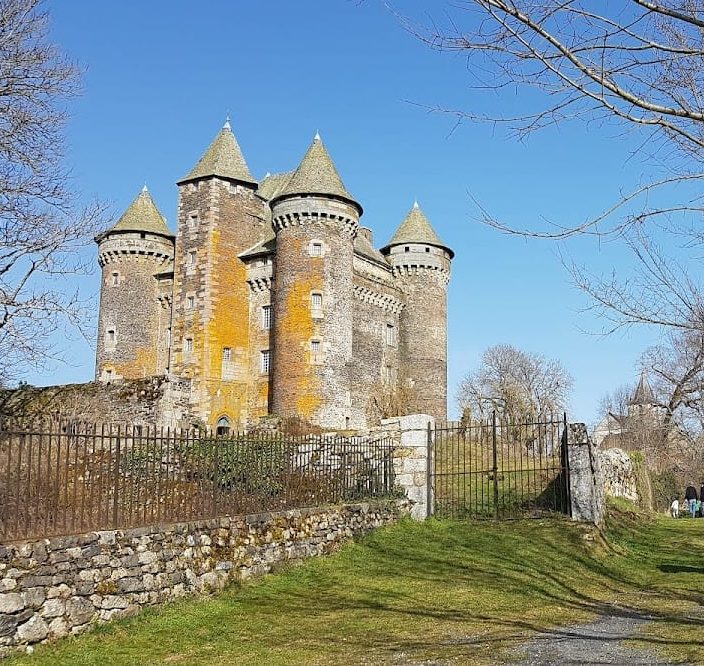
Château d’Entraygues: A Medieval Castle in France


Site at a Glance
- Rating
- 4.7
- Popularity
- Very Low
- Country
- France
- Primary era
- Medieval
- Eras represented
- Medieval, Early Modern
- Civilizations
- French
- Site type
- Military
- Remains
- Castle
On this page12 sections
History
Château d’Entraygues is a medieval castle in Entraygues-sur-Truyère, France, built as a thirteenth-century military fortress and seigneurial residence, meaning the seat of a feudal lord. It stands at the confluence of the Lot and Truyère rivers. During the Renaissance, its name was written as Antrague.
Foundation and Armagnac lordship
Henri II of Rodez, who held Entraygues as viscount of Carlat, began the castle in 1278. A viscount was a high-ranking territorial lord. Guillaume de Balzac was its initial owner, while the castle’s original role was that of a seigneurial residence and military stronghold.
Henri II’s daughter, Cécile of Rodez, brought Entraygues and the viscounty of Carlat to her husband, Bernard VI of Armagnac, Count of Armagnac and lord of Albret. Bernard VI strengthened the town with thirteen towers joined by ramparts, extending the defensive system around the settlement.
The castle and lordship changed hands during the fifteenth century. In 1463, Jean V of Armagnac, viscount of Rodez, sold Entraygues to his cousin Jacques of Armagnac, Duke of Nemours, under a redemption agreement valued at 12,763 écus. When the redemption was not completed, Entraygues and the viscounty of Carlat remained with Jacques. In 1469, Louis XI, king of France from 1461 to 1483, confiscated the duke’s lordship and other possessions.
Changing lords and religious conflict
The Yzarn de Freissinet family lived in the town and castle during the first half of the fourteenth century. In 1406, Bernard VII of Armagnac granted Guillaume de Solages, lord of Tholet, the title of lord of Entraygues for life.
Religious warfare brought severe disruption in the sixteenth century. In 1558, Calvinist bands, followers of the Protestant movement associated with John Calvin, seized Entraygues and pillaged the surrounding region. The castle was retaken and destroyed in 1587, and part of the structure was demolished in 1604.
Entraygues was later granted to Pierre Prunhaut, lord of Moissy and councillor of the Parlement of Paris. Raymond Viallard, captain of the castle of Laguiole, subsequently held it. His daughter, Paule Viallard, lady of Entraygues, married Henri de Montvallat, lieutenant of the Noailles company of gendarmes and seneschal of Rouergue. A seneschal was a senior administrative and judicial official serving a lord or territorial ruler. Henri was killed during the action at Millau in 1629.
Montvallat residence and later ownership
Henri de Montvallat rebuilt a new residential building in the seventeenth century. Several generations of the Montvallat family remained lords of Entraygues until 1789. The succession included Jean-Raymond de Montvallat, Henri de Montvallat of Montpezat, Gaston de Montvallat, and Nicolas-Hyacinthe de Montvallat. Having no heirs, Nicolas-Hyacinthe made a will in 1771 leaving Entraygues and Castrevielles to his cousin Joseph-Casimir de Montvallat.
During the French Revolution, Entraygues was confiscated and sold as national property. This term refers to property seized by revolutionary authorities and sold by the state, often after it had belonged to noble or ecclesiastical owners. The castle later became a private educational establishment. Jean-Louis Costes bought it in 2022 with the intention of converting it into a hotel.
Remains
Medieval defensive fabric
Thirteenth-century elements
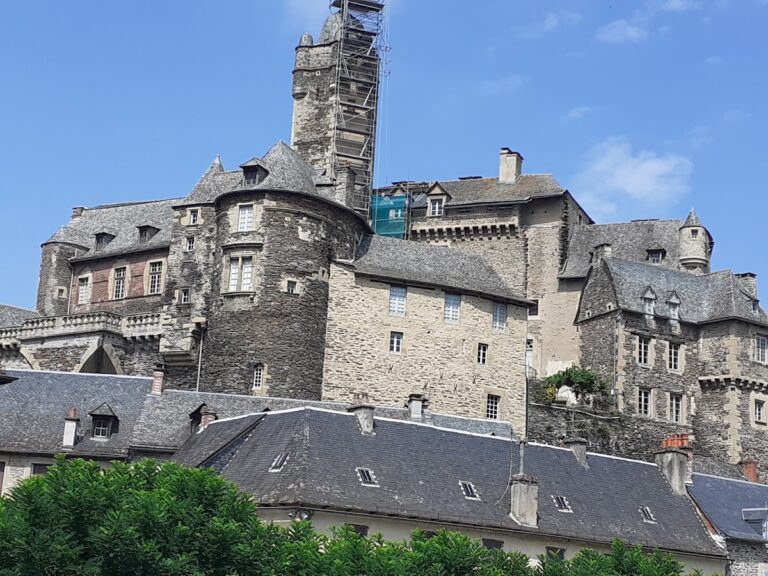
Construction continued from the thirteenth century through the seventeenth century. The surviving thirteenth-century fabric includes the stairwell, a vaulted room on the left side of the ground floor, and two square towers. These elements belong to the castle’s earliest building phases and form part of the physical remains of its medieval core.
Farnal Tower
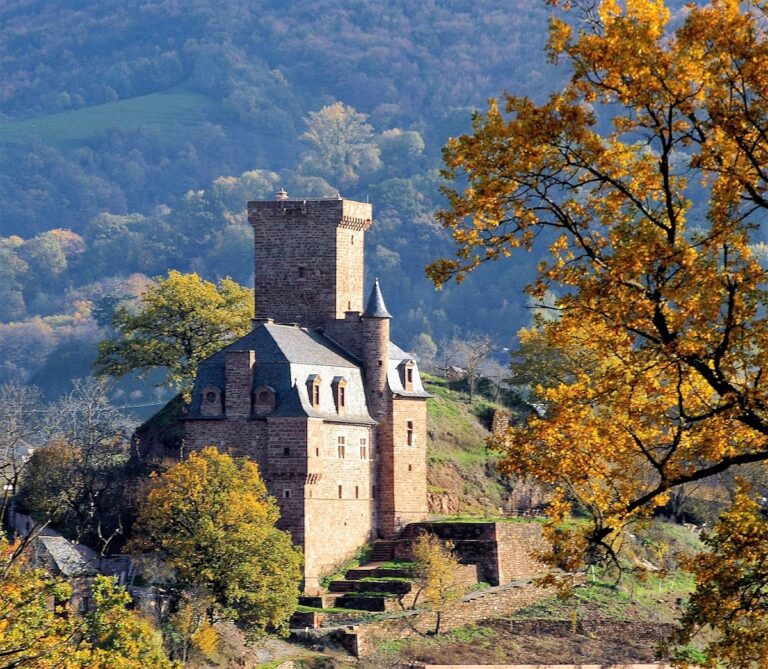
The Farnal Tower stands on the Lot side of the castle. It is one of the square towers associated with the medieval complex, and views are recorded from its upper part.
Panadèse Tower
The Panadèse Tower stands on the Truyère side. Dating from the thirteenth and fourteenth centuries, it represents a later stage within the castle’s medieval construction history.
Residential complex
Seventeenth-century building
A residential building constructed in the seventeenth century forms part of the surviving complex. It reflects the rebuilding associated with Henri de Montvallat after the castle’s destruction and partial demolition in the late sixteenth and early seventeenth centuries.
Courtyard and layout
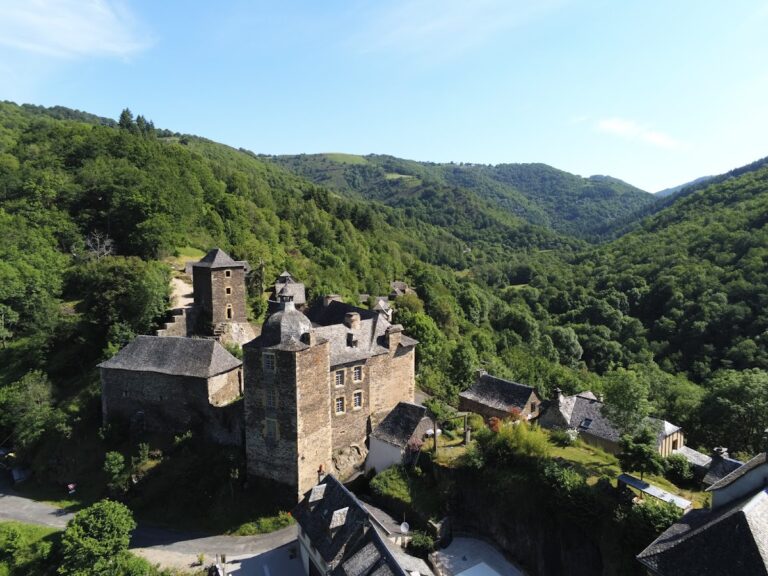
The castle includes an interior courtyard, around which the surviving defensive and residential elements are arranged. Views are also recorded from the northwest, providing a documented perspective on the complex at the meeting of the Lot and Truyère sides.
Nearby sites