Castle of Tenno: A Medieval Hilltop Fortress in Italy


Site at a Glance
- Rating
- 4
- Popularity
- Very Low
- Country
- Italy
- Primary era
- Medieval
- Eras represented
- Medieval
- Civilizations
- Holy Roman Empire
- Site type
- Military
- Remains
- Castle
On this page12 sections
History
Castle of Tenno is a medieval hilltop fortress in Tenno, Italy, built in the late twelfth century in a period of fortified settlement across the Trentino region. It stands above the town and was first recorded at the beginning of the thirteenth century, when it belonged to the Counts of Eppan and their Ulten branch, noble lineages associated with the Tyrol and Trentino.
From the Counts of Eppan to the Bishops of Trent
In 1210 and 1211, the Counts of Eppan transferred the castle to Friedrich von Wangen, Bishop of Trent, in exchange for other lands. The Bishops of Trent were prince-bishops who combined ecclesiastical authority with temporal rule over the territory centered on Trent. The Counts of Arco became the castle’s administrators in 1260 and introduced structural alterations. In 1284, control passed to Meinhard II, Count of Tyrol and a major territorial ruler in the eastern Alps, before the castle returned to the Bishop of Trent by 1314.
Scaliger, Visconti, and Venetian control
In the mid-fourteenth century, the Bishop of Trent sold the castle to Mastino II della Scala, lord of Verona and a member of the Scaliger dynasty. He granted it as a fief to the Counts of Arco, and the complex was enlarged during this phase. After the Scaligeri, Verona’s ruling dynasty, were expelled from the northern Lake Garda region in 1387, the castle passed between the Visconti of Milan, the Bishops of Trent, and the Venetians.
The fortress became involved in the conflict between the Visconti and Venice in 1439. On 9 November, Visconti forces commanded by Niccolò Piccinino were defeated in a battle outside the castle. Piccinino withdrew into the fortress and reportedly escaped Venetian troops led by Gattamelata, the military nickname of Erasmo da Narni, by hiding in a sack carried by a servant. Niccolò Machiavelli later included the episode in his Florentine Histories.
Late medieval defenses and later warfare
Castle of Tenno returned to the protection of the Bishops of Trent in 1460. A conspiracy organized by the Lodron family, a prominent noble house in Trentino, later attempted to seize it but failed. The leader was quartered and publicly displayed outside the settlement as a warning.
During the tenure of Bishop Johannes Hinderbach, the castle was restored and equipped with cannon. An inscription in the courtyard records this work. In 1487, during the Tyrolean–Venetian War, Tyrolean forces captured the Venetian fortress of Rovereto and the castle was besieged. Its defenders, led by the Counts of Arco, repelled repeated Venetian attempts to take it from the direction of Riva del Garda.
French forces under General Vendôme captured the castle in 1703 during the War of the Spanish Succession. The occupation left Castle of Tenno relatively undamaged compared with several other castles in the surrounding area, including Castel Penede at Nago and the castles of Arco and Drena.
Private ownership and modern changes
The Bishops of Trent retained the castle until the nineteenth century, when it passed into private ownership. Its square keep collapsed in 1920. In August 1997, Klaus Zumwinkel, a German business executive, acquired the property and remodeled it, including the installation of a swimming pool. Before the sale, it had belonged to two engineers from Belgium and Luxembourg, whose heirs later disposed of it. Castle of Tenno is recognized as Italian national heritage.
Remains
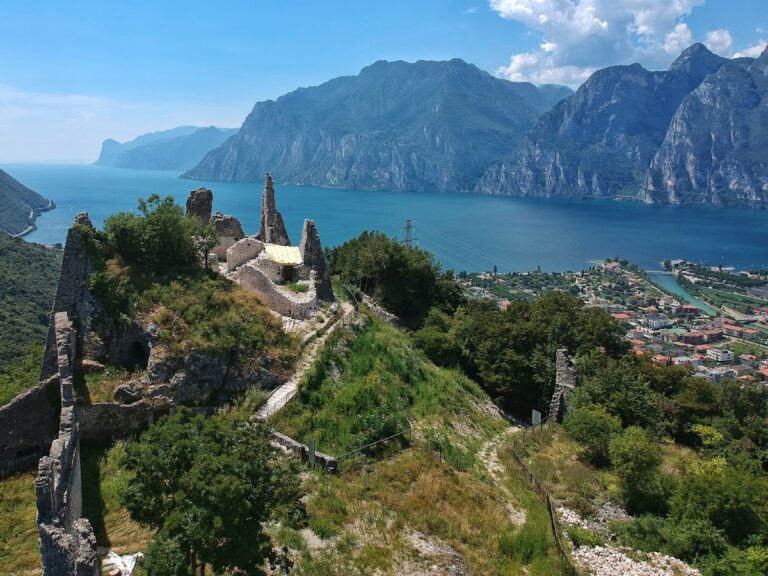
The castle occupies a rocky spur above Tenno at approximately 428 metres above sea level. It survives as a partially preserved hilltop fortress built in rubble-stone masonry, with sloping walls and defensive elements connected with the settlement below. The complex is privately owned and used as a residence, while its present form can be viewed only from the exterior.
Fortified structures
Walls and defensive elements
The surviving fortifications include battered walls, whose lower sections slope outward to broaden their base and strengthen the masonry. These walls form part of the defensive system associated with the settlement beneath the rocky spur. Their surviving sections convey the fortress’s position and construction as a hilltop stronghold.
Square keep
The principal fortified tower was a square keep, the castle’s main defensive tower. It formerly reached 48 metres in height before collapsing in 1920. The surviving complex therefore retains the setting and associated fortification elements of the keep, but not its full former vertical structure.
Restored residential areas
Courtyard and cannon defenses
The courtyard contains an inscription recording the restoration carried out under Bishop Johannes Hinderbach, when cannon were installed at the castle. The inscription links the surviving courtyard to the fortress’s later medieval defensive modernization.
Domestic and residential rooms
The loggia, kitchen, servants’ quarters, and residential rooms were completely rebuilt during Hinderbach’s restoration. These spaces form the domestic side of the complex alongside its defensive walls and keep. Later private remodeling included the installation of a swimming pool.