Werk Nago: An Austro-Hungarian Road Barrier at Lake Garda


Site at a Glance
- Rating
- 4.5
- Popularity
- Low
- Country
- Italy
- Primary era
- Modern
- Eras represented
- Modern
- Civilizations
- Habsburg
- Site type
- Military
- Remains
- Fort
On this page6 sections
History
Werk Nago, also known as Forte di Nago and the Nago Road Barrier, is an Austro-Hungarian fortification in Italy, near Nago on the northern shore of Lake Garda. Built as a first-generation nineteenth-century fortification between 1860 and 1861, it formed part of the Fortress of Riva and belonged to Subrayon III, a subdivision of the wider Austrian fortified system defending the Riva del Garda area and its approaches from Italy.
Construction within the Austrian border defenses
The fort was conceived after Austria lost Lombardy in the Second Italian War of Independence, a conflict that reshaped control of northern Italy. It belonged to a defensive belt of about thirty works planned along the Italian border. The construction project received approval on 21 December 1859, and work began on 1 June 1860 under the firm Tomasini. The fort was completed on 5 January 1861 and passed its acceptance inspection in 1863. It was among the early works erected for the Fortress of Riva between 1860 and 1862.
The Imperial-Royal Army, the army of the Austrian half of the Austro-Hungarian monarchy, initially administered the installation. Its garrison comprised five officers and 148 men. The fort was built entirely above ground in limestone blocks. This early form of permanent fort construction was already considered outdated when work started, offering protection against field artillery and only limited resistance to assault.
Road control and wartime use
Werk Nago controlled the route from Nago toward Torbole and Riva del Garda. The road approached from Rovereto and Mori through the Val di Loppio, then continued toward the northern part of Lake Garda. The fort’s weapons were intended to block the Alto Garda area and the San Giovanni Pass, while its gates allowed it to function as a road barrier as well as an artillery position.
The fort was disarmed on 24 May 1915, during the First World War. Italy entered that war against Austria-Hungary in 1915, placing the installation within a direct defensive context, but Werk Nago no longer had combat value. During the conflict it served only as accommodation for troops and as a magazine. Its location was near Castel Penede, which had been destroyed in 1703.
Remains
Batteries and guard building
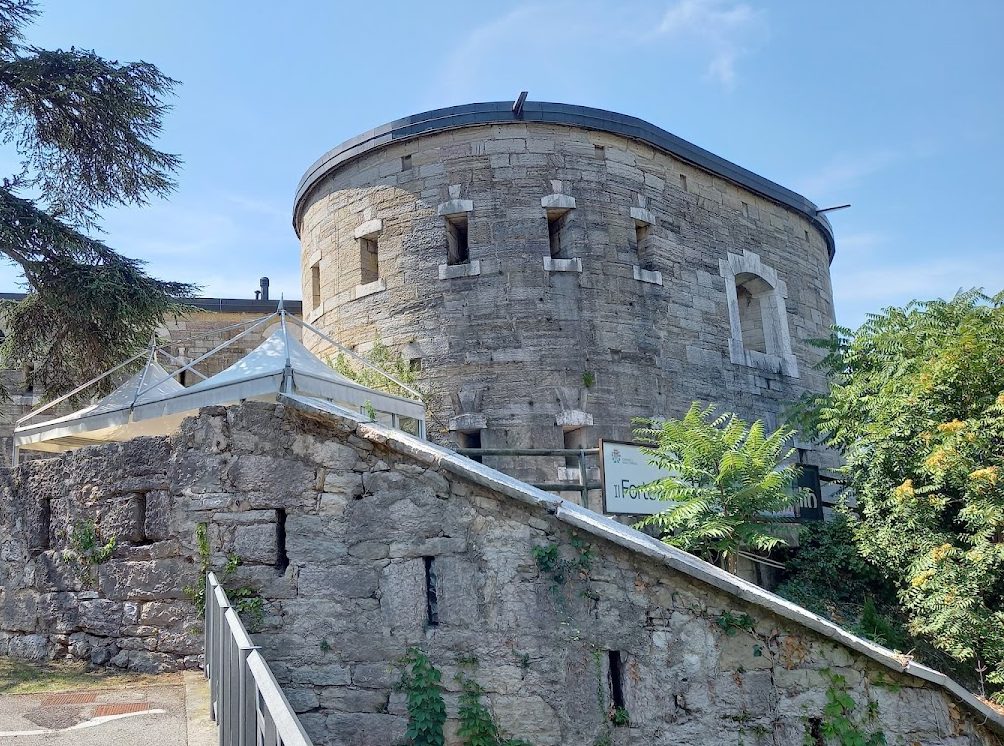
The preserved complex is arranged as an upper battery, a lower battery, and a guard building set on two different levels. A staircase connects the upper and lower sections, with a powder magazine interrupting the stairway. The upper battery is the larger part of the fort. Its ground floor has eight gun embrasures, openings through which cannon could fire, while the raised floor has six more. Small-arms loopholes are distributed across the upper levels, with eleven on the first floor and thirteen on the second.
This arrangement placed firing positions at different heights, creating vertical defense, meaning that the fort could engage attackers from above and below. The design was regarded as distinctive among first-generation fortifications. The lower battery and guard building each retain an iron grating gate capable of closing the road, while another iron gate blocked the carriage road through the complex.
Construction and water supply
Limestone blocks form the fort’s above-ground masonry. The walls are approximately 2.20 metres thick at the foundations and about 1.90 metres thick in the exposed sections. The upper and lower batteries were linked as a single defensive installation, with the powder magazine incorporated into the connecting staircase. A spring inside the fort supplied potable water, giving the garrison an independent water source.
The fort stood beside the road linking Nago with Torbole and Riva del Garda. That route corresponds to the modern Via Europa, running parallel to the SS 240. The entire complex survives, preserving the relationship between its two batteries, guard building, road gates, artillery openings, small-arms defenses, and internal water supply.
Nearby sites