Castel Penede: A Medieval Hilltop Fortress in Italy


Site at a Glance
- Rating
- 3.8
- Popularity
- Very Low
- Country
- Italy
- Primary era
- Medieval
- External website
- Open
- Eras represented
- Iron Age, Classical, Medieval, Early Modern, Modern
- Civilizations
- Celtic, Habsburg, Holy Roman Empire, Roman, Venetian
- Site type
- Military
- Remains
- Castle
On this page15 sections
History
Castel Penede is a medieval hilltop fortress in Italy, above Nago-Torbole in Trentino, built under Ulrich II of Arco before 1210. Its name derives from the pre-Roman place-name Penna, referring to a ridge, mountain, peak, or sharply pointed rock. The fortress occupied a strategic position above routes linking the lower Sarca valley, northern Lake Garda, the Adige valley, and the valleys leading toward the north.
Earlier occupation and the medieval foundation
The hill was occupied at intervals from prehistoric times through the Roman period. Excavations on its western slope have identified settlement beginning in the sixth century BC among communities associated with the Fritzens-Sanzeno culture, an Iron Age culture of the eastern Alpine region. The sequence continued through the fifth century AD, during the late Roman Empire. Other investigations have revealed Bronze Age traces, at least two Celtic settlements, a smaller Rhaetian settlement, and a Roman settlement of the early imperial period.
A Roman necropolis was discovered in 1832, while coins from different periods, including issues dating from the reign of Vespasian to that of Constantine, demonstrate the hill’s long use. The medieval castle was first recorded in 1210, when a peace agreement between Ulrich II, Count of Arco, and Friedrich von Wangen, Prince-Bishop of Trent, confirmed Ulrich’s claims to Castel Penede. In return, the count recognized rights that the Arco family had previously appropriated.
Castel Penede guarded the passage through the Valle Santa Lucia and over the Bocca di Nago. This route connected the lower Sarca valley with the Valle dei Cameras, the Adige valley, and the northern part of Lake Garda. Goods moved between Riva del Garda, Torbole, Nago, and Mori, and traffic paid tolls. Under an agreement of 1192, the resulting revenues were divided between the Prince-Bishop of Trent and the community of Riva del Garda.
The Arco family held two other fortifications around Nago from the late twelfth century. After the family divided into two branches, the Nago and Torbole possessions, including Penede, belonged to Ulrich II’s branch, while both branches continued to claim the family castle at Arco.
Arco conflicts and Castelbarco control
By about 1240, Ulrich II’s son Albert, also known as Adelpreto of Arco, held Penede. His branch supported the Ghibellines, the medieval faction generally aligned with the emperor, while the other Arco branch supported the Guelphs, who generally backed the papacy. Albert probably died during the 1245 siege of Castel Penede by the Guelph Count Rizzardo di San Bonifacio. The attack followed the occupation of Trent by the Ghibelline leader Ezzelino III da Romano.
In 1265, Albert’s brother Riprando allied with the Scaligers in an attempt to seize the castle of Arco. Ulrich III of Arco captured Riprando and his daughter Cubitosa. Riprando apparently died violently in the prison of Arco Castle, while Cubitosa escaped to Trent, where she died in 1266. Her will assigned her possessions, including Castel Penede, first to the Bishop of Trent and then to the Counts of Tyrol. Because the bishop was allied with Ulrich III, the inheritance passed to Meinhard II of Tyrol.
Meinhard II granted the Castelbarco family formal possession of Castel Penede in 1272 in return for their loyalty. The family already controlled lands in Nago and Torbole. The Arcos briefly captured the fortress in 1279, but the Castelbarcos soon expelled them and resumed control.
The Castelbarco period also produced a later literary tradition linking Castel Penede with Dante Alighieri. The view from the fortress is said to have inspired Dante’s reference to Lake Garda in Canto XX of the Inferno. This tradition places his stay at Penede around 1309. Dante was also a guest of the Castelbarcos at Castel Lizzana near Rovereto in 1315 and 1316.
Fourteenth- and fifteenth-century struggles
In 1338, Nicolò d’Arco sought formal possession of Penede from Nicholas of Brno, the newly appointed Bishop of Trent. After the request was refused, Nicolò attacked the castle in 1340 with assistance from Luchino Visconti, the Milanese ruler. The siege used catapults and seriously damaged the fortress. To prevent the castle from falling to the Arcos, the Castelbarcos offered it for sale to the Bishop of Trent, who occupied Penede in late November 1340 while the siege was still in progress.
After the final payment to the Castelbarcos in 1343, control passed to the Prince-Bishop of Trent. A declaration issued in 1348 stated that the Counts of Arco were the legitimate owners, and Nicolò d’Arco regained possession that year.
The castle remained contested during the fourteenth and fifteenth centuries. The Arcos held it until conflicts beginning in 1411, after which Guelph and Ghibelline forces repeatedly captured and retook Penede for more than twenty years. During the Lombard Wars, the conflicts between Venice and Milan, its position again gave the fortress a major military role.
In September 1438, the Arco-held castle blocked the northward retreat of Gattamelata, a Venetian condottiere, after the Milanese siege of Brescia. A feigned attack by a Venetian captain from Rovereto distracted the garrison and allowed Gattamelata to continue. Within three months he returned, defeated the garrison commanded by Francesco d’Arco through an encircling maneuver, captured Francesco, and took Penede for Venice in December 1438.
Venetian, imperial, and Tyrolean rule
Castel Penede remained under Venetian control until 1509, when imperial forces occupied it after Venice’s defeat at Agnadello. The castle was returned to the Counts of Arco as an imperial fief, meaning property held from a superior lord in return for obligations. During the Venetian period, the fortress had been strengthened and expanded.
In 1579, troops of Ferdinand II, the Tyrolean ruler, seized Penede after the Arcos attempted to free themselves from Tyrolean dependence. Following Ferdinand’s death in 1595, a compromise restored the Arcos’ administration of their lordship and the castle. In 1614, Emperor Matthias formally reinstated them as feudal lords.
After the return to the Arcos, Penede’s military value and maintenance declined. The growing use of firearms reduced the strategic importance of traditional fortifications, and the Arcos carried out no major repairs. Poor management temporarily cost them responsibility for the castle, but its condition did not substantially improve after they regained it.
Destruction, abandonment, and archaeological investigation
Austrian troops occupied Castel Penede in July 1703 during the War of the Spanish Succession, a European conflict over the succession to the Spanish throne. The occupation apparently reflected concern that the Arcos might ally with the French commander Vendôme. French forces captured Nago and Torbole on 31 July and began besieging Penede the following day. After three days, the defenders surrendered on 4 August.
The castle was plundered, and during the French withdrawal it was judged no longer defensible. A possible French burning remains uncertain, but the fortress was certainly abandoned in 1703. For more than two and a half centuries afterward, its walls supplied building material for other construction.
During the First World War, the Austro-Hungarian army built military positions and a large artillery emplacement on the hill and within the former castle area. Restoration campaigns by the Autonomous Province of Trento began in the 1990s and continued afterward. From 2019, archaeological excavations by the University of Trento revealed prehistoric and Roman settlement remains and clarified the long sequence of occupation on Doss Penede.
Remains
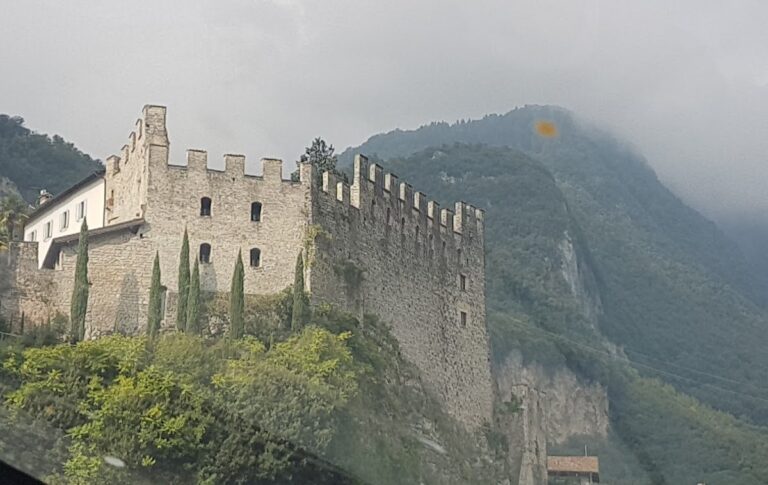
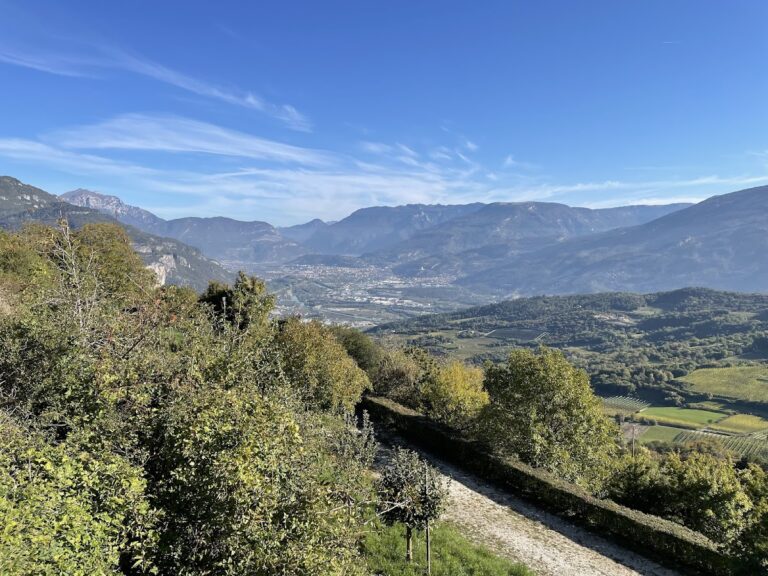
Castel Penede occupies the southern end of a rocky spur extending from Nago. The hill drops almost vertically by up to 80 metres to the south and east, while its western and northern sides descend more gently toward the Sarca and Nago. Built of rubble stone, the fortress overlooked northern Lake Garda, the port of Torbole, the Valle Santa Lucia road, and the historic route toward Mori, the Adige valley, and the Valle dei Cameras. The approximately three-hectare archaeological area contains remains from successive periods, with the medieval fortress sharing the hilltop with earlier settlements.
Fortress enclosure and defensive structures
Enclosing walls
The original arrangement of the fortress is difficult to reconstruct, but substantial sections of the main defensive enclosure survive along the eastern and southern sides, where the walls follow the precipice above the Valle Santa Lucia. These sections retain traces of swallow-tail merlons, forked V-shaped battlement crests. The surviving circuit formed part of a wider network of fortifications controlling the communications route through Nago and the Sarca region.
Rondels and southern buildings
The eastern wall contains the remains of a rondel, a rounded projecting fortification, on a small projection reached through a passage in the wall. A second rondel stood opposite it near the present entrance to the ruins and survives only in highly fragmentary form.
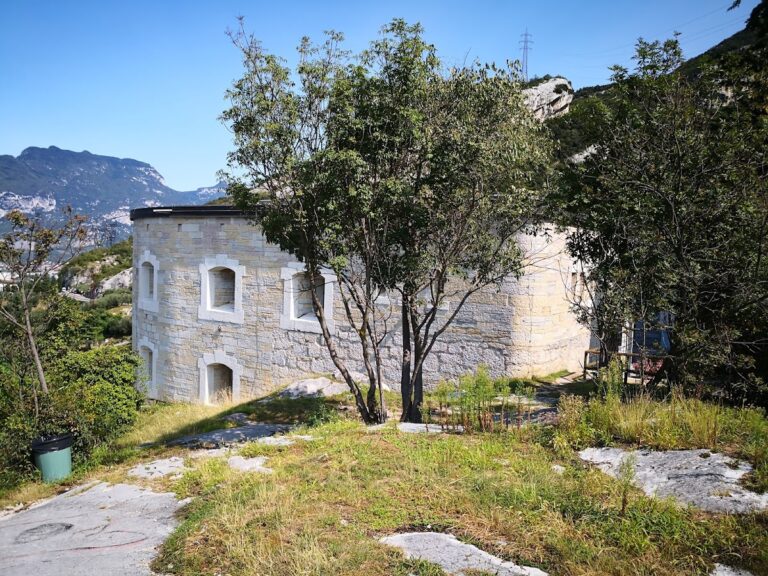
More substantial remains occupy the slightly raised southern part of the site above the cliff toward Torbole. They include parts of the keep tower and a cistern. During the First World War, the cistern was converted into a military position, linking the medieval structure with the later defensive use of the hill.
Prehistoric and Roman settlements
Earlier settlements
Archaeological investigations have identified Bronze Age traces, a prehistoric settlement, at least two Celtic settlements, and a smaller Rhaetian settlement. The Iron Age occupation on the western slope began in the sixth century BC among communities associated with the Fritzens-Sanzeno culture. These remains form part of the successive occupation sequence beneath and around the medieval fortress.
Roman settlement
A stratified Roman settlement of medium size included five houses, a castrum, a fortified settlement or military installation, a stable, and two workshops. The foundations and walls are clearly defined. Test excavations on the northern side of the promontory also indicated a terraced Roman building, possibly a villa. A Roman necropolis discovered in 1832 and coins dating from Vespasian to Constantine provide additional evidence for Roman activity on the hill.
Archaeological finds
Weapons, coins, crafted objects, and pottery come from the prehistoric, Celtic, Rhaetian, Roman, and later occupations. Together with the buildings and defensive remains, these finds help define the changing use of the hill before and during the construction of Castel Penede.
First World War installations
Trenches and artillery positions constructed by the Austro-Hungarian army during the First World War remain visible on the castle hill and within the former castle area. A large artillery emplacement occupied part of the site, while the medieval cistern was adapted as a military position.
Nearby sites