Castle of Tavira: A Medieval Fortress in Portugal



Site at a Glance
- Rating
- 4.3
- Popularity
- High
- Country
- Portugal
- Primary era
- Medieval
- External website
- Open
- Eras represented
- Iron Age, Medieval, Early Modern
- Civilizations
- Almohad, Almoravid, Phoenician, Portuguese
- Site type
- Military
- Remains
- Castle
On this page13 sections
History
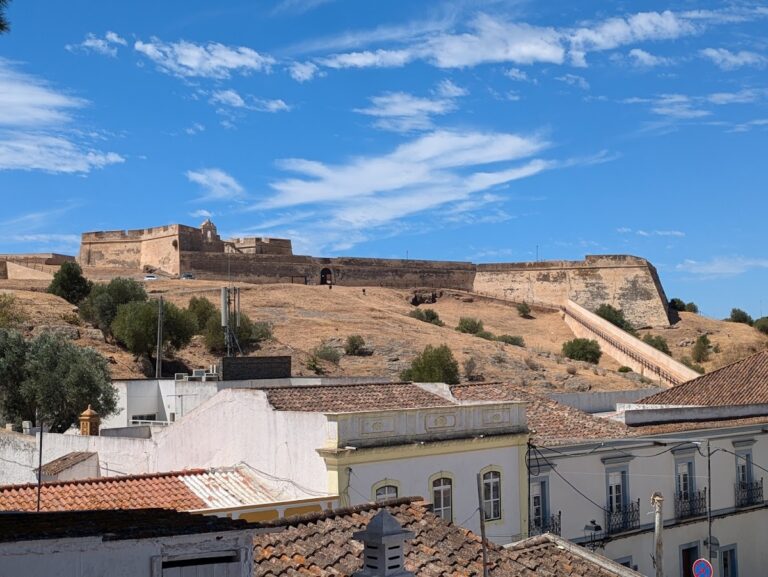
The Castle of Tavira in Portugal is a medieval fortification whose earliest identified phase was built under Muslim rule in the late eleventh or early twelfth century. It stands above the mouth of the Gilão River, where Tavira developed as an important maritime port through successive Phoenician, Greek, Celtic, Carthaginian, Roman, Moorish, and Portuguese phases.
Ancient settlement and Muslim Tavira
Human occupation in the region reaches back to prehistory. An archaeological campaign in 1997 uncovered part of a Phoenician wall dating to the eighth century BC, indicating that the site contained a Phoenician trading post or colony. During the Roman conquest of the Iberian Peninsula, the settlement was known as Balsa. Its position gained strategic value from a bridge over the river and from its location on an ancient Roman road, where a military detachment may have been stationed.
Archaeological research places the Muslim settlement in the eleventh century. Written references from the first half of the twelfth century call it at-Tabira and describe its fortification during conflicts between the Almoravids and Almohads, successive Muslim ruling movements that controlled parts of Iberia between the eleventh and thirteenth centuries. In 1168, the settlement came under the authority of Emir Almunine. Together with Santa Maria al-Harum, now Faro, and Silb, now Silves, it was one of the principal settlements of Gharb al-Andalus, the western region of the Muslim-ruled Iberian Peninsula.
Conquest and Christian rule
Portuguese forces reached the eastern Algarve from 1238, and Tavira was conquered on 11 June 1239. Historical tradition also gives May 1240 or 1242 as possible dates. The campaign was led by Paio Peres Correia, master of the Order of Santiago, a Christian military-religious order active in the medieval expansion of Christian kingdoms into Muslim-ruled Iberia.
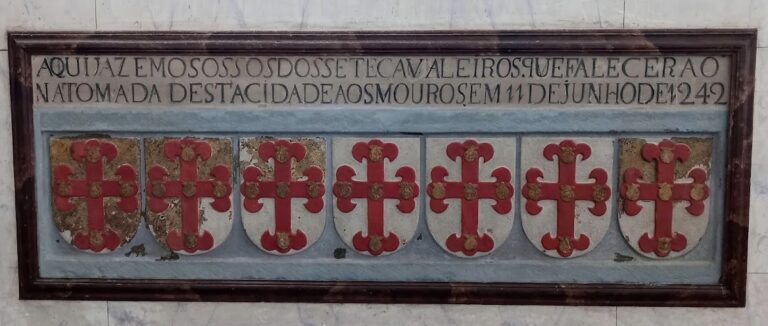
Tradition connects the conquest with retaliation for the deaths of members of the order who were ambushed while hunting at Antas, near present-day Luz. Related versions describe six Christian knights and a Jewish merchant killed by the Moors during a truce. The names vary between accounts, including D. Pedro Pires, Mem do Vale, Durão Vaz, Álvaro Garcia, Estêvão Vaz, Beltrão de Caia, and Garcia Roiz in one version.
On 9 January 1242, or possibly in 1244, Sancho II of Portugal donated Tavira and the patronage of its church to the Order of Santiago. Pope Innocent IV confirmed the donation in 1245. Alfonso X of Castile later claimed Tavira because it had been conquered by a Castilian military order. He besieged and conquered the town in 1252.
A treaty concluded in the following year linked the Algarve’s eventual transfer to Portugal with the marriage of Alfonso III of Portugal to Alfonso X’s daughter and the birth and coming of age of a male heir. Once these conditions were fulfilled, Alfonso X ceded the Algarve to Alfonso III by a letter issued at Seville on 20 September 1264. Tavira received the first of the Algarve’s new municipal charters in August 1266. A foral was a royal charter that defined a town’s rights, privileges, and obligations.
Royal expansion and military change
During the reign of Denis of Portugal, the castle was repaired and strengthened, while the town’s enclosure was enlarged around 1292. A royal letter of 15 April 1303 expanded the inhabitants’ privileges and protected their property from seizure or sale, except for debts owed to the Crown.
During the Portuguese succession crisis of 1383–1385, the Master of Avis, the future John I of Portugal, granted the Reguengo de Tavira to Fernão Álvares Pereira, brother of Constable Nuno Álvares Pereira. A reguengo was land held as part of the royal domain. After the conquest of Ceuta and the beginning of Portuguese overseas expansion, Tavira’s strategic and economic importance increased. In 1475, however, its inhabitants complained to the Cortes that the castle was in danger of collapse. The Cortes were representative assemblies of the Portuguese monarchy.
Under Manuel I, Tavira received the Foral Novo in 1504 and became a city on 16 March 1520. The Foral Novo was a royal revision of municipal privileges. Vasco Eanes Corte-Real served as the city’s chief governor at that time. When Sebastian I visited Tavira in 1573, work was under way on Santo António Fort, also known as Forte do Rato, opposite the bar of the Gilão River. The fort was being constructed by 1577.
During the Portuguese Restoration War, the seventeenth-century conflict through which Portugal reestablished its independence from the Spanish Habsburg monarchy, John IV confirmed Tavira’s earlier privileges. He also ordered the medieval castle to be modernized, structurally reinforced, and adapted for contemporary artillery. The town’s defenses were later extended by the São João da Barra de Tavira Fortress at Gomeira, facing the river bar. Construction began in 1672, and the fortress was in place by 1717.
Earthquake and modern recognition
The Lisbon earthquake of 1755 severely damaged the castle. The destruction contributed to the extensive dismantling of Tavira’s defensive perimeter during the following centuries. The castle walls were declared a National Monument by a decree published on 16 May 1939. The Castle of Tavira as a whole is also described as having been classified as a National Monument in 2014.
Remains
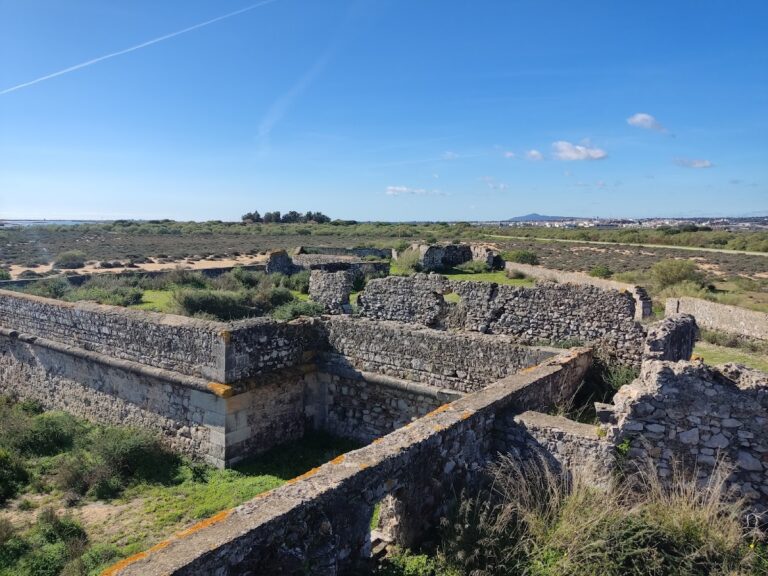
The surviving fortification combines Muslim and Christian construction phases within an enclosure that developed from a modest early citadel into an oval medieval complex. Rammed-earth walls, detached defensive works, gates, and later Christian masonry preserve parts of the changing layout. In the Late Middle Ages, the enclosure covered approximately five hectares.
Muslim fortifications
Early citadel and enclosure
The earliest identified castle phase belongs to the Almoravid period, in the late eleventh or early twelfth century. It probably consisted of a modest alcáçova, a fortified citadel or palace enclosure, in the southeastern angle and a walled enclosure running from north to south. The Almohad period brought a major reform, adding the principal elements of the Muslim fortification that survive. Rammed-earth walls belong to this phase, preserving an important part of the castle’s early construction.
Horseshoe gate and albarrana tower
An ancient horseshoe-arch gate was discovered in the area of the present Praça da República, beside the building of the Overseas National Bank. It was originally connected with a defensive tower. In the area of the present alcáçova, a multifaceted albarrana tower also survives. This was a projecting defensive tower separated from the main wall but linked to it for protection. The tower faces south and stands detached from the other structures.
Christian enclosure and later defenses
Oval walls and medieval expansion
After the Christian conquest, a new building phase gave the fortification the oval plan that remains identifiable. Works undertaken under Alfonso III and Denis of Portugal formed important parts of this Christian phase. Remains in the grounds of Pensão Castelo are believed to date from the reign of Denis. The enlarged enclosure eventually covered about five hectares during the Late Middle Ages, incorporating the earlier Muslim defenses into a broader fortified town.
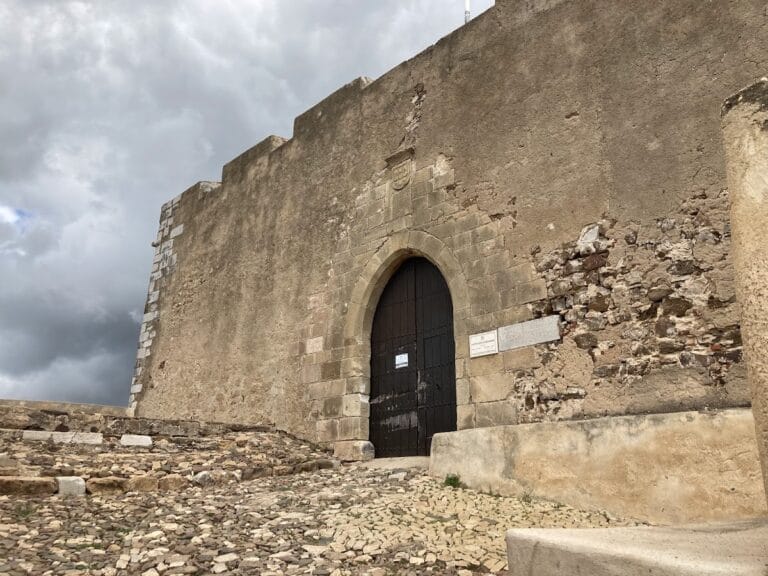
D. Manuel Gate
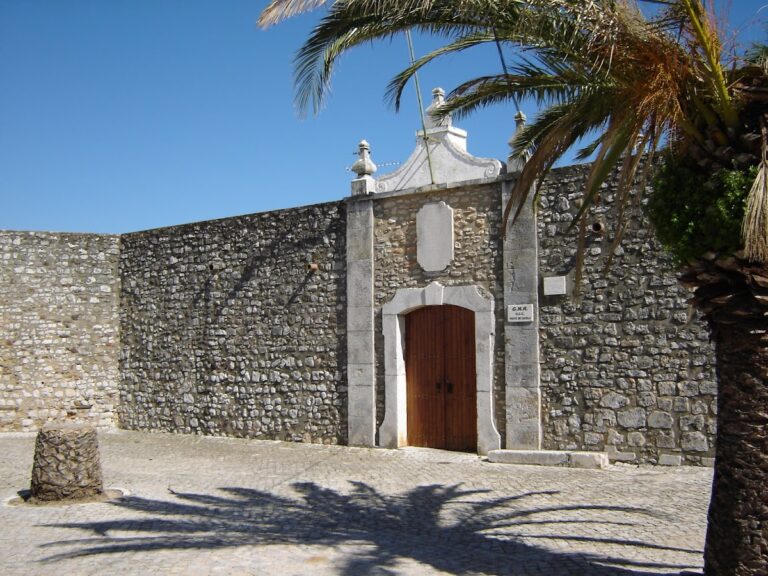
The D. Manuel Gate originally consisted of a pointed arch in the Gothic style. During the transition to the modern period, it became the principal passage between the interior and exterior of the walls, and the arms of Manuel I were inscribed upon it. The enclosure had seven gates: Fernão Mendes, Mouraria, Postigo, Feição, Vila Fria, D. Manuel, and Porta Nova.
Fortified landscape and local traditions
The later defensive landscape included Santo António Fort, or Forte do Rato, opposite the bar of the Gilão River, and the São João da Barra de Tavira Fortress at Gomeira, facing the same entrance to the river. Local traditions also associate the castle with an enchanted Moorish woman who appears on Saint John’s Eve, weeping over her fate. She is said to have been the daughter of Aben-Fabila, the Moorish governor who disappeared by magic when Tavira was conquered by Christians. Another legend tells of the Christian knight Don Ramiro, who fell in love with her, tried to break the enchantment, and saw her enter a cloud above the castle before dawn.
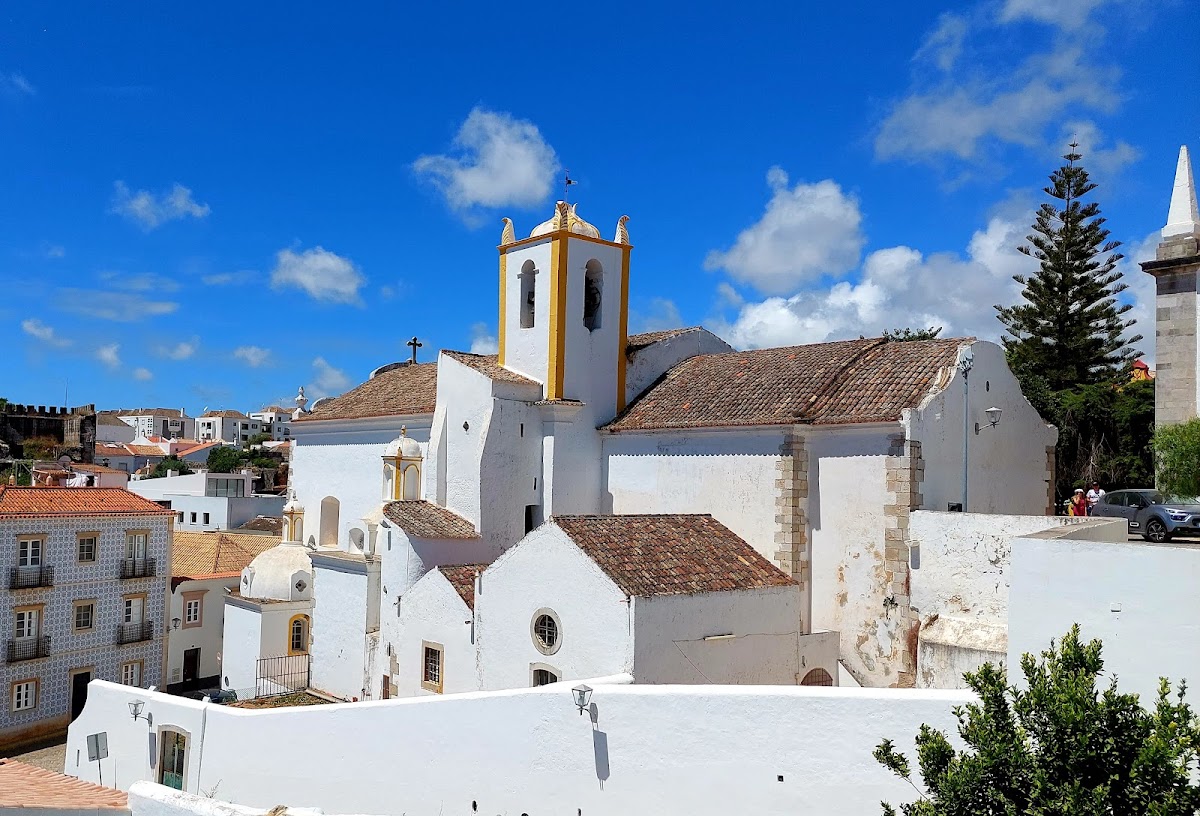
A further tradition places the seven dead Christian figures in a later siege by Alfonso XI of Castile around 1328, during the reign of Alfonso IV of Portugal. According to the story, the Castilian king saw seven immense figures carrying flags marked with the arms of Saint James at the Church of Santa Maria. Told that they were the knights killed during the Christian conquest and that they guarded Tavira, he abandoned the siege and returned to Castile without harming Portugal.