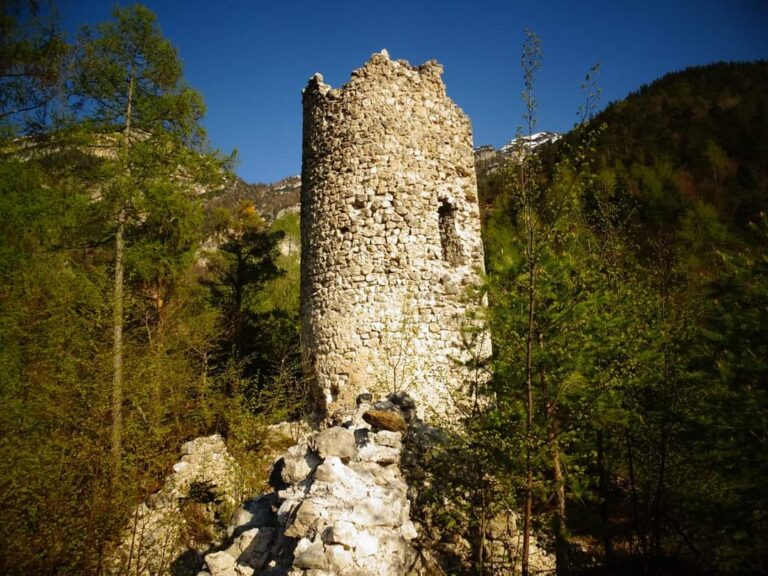
Castel Firmian: A Late Gothic Castle in Mezzocorona, Italy


Site at a Glance
- Rating
- 4.1
- Popularity
- Very Low
- Country
- Italy
- Primary era
- Medieval
- External website
- Open
- Eras represented
- Medieval, Early Modern
- Civilizations
- Holy Roman Empire
- Site type
- Military
- Remains
- Castle
On this page7 sections
History
Foundation and Strategic Purpose
Castel Firmian is a late Gothic castle in Italy, located northwest of Mezzocorona in the Piana Rotaliana. Built in 1480 at the initiative of Nicolò I di Firmian, it replaced the Firmian family’s earlier residence at the higher Castel San Gottardo, whose difficult access had become inconvenient. Nicolò was captain of Val di Non and the Giudicarie Valleys, and had married Dorotea, the last heir of the Kronmetz family.
The new castle stood below Castel San Gottardo and continued the jurisdiction previously held by the Mez family. Its administration involved a patrimonial judge, an official responsible for a lord’s hereditary jurisdiction, and a dynastic captain, an office linked to the ruling family. The castle was also intended to control the ancient Roman road leading beyond the Noce River into Val di Non. A projecting defensive work, known as a rivellino, guarded the approach toward this road.
Seventeenth-Century Transformation
Around 1650, Castel Firmian was raised by one storey. Its earlier narrow windows were replaced, and a new southeastern wing was built and joined to the tower. Inside, a two-storey hall was created as the building’s architecture shifted from late Gothic, the final medieval phase of Gothic design, toward late Baroque, the more elaborate architectural style of the seventeenth and eighteenth centuries.
The defensive moats were filled during this transformation. In the years that followed, a servant’s house and a stable were added, while the wall-walks and battlemented walls remained unchanged. The castle has remained associated with the Firmian heirs, who historically lived in the surrounding vineyards and continue to reside in the Piana Rotaliana.
Family Memory and Religious Associations
The tower contains a chapel dedicated to Saint John Nepomuk, a Bohemian Christian martyr. Paintings linked to the Firmian family preserve its traditional genealogical memory. One presents the knight Leopold as the family’s presumed progenitor and associates him with an alleged dispatch by Emperor Henry I in 933, when he was said to have led 400 mounted men against pagans.
Other family-associated paintings depict Corrado I de Formigaro, dated 1135, and Corrado II, assigned to the second half of the twelfth century. A later member of the family, Carlo G. Firmian (1716–1782), served as governor of Lombardy while the region was under Austrian control. He also supported writers and poets and became one of Wolfgang Amadeus Mozart’s major patrons during the composer’s early successes.
Remains
Castle Layout and Defences
Castel Firmian stands at an elevation of 270 metres, at the foot of the rock occupied by Castel San Gottardo and among the vineyards of the Piana Rotaliana. The original complex combined a tower with a residential building enclosed by walls and defensive moats. The rivellino projected from the main structure toward the ancient road beyond the Noce River, forming an outward defensive position for controlling movement along the approach.
The later southeastern wing is joined directly to the tower and forms part of the enlarged complex. The interior includes the two-storey hall created during the seventeenth-century rebuilding. The moats have since been filled, while the wall-walks and battlemented walls survive in their unchanged form.
Tower and Chapel
The tower bears the combined coats of arms of the Firmian and Kronmetz families, preserving the heraldic connection created through Nicolò I di Firmian’s marriage to Dorotea. Within the tower, the chapel of Saint John Nepomuk contains a wooden statue of Saint Gotthard of Hildesheim, an eleventh-century German bishop and saint, brought from Castel San Gottardo. Several paintings associated with the Firmian family are also preserved in the chapel.