Castle of Guadamur: A Historic Fortress and Noble Residence in Spain


Visitor Information
Google Rating: 4.3
Popularity: Medium
Official Website: castillodeguadamur.com
Country: Spain
Civilization: Early Modern, Medieval European
Site type: Military
Remains: Castle
History
The Castle of Guadamur sits near the village of Guadamur in Spain, originally built by Castilian nobility. Its construction began around 1470 under the direction of Pedro López de Ayala, the Count of Fuensalida, as part of a broader effort to stabilize and secure a region troubled by repeated assaults, fires, and looting during the mid-15th and early 16th centuries.
This fortress served as the seat of the County of Fuensalida, a title bestowed by King Enrique IV of Castile on Pedro López de Ayala in the year the castle’s construction started. Over the following decades, building activity extended until roughly 1520, reflecting the evolving military and residential needs of its noble occupants. The castle’s strategic importance was underlined by its use as a defensive stronghold and refuge during moments of unrest, including upheavals recorded in 1471, 1473, possibly 1507, and the War of the Communities—a notable revolt in Castile.
Ownership of the castle remained with the Ayala family for over a century before passing to the House of Velasco in the 17th century. Bernardino Fernández de Velasco y Pacheco Téllez-Girón, the eighth Count of Fuensalida, was among its prominent holders. Later in the 18th century, the estate moved to the House of Escalona. Subsequent property conflicts involved members of the noble houses of Osuna and Cedillo, the latter descended maternally from the second Count of Fuensalida. Despite its military character, the castle gradually lost prominence as a defensive site, and by the 18th century, the counts had relocated their residence to a palace in Toledo.
Throughout its history, the castle maintained an armed presence, with royal documents from King Philip II’s reign noting both its weaponry and the appointment of a salaried governor, or alcaide. However, by the mid-1600s, King Philip IV decreed the removal of the castle’s armaments to support broader royal military campaigns. The counts were actively engaged in military affairs under the Catholic Monarchs and later Spanish monarchs, linking the castle’s fate to wider political and martial events.
After a long period of decline, the castle was acquired in 1880 by three local inhabitants who used it as shelter for impoverished residents despite its deteriorated state. Not long after, in 1887, Jerónimo López de Ayala y del Hierro, the fifth Marquis of Villanueva del Castillo, prompted his father-in-law Carlos Morenés y Tord, the fourth Baron of Cuatro Torres, to purchase and restore the castle as a countryside residence. Morenés was a senator and scholar in medieval history, born in 1835, who undertook significant renovation efforts.
The castle suffered damage during the Spanish Civil War in the 20th century, with its last major restoration conducted by the Marquis of Aguilar de Campoo. In recognition of its cultural and historical significance, the Spanish government declared the castle a historic-artistic monument on June 18, 1964. Today, it carries the official heritage status of Bien de Interés Cultural.
Beyond its historical role, the Castle of Guadamur has served as a filming location for numerous productions, including mid-20th-century and contemporary films as well as television series. These appearances highlight its enduring presence as a tangible link to Spain’s medieval past.
Remains
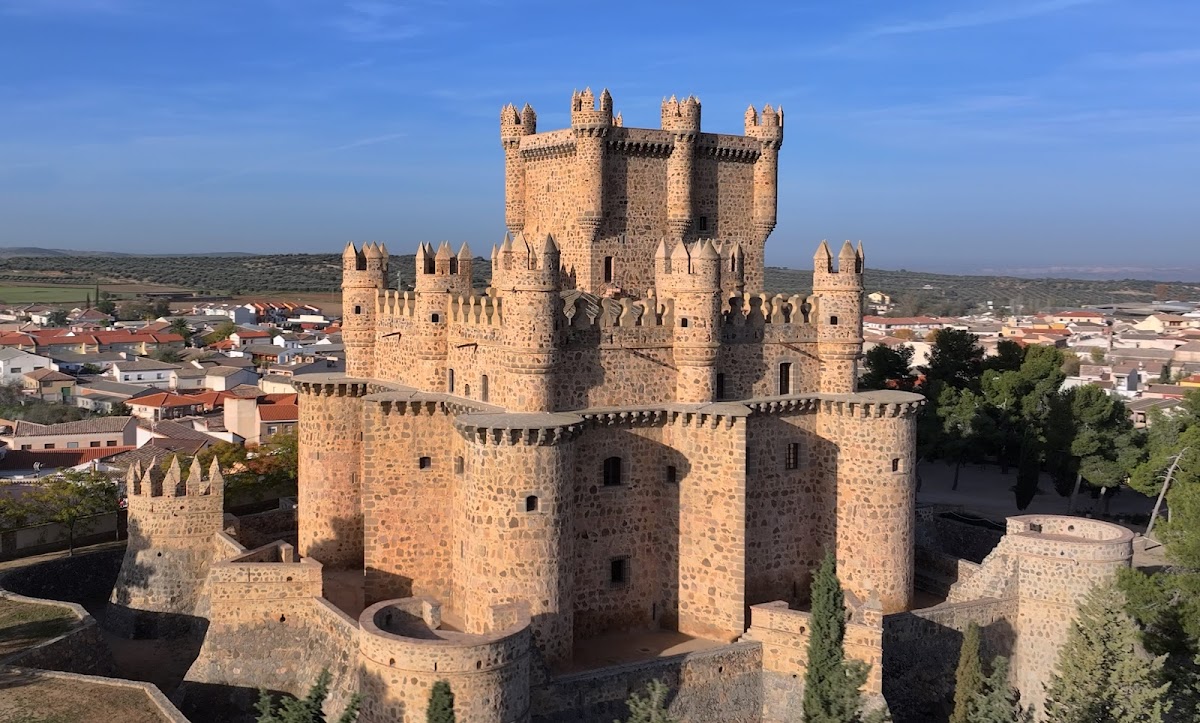
The Castle of Guadamur occupies a small hill called Cerro de la Ermita just east of the village it overlooks, commanding a view over a stream that traverses the town below. Its design reflects a combination of medieval defensive architecture and residential grandeur typical of late 15th-century Castile.
A prominent feature is the keep, or torre del homenaje, standing as a tall rectangular block approximately 30 meters high, with a footprint of about 10 by 15 meters. This principal tower is attached at a corner of the inner defensive wall, oriented so its main face faces the castle’s main entrance. The keep was constructed using granite masonry complemented by finely cut ashlar stone blocks, lending it a sturdy yet refined appearance that marked its importance.
Surrounding the courtyard, the main palace structures follow an almost square plan measuring roughly 20 by 12 meters. Each corner is anchored by circular towers, which, along with the inner ring wall featuring corner rounded towers and pointed bastion-like projections at the midpoint of each side, contributed to the fortress’s defense. These walls incorporate battlements and small turrets known as tourelles atop their upper sections. These architectural increments show early adoption of star-shaped bastions—triangular projections rising midway along the walls—foreshadowing defensive designs that became more common in European fortifications during the 18th and 19th centuries.
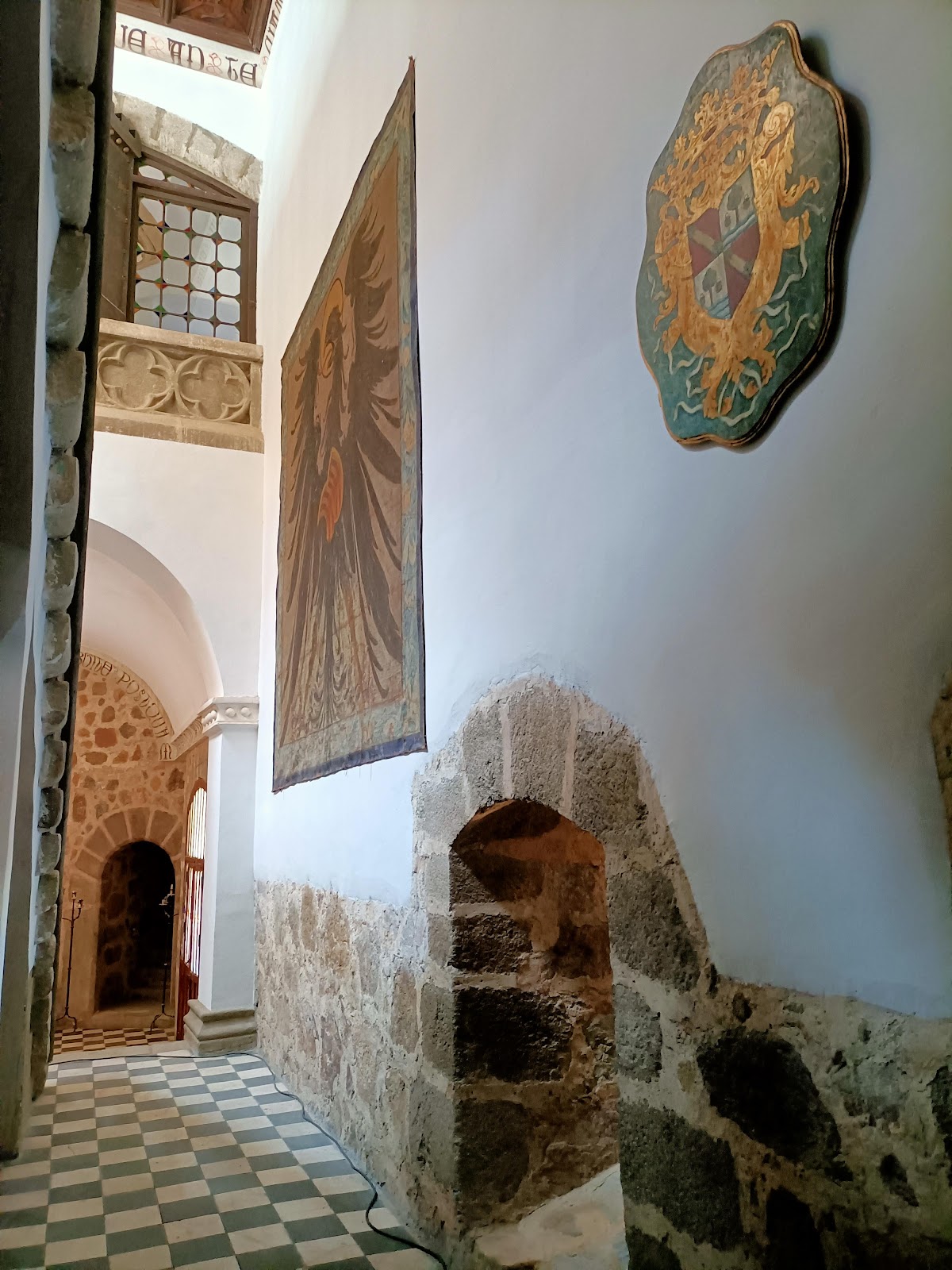
The castle’s interior included functional spaces on the ground floor, such as a chapel, kitchen, and service rooms, all vaulted to strengthen ceilings and allow for durability. Above, the main living floor featured lintelled rooms with wooden coffered ceilings—a ceiling style with recessed panels adding decorative complexity. Stone reliefs embellish the external walls and main gate, depicting heraldic lions and diagonal bands that reference the coats of arms of by then prominent noble families associated with the castle.
A second phase of construction brought further enhancements including an upper story to the palace, along with an outer defensive barrier and a surrounding moat. These additions increased both the residential space and the capacity to repel attackers.
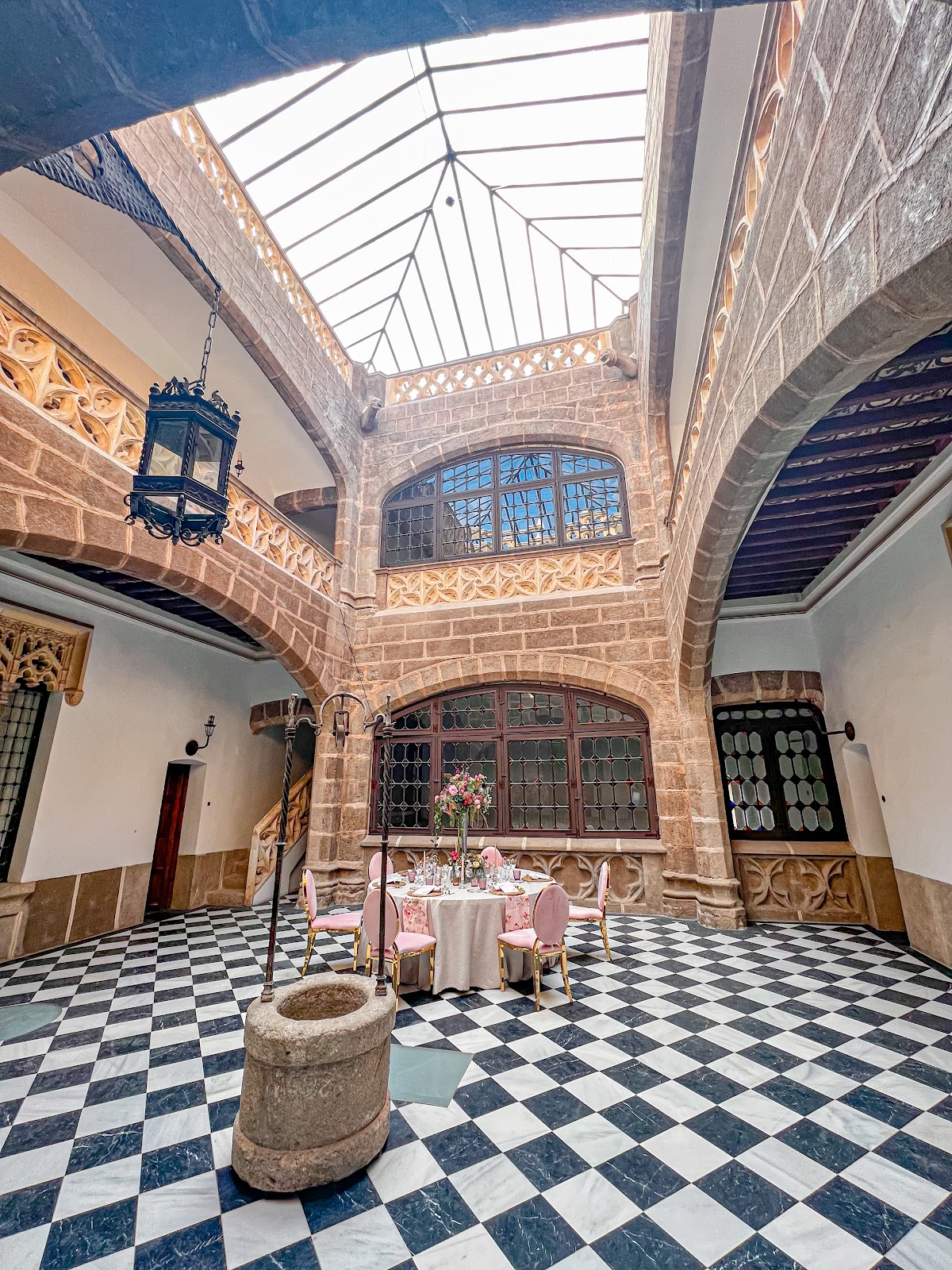
Inside the central courtyard, the space was subdivided into three smaller courts surrounded by residential and ceremonial chambers connected through dual rows of arcades—series of arches supported by columns—which provided sheltered walkways. Some larger rooms bore ornate friezes and cornices inscribed with Psalms and Latin prayers, integrating religious devotion into the castle’s living spaces.
Restoration work carried out in the 19th century, guided by Carlos Morenés y Tord and later noble owners, preserved several 15th-century wall reliefs and introduced frescoes on the nobles’ floor. These frescoes commemorate a royal visit in 1502 by Princes Juana and Felipe, recreated from historical records during the renovation. This intervention improved the castle’s condition significantly, reversing years of neglect and poor sanitation.
Today, the Castle of Guadamur presents a largely restored monument bearing witness to its historic roles as a military fortress, noble residence, and refuge. Its well-preserved walls, towers, and decorative elements offer insight into the architectural and social complexities of late medieval Castilian fortifications.
Nearby sites