Castle of Barcience: A Fifteenth-Century Noble Residence in Spain


Site at a Glance
- Rating
- 4.2
- Popularity
- Low
- Country
- Spain
- Primary era
- Medieval
- Eras represented
- Medieval
- Civilizations
- Crown of Castile
- Site type
- Military
- Remains
- Castle
On this page6 sections
History
Castle of Barcience is a fifteenth-century castle in Barcience, Spain, built by the powerful Castilian House of Silva. The present fortress was created during the fifteenth century after the area had already been fortified in the eleventh and twelfth centuries. Its historical importance is reflected in its long association with the Silva family and later noble and ducal owners.
Earlier Fortification and the Silva Family
Barcience was fortified from the eleventh and twelfth centuries. In the thirteenth century, the area passed to the Order of Santiago, a medieval military-religious order that controlled and defended territories in the Iberian Peninsula. It was later ceded to Alfonso Tenorio, head of the Silva family. Members of this family became counts of Cifuentes in 1454.
The Silva family constructed the present castle from the ground up during the fifteenth century. Juan de Silva began the work, and his grandson, Juan de Silva y Castañeda, completed it. During the sixteenth century, the castle was equipped with artillery and maintained a garrison. Over the centuries, however, its principal role was that of a seigneurial residence, the main home of a feudal or noble lord.
Later Ownership and Present Condition
The castle subsequently passed from the Silva family to the ducal houses of the Infantado, Osuna, and Pastrana. The dukes of Pastrana donated it to Pope Leo XIII, who was head of the Roman Catholic Church from 1878 to 1903. He later sold the castle, the surrounding estate, and the village to a private owner.
Cirilo Calderon, a businessman, acquired the extensive Barcience estate and developed its agricultural exploitation. The property later passed to Luis Calderon, his heir. The castle is now privately owned and has been left in complete abandonment, with parts of its structure lost and graffiti on the building. It is protected by Spain’s generic decree of 22 April 1949 concerning castles and by Law 16/1985 on Spanish Historical Heritage. It is also classified as a property of cultural interest, a Spanish designation for protected historic or cultural assets.
Remains
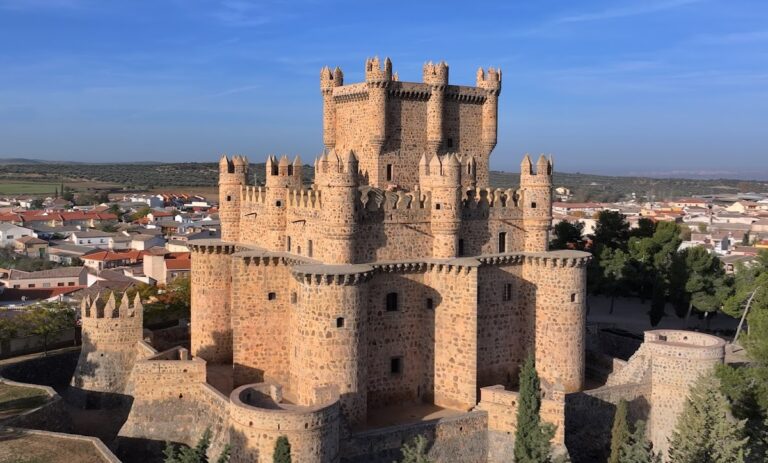
The castle stands on a small hill overlooking Barcience. Its principal body is almost square in plan, with four corner towers arranged around the enclosure. Two circular towers occupy the western, or rear, corners, while two square towers stand at the eastern, or front, corners. The northeastern tower is the largest, and the other principal front tower is rectangular. The surviving exterior masonry conveys the castle’s compact fortified layout.
Keep and Emblem
The square keep, the castle’s principal fortified tower and a defensive and residential structure, is its most prominent feature. Its exterior wall carries a monumental relief of a rampant lion, the emblem of the House of Silva and the counts of Cifuentes. The interior is completely ruined, although surviving evidence indicates that the keep had two floors. Wall walks, passages along the top or inner side of defensive walls, connected the towers and allowed defenders to move through the fortifications.
Entrance Defenses
The castle probably had a moat and an outer barrier. Two projecting masonry towers of this barrier survive at the entrance, where they protected the approach. The keep and the exterior masonry structure are the best-preserved parts of the castle, while the interior and especially the surrounding outer enclosure remain in ruins.