Castle in Wąwolnica: A Royal Stopping Station and Court


Site at a Glance
- Rating
- 4.9
- Popularity
- Medium
- Country
- Poland
- Primary era
- Medieval
- External website
- Open
- Eras represented
- Medieval
- Civilizations
- Kingdom of Poland
- Site type
- Military
- Remains
- Castle
On this page10 sections
History
The castle in Wąwolnica, Poland, was a mid-fourteenth-century royal foundation built by King Casimir III the Great on Church Hill. It served as a stopping station during the king’s circuits through his realm, linking the site to the administrative and travel network of the Polish kingdom.
Royal foundation and medieval administration
The castle was mentioned shortly after Casimir III’s death in 1370, in the Kraków Cathedral Chronicle written by Janko of Czarnków, a fourteenth-century Polish cleric and chronicler. From 1381 to 1474, it hosted sessions of the Lublin castellan’s court over the minor nobility. A castellan was a royal official responsible for a castellany, an administrative district centered on a stronghold.
In 1461, the castle appeared in a record as castrum nostrum Wawelnica, meaning “our castle of Wawelnica.” Its administration continued through the late fifteenth century, when a burgrave, the official responsible for managing a castle, was recorded in 1496, 1499, and 1500.
Royal estate and destruction
In 1518, Mikołaj Firlej, a Polish nobleman and royal officeholder who held the Wąwolnica estate, received a two-year lease of the travel station located within the castle. This arrangement connected the castle’s continuing use with the management of royal property.
A great fire destroyed the castle and town in 1567. The town was later relocated to a suburb and re-established, while the former town and castle area gradually passed into the ownership of the Benedictine Abbey on Łysa Góra. Benedictines are members of a Western Christian monastic order governed by the Rule of Saint Benedict.
Monastic reuse and archaeological rediscovery
By 1650, the castle buildings were in poor condition. A papal bull issued by Pius VII in 1819 dissolved the monasteries on Łysa Góra and in Wąwolnica. A local tradition recorded in 1845 held that the church and monastery had been converted from the old castle, while nineteenth-century evidence indicates that the castle building had been taken over as a Benedictine monastic residence.
The castle walls were dismantled around 1850–1860, and a parsonage, the residence assigned to a parish priest, was built on the site. Archaeological work in 1999–2002 identified the vaulted basement of a large residential-defensive tower in the northeastern part of Church Hill. The discovery clarified the position of the former royal castle beside Wąwolnica’s medieval town defenses.
Remains
Church Hill and the castle area
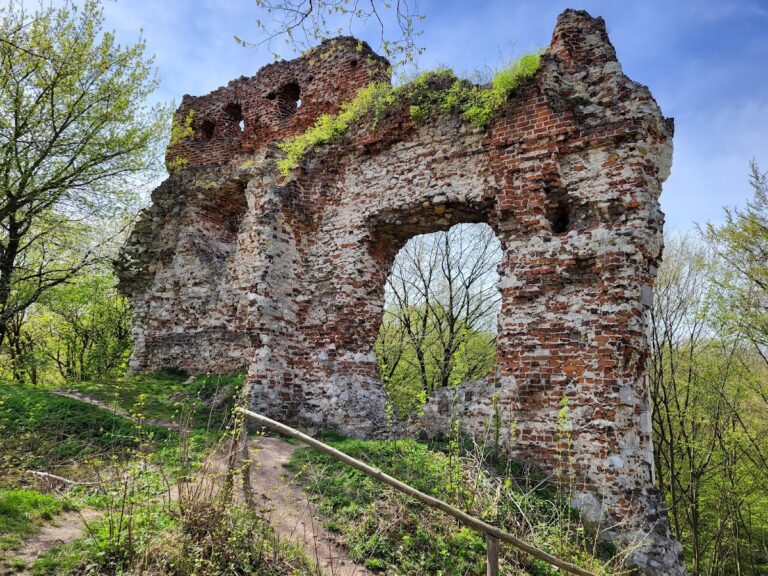
The castle stood on Church Hill, with its buildings occupying the northeastern part of the medieval town. The former castle and monastery complex lay northeast of the present Church of Saint Adalbert. Archaeological investigation revealed the vaulted basement of a large residential-defensive tower in the northeastern part of the hill. The tower adjoined the medieval town’s defensive wall, which formed part of the castle area’s wider setting.
Surviving and altered buildings
Former monastic residence and parsonage
Nineteenth-century descriptions noted wall traces with loopholes and evidence of a larger building within the monastic structures. The castle walls were dismantled around 1850–1860, after which a parsonage was erected on the former castle site. These changes shaped the present arrangement of the northeastern part of Church Hill.
Church of Saint Adalbert
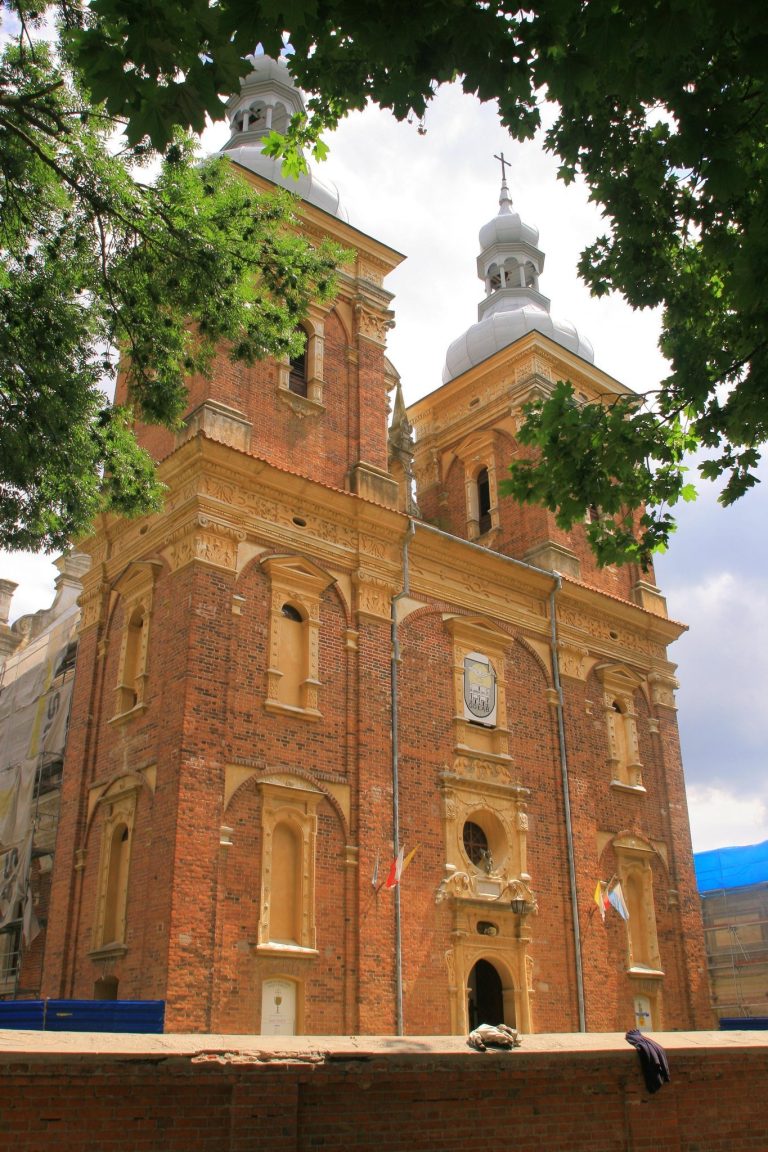
A medieval, two-level Church of Saint Adalbert stood immediately south of the castle area. Part of the church was demolished in 1907, while its lower level survives. Until 1914, the church was dedicated to Saint Adalbert.
Chapel of Our Lady of Kębło
The two-level Chapel of Our Lady of Kębło marks the northeastern corner of the medieval town market and the southern extent of the royal castle’s buildings. Its dedication refers to a local Marian devotion associated with the Virgin Mary. From the time of Casimir III to the present, the chapel is the surviving building associated with the former castle site.