Wenecji Castle: A Gothic Fortress in Poland


Site at a Glance
- Rating
- 4
- Popularity
- Low
- Country
- Poland
- Primary era
- Medieval
- Eras represented
- Medieval
- Civilizations
- Kingdom of Poland
- Site type
- Military
- Remains
- Castle
On this page7 sections
History
Wenecji Castle is a Gothic fortress in Poland, located in Fenis near Żnin and built around 1375 as part of the Polish kingdom’s fourteenth-century program of strengthening its defenses. The work was commissioned by the nobleman Mikołaj Nałęcz of Chomiąż in marshland around the Gąsawka River, within the historical region of Pałuki.
Foundation and Noble Ownership
Mikołaj Nałęcz later became associated with the epithet “the Devil of Wenecja.” A local legend says that divine punishment caused the castle walls to fall on Nałęcz and peasants he had imprisoned in underground dungeons. This story is a legend rather than an established historical event.
The castle was damaged in 1395 during fighting between the Nałęcz and Grzymała factions. After Nałęcz died around the turn of the fifteenth century, the property passed to his grandson, Mikołaj Pomian. In 1420, Pomian transferred it to the Archdiocese of Gniezno.
Archiepiscopal Fortress and Prison
Archbishop Mikołaj Trąba initially strengthened the castle against the Teutonic Order, a Catholic military order that ruled a powerful state on Poland’s northern frontier. The artillery defenses were supervised by the gunsmith Grzegorz of Ossek.
From 1467 to 1473, the castle was the official residence of Piotr Nałęcz of Szamotuły, the general starost of Greater Poland. A general starost was a senior territorial administrator, and this title identified the official responsible for a broad regional jurisdiction.
The archdiocese later used Wenecji Castle as a prison for priests, probably including clergy influenced by the Hussite movement, a fifteenth-century Christian reform movement that began in Bohemia and was associated with Jan Hus. Archbishop Jakub of Sienna abolished the prison in 1461 and ordered the castle’s destruction, although parts of the complex remained in use until 1511.
Fortifications, Dismantling, and Preservation
Additional defenses, including some of the earliest bastions in Poland, were constructed around the castle during the second half of the fifteenth century. Bastions are projecting structures that allow defenders to fire along adjoining walls. Once the threat from the Teutonic Order had declined, the costly fortress was no longer regarded as necessary.
By the sixteenth century, the castle had been partly dismantled. Bricks were carried along the Gąsawka River to Żnin, where they were used in the construction of the archbishop’s palace. The ruins continued to deteriorate, and part of the castle was blown up in the nineteenth century. The resulting stone was used to build the road to Żnin.
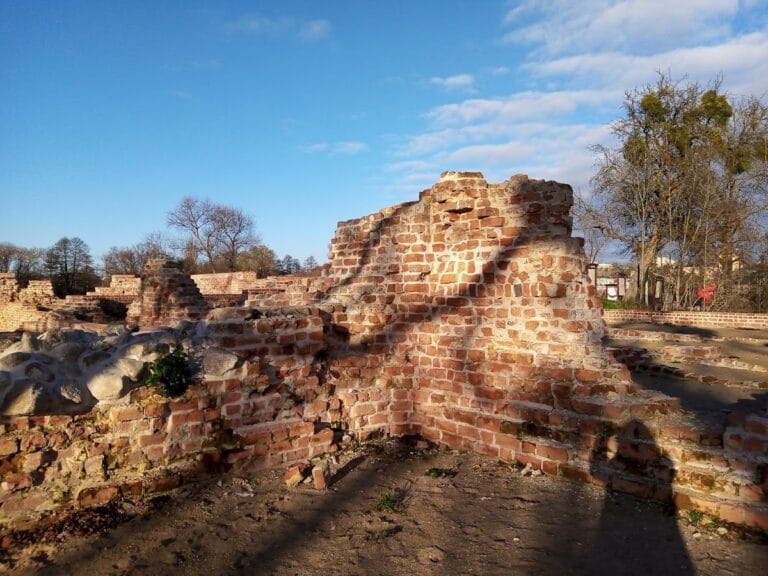
Archaeological investigations began after the Second World War. The ruins now form a branch of the Museum of the Pałuki Region in Żnin and are preserved as a permanent ruin, meaning that the surviving fabric is stabilized without reconstructing the castle as a complete building. Wenecji Castle is entered in Poland’s heritage register under number A/1388, with registration dated 18 March 1948.
Remains
Fortress Layout
Wenecji Castle was a Gothic quadrilateral fortress built from stone and granite fieldstone, with brick used in the upper sections. A defensive tower occupied the northeastern corner, while the entrance gate stood at the center of the southern wing. Surviving sections of stone and brick wall reveal the former internal division of the complex, including parts of the courtyard. The castle stood amid the Biskupińskie, Weneckie, and Skrzynka lakes, whose surrounding waters formed part of its physical setting.
Archaeological Evidence
Excavations at the castle recovered archaeological finds that are held in the Archaeological Department of the Jan Kasprowicz Museum in Inowrocław. These finds accompany the surviving walls and courtyard fragments in preserving evidence of the fortress’s construction and use.