Castillo de Petrer: A Muslim Fortress in Alicante, Spain


Site at a Glance
- Rating
- 4.6
- Popularity
- Low
- Country
- Spain
- Primary era
- Medieval
- External website
- Open
- Eras represented
- Medieval
- Civilizations
- Almohad
- Site type
- Military
- Remains
- Castle
On this page6 sections
History
Castillo de Petrer is a Muslim fortress in Spain, standing above the town of Petrer in Alicante. It originated in the late twelfth or early thirteenth century, probably replacing an earlier watchtower, and was built to control the route between the Castilian plateau and the Mediterranean coast.
Muslim origins and the thirteenth century
The fortress served a strategic and territorial purpose in a region where routes connected the inland plateau with the coast. During the Muslim revolt of 1265, Muslim rebels seized the castle. Alfonso X, the thirteenth-century king of Castile and León, sought help from James I of Aragon, whose rule expanded the Crown of Aragon in the Iberian Peninsula. James I soon reconquered the fortress.
Restoration and protection
Reconstruction of Castillo de Petrer was completed in 1982, with further works carried out in 2010. The restored castle has been protected as a cultural-interest monument and has held national historic-artistic monument status since 1983. It is also included among the cultural-interest properties of Alicante Province.
Remains
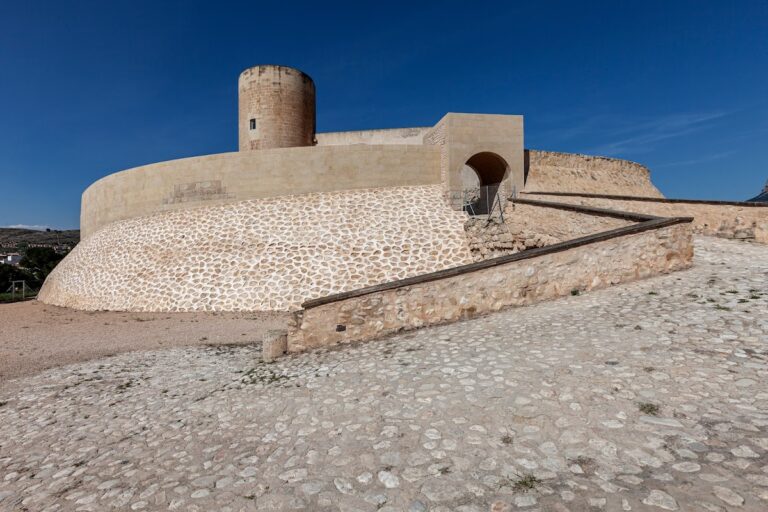
Castillo de Petrer occupies a mountain elevation about 500 metres above sea level, north of Petrer’s urban centre, overlooking the Vinalopó Valley. Its polygonal plan is formed mainly in masonry, with regularly cut ashlar stone blocks at the corners. Crenellations, the notched parapet along a fortified wall, line parts of the defenses, while an interior embankment crosses the castle.
Defensive walls and towers
The outer wall is composed of two rammed-earth sections, made by compacting earth within forms. A central tower separates these sections, and additional towers stand at their ends. Together, these elements create the castle’s principal defensive enclosure and preserve the relationship between its walls and towers.
Keep and interior spaces
The most prominent structure is a large square keep, the castle’s principal fortified tower. It has two floors and a basement. During the Islamic period, the basement functioned as a cistern, a reservoir for storing water, and it was later used as a prison. The castle also contains a large vaulted hall that historically hosted festivities held by the feudal lord. Today, the keep houses exhibitions, while the hall is used for chamber concerts during Guitar Week and for civil weddings.