Castillo de Elda: An Almohad Fortress and County Palace
Site at a Glance
- Rating
- 4.2
- Popularity
- Very Low
- Country
- Spain
- Primary era
- Medieval
- External website
- Open
- Eras represented
- Medieval, Early Modern
- Civilizations
- Almohad, Crown of Aragon, Crown of Castile, Spanish
- Site type
- Military
- Remains
- Castle
On this page12 sections
History
Castillo de Elda is an Almohad fortification in Elda, Spain, built and maintained between 1172 and 1243 as part of the medieval Islamic and Christian struggle for control of the Vinalopó Valley. The Almohads were a North African Islamic dynasty that ruled parts of the Iberian Peninsula during the twelfth and thirteenth centuries. The fortress occupied a strategic position above the Vinalopó River and protected the Muslim community that grew into Islamic Elda.
Almohad foundation and Islamic Elda
After the Almohad defeat at the Battle of Huete in 1172 and the Christian advance that followed, the Taifa kingdom of Murcia promoted settlement and the strengthening of strategic locations in the Vinalopó Valley. A taifa was an independent or semi-independent Muslim kingdom in al-Andalus, the Muslim-ruled part of the Iberian Peninsula. Elda was among the positions developed during this period, and its fortress took the form of an alcázar, a fortified palace or citadel that could combine defensive, administrative, and residential functions.
The fortress served the Muslim population associated with the settlement. Archaeological remains in Elda’s historic center connect the castle with the wider development of Islamic Elda, placing the stronghold within a settled community rather than treating it as an isolated military work.
Christian rule and military transformation
Following the Christian conquest, the prolonged expansion of Christian-ruled kingdoms into Muslim territories in medieval Iberia, the fortress and the surrounding community changed hands repeatedly. From the middle of the thirteenth century to the early fifteenth century, grants and sales transferred ownership among different holders. Its predominantly military role made it a base for operations during warfare in the region.
During the late fourteenth and early fifteenth centuries, the castle was substantially strengthened and remodeled. These works increased the size and defensive capacity of its garrison. The fortress was held first by Violante, a noblewoman identified by the honorific Doña, and later by the Corella family, the Counts of Cocentaina, whose hereditary title was associated with the town of Cocentaina in Alicante Province.
The Coloma county palace
On 4 September 1513, the Count of Cocentaina sold Elda, Petrer, and Salinas to Juan de Coloma. Coloma was an Old Christian from Borja, a commoner, and secretary to Ferdinand II of Aragon and Isabella of Castile. In Christian Spain, the term Old Christian referred to a person regarded as having Christian ancestry, in contrast with converts from Islam or Judaism and their descendants.
The Coloma family lived in these lands throughout the sixteenth century and part of the seventeenth. Under their ownership, the medieval military fortress became a county palace. More aristocratic and domestic facilities were introduced, and the castle’s primary function shifted decisively from defense to noble residence. The palace included a chapel, a large water cistern, and rooms for household and service activities.
The expulsion of the Moriscos brought severe economic losses to the Counts of Coloma. Moriscos were Muslims who had been converted, often under compulsion, to Christianity in Spain, together with their descendants. The resulting fall in tax revenues led the counts to move their residence to Valencia, after which the castle began to deteriorate.
Dismantling, research, and protection
The State acquired the castle in 1841. In 1842, part of the complex was dismantled for stone intended for a bridge over the Vinalopó. An additional attempt followed in 1844 to convert the site into a prison for the court of first instance. By 1846, parts of the castle had been adapted for theatrical performances, comic shows, and the release of young bulls.
The castle was sold at auction in 1848 for 121,000 reales, a historical Spanish currency unit used before the nineteenth-century adoption of the peseta. Pedro León Navarro y Vidal, a master builder who owned it from 1866 to 1886, dismantled and stripped the complex. Marble, ashlar masonry, woodwork, coffered ceilings, furniture, metals, and other materials were removed. A bridge over the Vinalopó, completed in 1879, used ashlar from the castle’s circular towers in its columns and arches.
Archaeological research and exhibitions organized by Teófilo Rico Verdú helped recover knowledge of the fortress. A three-year research project, advised by Elda’s municipal archaeologist and the director of the city’s Archaeological Museum, added information about its earlier owners and its Islamic and Christian alterations. Reconstruction work has continued since 1983, although Castillo de Elda remains in ruins.
The castle is protected by Spain’s general castle-protection decree of 22 April 1949 and by the 1985 Spanish Historical Heritage Law. It became a Property of Cultural Interest in the monument category on 8 March 2001.
Remains
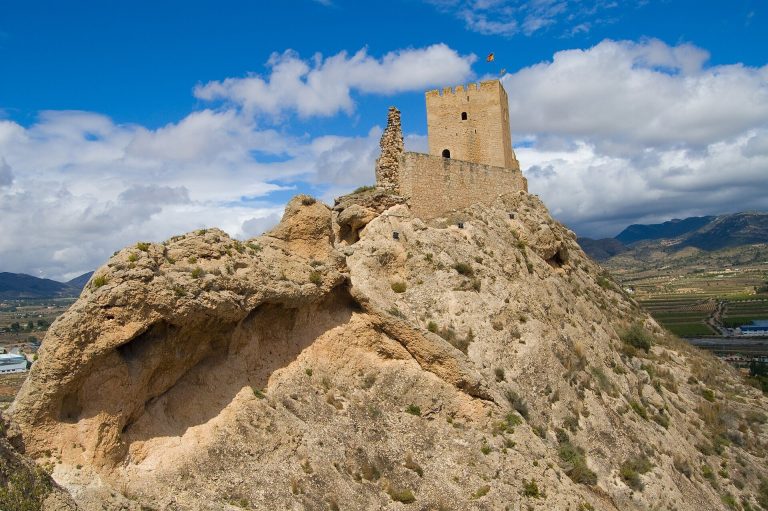
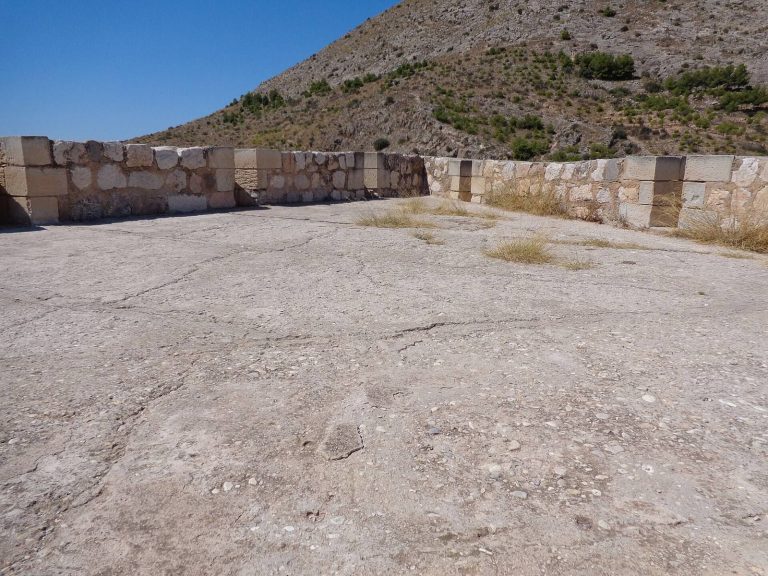
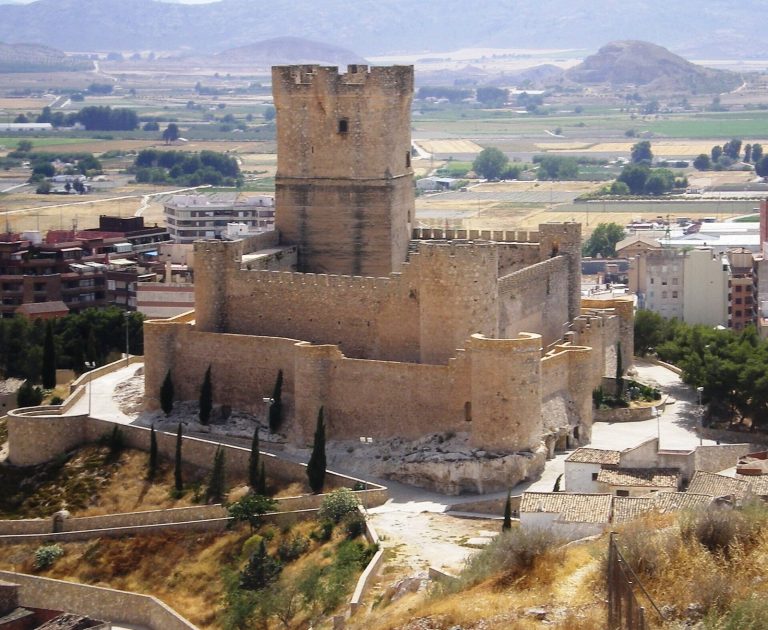
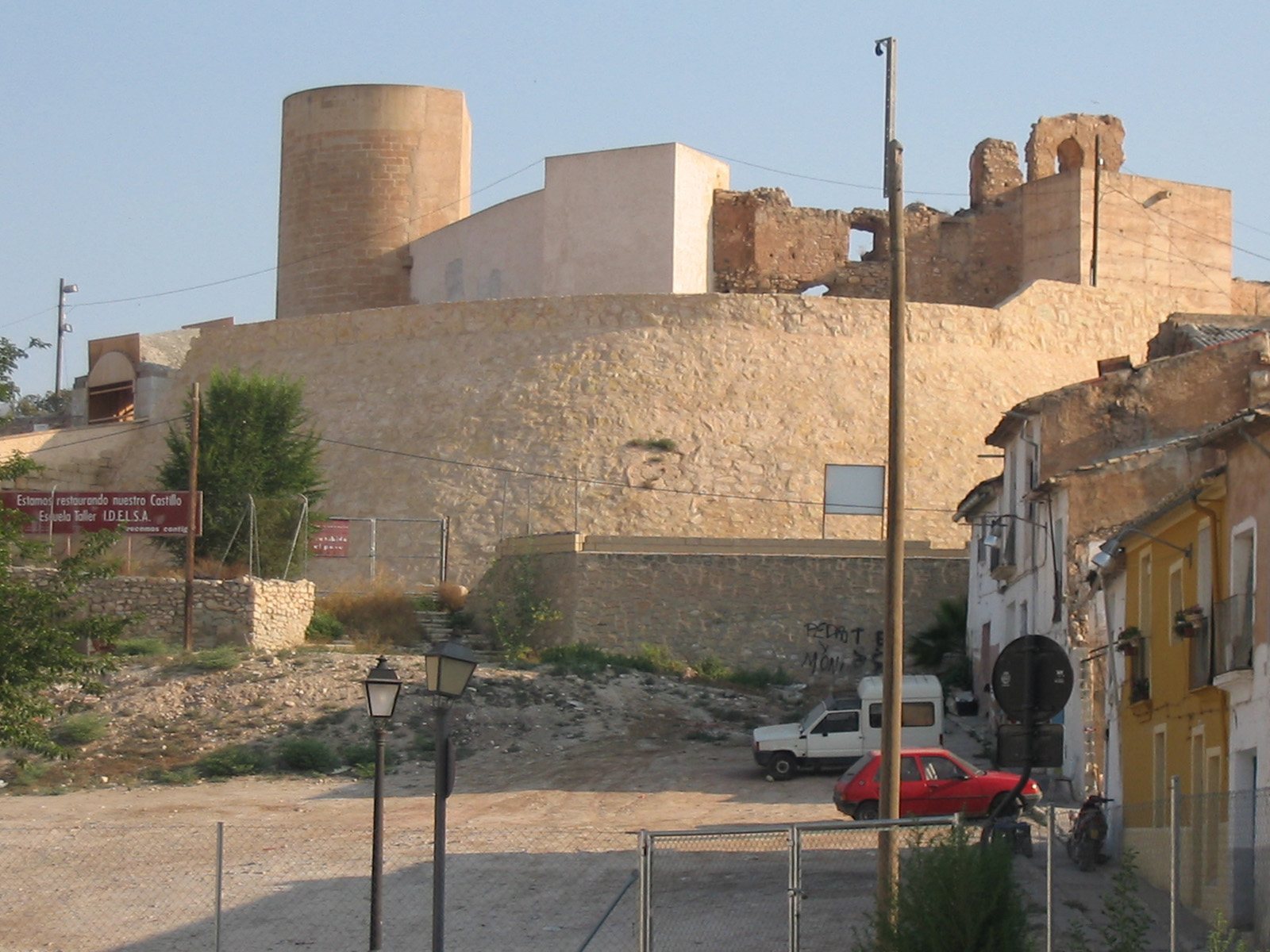
Castillo de Elda occupies a small hill beside and above the Vinalopó River. Its surviving organization broadly follows the defensive arrangement inherited from the Islamic period, while Christian reinforcement and Coloma-period residential remodeling altered the walls, towers, entrance, and interior. The present complex is ruined, with some palace rooms still buried and unexcavated.
Defensive and residential structures
Islamic fortress
The earliest physical form was an Islamic alcázar and defensive fortress. The hilltop position supported a fortified layout, and later Christian work probably reinforced the walls and towers while retaining much of the earlier defensive organization. The remains therefore preserve a layered structure in which the Islamic foundation continued to shape the castle’s form through later phases.
Coloma palace
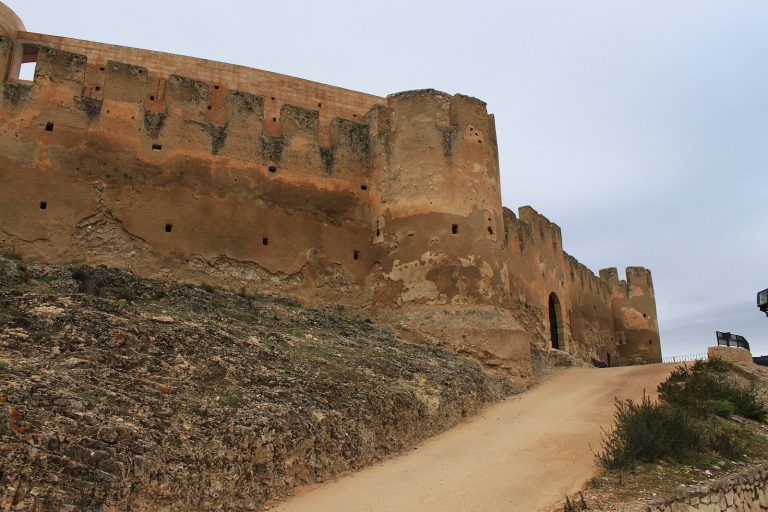
During the Coloma period, alterations affected both the exterior and interior. The entrance gate was modified, circular towers were constructed, and rooms with a more aristocratic character were added. The resulting palace included a small chapel, a large water cistern, and domestic and service rooms. The domestic and service areas remain buried and unexcavated, while reconstruction and restoration have addressed parts of the ruined complex.
Religious and burial evidence
Possible church of Saint Mary
A church dedicated to Saint Mary may have stood within the fortress between the Christian conquest and 1308. If so, it was probably the first Christian place of worship in medieval Elda. Its proposed date places the building within the period when the castle was being incorporated into Christian rule.
Burial ground
The area beyond the castle walls to the south and southeast served as a burial ground from the late thirteenth century until the beginning of the sixteenth century. This burial area formed part of the settlement’s changing use of the ground around the fortress during the centuries after the Christian conquest.