Castillo de Sax: A Historic Fortress in Alicante, Spain


Site at a Glance
- Rating
- 4.3
- Popularity
- Low
- Country
- Spain
- Primary era
- Medieval
- Eras represented
- Classical, Medieval
- Civilizations
- Almohad, Crown of Castile, Roman
- Site type
- Military
- Remains
- Castle
On this page8 sections
History
Castillo de Sax is a historic fortress in Spain, built on an earlier Iberian and Roman site above the settlement of Sax. Its present stronghold has an Andalusi, probably Almohad, origin, and an Islamic alcazar occupied the Castle Rock between the tenth and twelfth centuries. The fortress formed part of the defensive line of the Alto Vinalopó, a local administrative and geographic district in Alicante Province, alongside the castles of Villena and Biar.
Islamic origins and Christian conquest
The fortress defended the surrounding territory during the Muslim period and continued to serve that purpose after the Christian conquest of Iberian lands. In 1239, Ramón Folch, Viscount of Cardona, made an unsuccessful attempt to take the castle. Later that year, the Knights of the Order of Calatrava captured it under the command of the Commander of Alcañiz. The Order of Calatrava was a medieval military order that defended Christian territories and took part in the conquest of Iberia.
After its capture, possession passed to Alfonso X of Castile because agreements concerning the territory assigned it to Castilian rule. Alfonso X, known as Alfonso the Wise, ruled Castile and León from 1252 to 1284. Castillo de Sax subsequently became part of the Lordship of Villena, a territorial lordship associated with Don Juan Manuel, the fourteenth-century Castilian nobleman who was linked to the castle’s reconstruction.
Reconstruction and later rule
The castle was reconstructed in the fourteenth century, with the work attributed to Don Juan Manuel. Most of the surviving fabric is generally assigned to that period, although the northern part is older and the keep represents the latest major component of the fortress.
In 1480, the Catholic Monarchs incorporated the castle into the Crown. During the War of the Spanish Succession, a conflict over the Spanish throne, its garrison supported Philip of Anjou, later Philip V. Troops commanded by his principal rival, Archduke Charles of Austria, besieged the fortress, and the garrison withdrew.
Charles III appointed the Duke of Arcos governor of the castle in 1764. The governorship passed to the Duke of Maqueda in 1782. The municipality has owned Castillo de Sax since 1980, and the restored fortress is in very good condition. It is protected as a monument of cultural interest and forms part of Alicante Province’s protected cultural heritage, under a designation made on 18 July 2001.
Remains
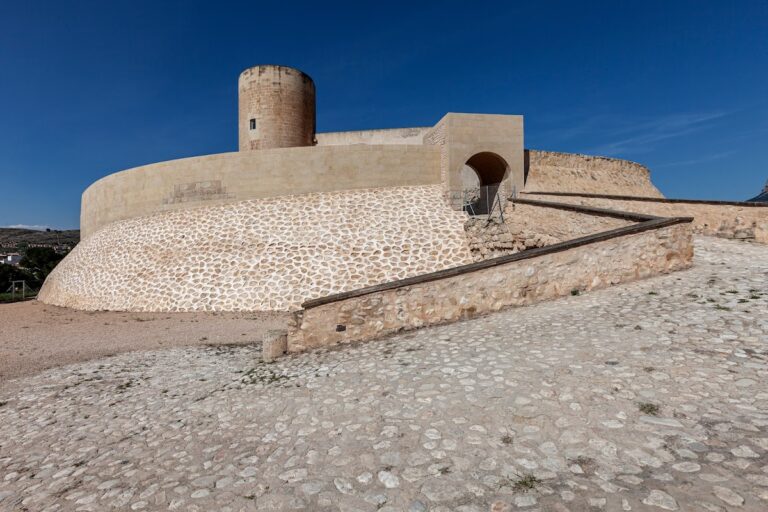
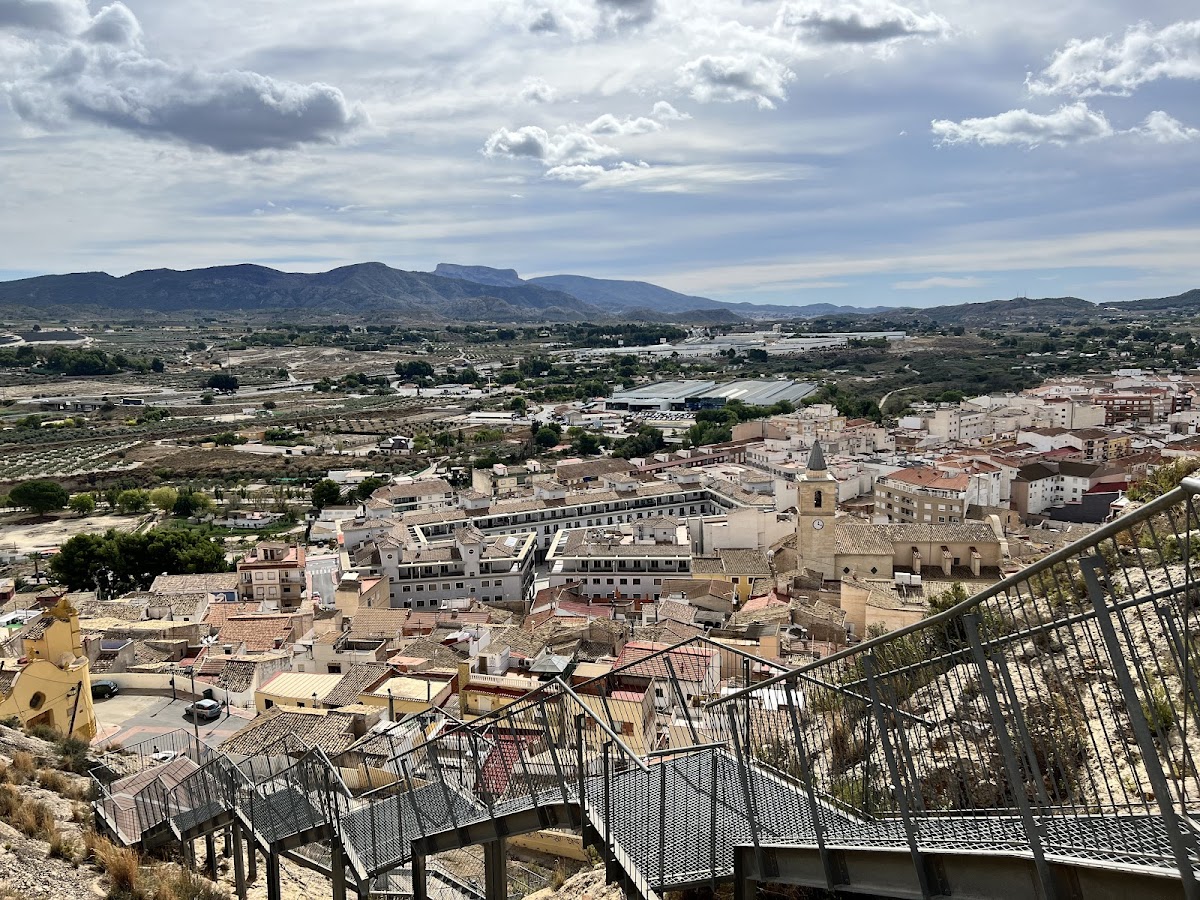
Castillo de Sax occupies an elongated, steep rocky hill at approximately 524 metres above sea level. From this position, the fortress overlooks Sax and much of the Vinalopó Valley between Elda and Villena. Its irregular plan is divided into two enclosures. An outer barbican, an advanced fortification protecting an entrance or approach, defended the bridges and access points, while a larger walled enclosure contained a substantial lodging or accommodation building. Defensive works on the slope protected the principal entrance, which is approached from the northwest.
Fortifications and towers
The keep
The principal rectangular tower stands in the second enclosure on a rocky cavern and rises more than 15 metres. Identified as the keep, or principal fortified tower of the castle, it has three storeys and walls up to 2 metres thick. Its masonry is ashlar, formed from regularly cut stone blocks. The first and second floors have pointed barrel vaults, which are tunnel-like vaults with pointed rather than semicircular sections. Arrow slits, narrow openings for defensive fire, pierce the second and third storeys.
A staircase attached to the inner wall connects the floors through pointed, stepped arches. The first storey contained an arms room, while a crenellated terrace above was reached by a staircase covered with pointed ogival arches. A former drawbridge once gave access to the keep but has disappeared. A large cistern adjoins the tower, with one of its sides incorporated into the keep’s structure.
The opposite tower
At the other end of the elongated castle stands a second large cubic tower. It has a square plan, thick walls, a single storey, and a barrel-vaulted interior. Its foundations may incorporate a Roman structure, linking the surviving defensive complex with the earliest occupation of the Castle Rock.
Walls and entrances
The two towers are connected by stretches of curtain wall, the continuous defensive wall between fortified towers. The wall tops carry crenellations, and the northern portion of the complex preserves an older phase than much of the fourteenth-century fabric. The principal access passes through a defensive bastion, a projecting fortified position, before reaching the main courtyard. The outer barbican and slope defenses together protected the approaches, while the larger inner enclosure held the principal accommodation and towers.