Verbrand Fort: A French Redoubt and Nature Reserve in Belgium


Site at a Glance
- Rating
- 3.9
- Popularity
- Very Low
- Country
- Belgium
- Primary era
- Early Modern
- External website
- Open
- Eras represented
- Early Modern, Modern
- Civilizations
- French, Habsburg
- Site type
- Military
- Remains
- Fort
History
Verbrand Fort is a redoubt and nature reserve in Belgium, built by French troops in 1703 as part of the Staats-Spaanse Linies, a network of defensive earthworks and fortifications along the border region of present-day Belgium and the Netherlands.
The redoubt served during the War of the Spanish Succession, the European conflict fought from 1701 to 1714 over the succession to the Spanish monarchy. Together with Michem Redoubt, also known as Fort de Courrières, and the Fort of Damme, it formed one of the outposts of Fort Bavaria, a fortress within the same defensive network.
In 2001, Wielewaal, the predecessor of Natuurpunt, purchased Verbrand Fort. Natuurpunt, a Flemish nature-conservation organization, manages the five-hectare site and is listed as its owner.
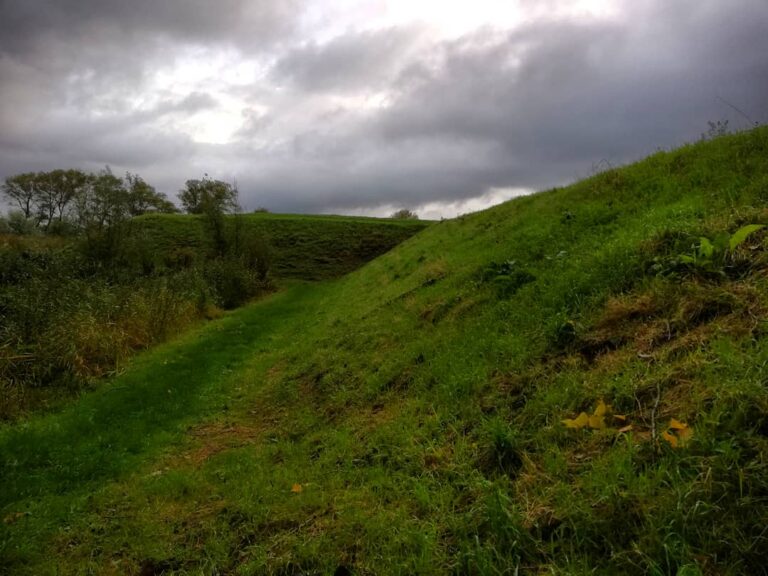
The site was redeveloped in autumn 2011. The moat was deepened, and the excavated soil was used to reconstruct the redoubt’s rampart. This work formed part of the Interreg IVa project “Forts and Lines in a Cross-Border Perspective” and received support from the Flemish government through the Green Cycling Belt Bruges.
Remains
Verbrand Fort remains recognizable at the angle between the Romboutswervedijk and the Schipdonk Canal, southwest of De Siphon. It was a square redoubt with a wooden lookout tower at its center. The earthwork is understood through its moat and rampart, whose form was reinforced during the 2011 redevelopment.
In 2001, the fort site was a wet meadow with a remaining elevation at its center. The surviving moat contains notable aquatic and bank vegetation, while the wider site supports abundant waterfowl and meadow birds. Its physical remains therefore form both a visible military landscape and a managed natural area.
Nearby sites