Santa Maria foris portas: An Early Medieval Church in Castelseprio, Italy


Site at a Glance
- Rating
- 4.5
- Popularity
- Low
- Country
- Italy
- Primary era
- Medieval
- External website
- Open
- Eras represented
- Medieval
- Civilizations
- Carolingian
- Site type
- Religious
- Remains
- Church
On this page10 sections
History
Santa Maria foris portas is an early medieval church in Castelseprio, Italy, associated with the Carolingian period and renowned for its exceptional fresco cycle. Its Latin name means “Saint Mary outside the gates,” describing its position on a hill about 200 metres from the walls of the ancient fortified settlement. The building is the oldest surviving structure in Castelseprio and the only one to remain after the fortified settlement was destroyed and abandoned.
Construction and early medieval setting
The date of construction remains debated. The church was once assigned to the seventh or eighth century, but physical and chemical examinations have placed its construction around the second quarter of the ninth century. Other proposals range from the late fifth or early sixth century to the seventh century. Its current association with the Carolingian period does not exclude older architectural traditions, since its design has been linked to Lombard continuity extending from the Early Christian basilicas of Milan through the eleventh century.
The Lombards were a Germanic people who established a kingdom in Italy from 568 until Charlemagne conquered it in 774. After the Carolingian period, Santa Maria foris portas probably became a private church connected with the counts and gastaldi of Seprio. Gastaldi were officials who administered territories on behalf of a ruler or lord. Excavations beside the church uncovered remains interpreted as private residences belonging to these local authorities. A large Carolingian-period tomb near the atrium also suggests that part of the surrounding area served as a burial zone for the local feudal lords.
The church survived the destruction of Castelseprio because devotion to its dedication to the Madonna continued. It belongs to the Catholic Church and follows the Ambrosian rite, the Catholic liturgical tradition associated principally with Milan and its ecclesiastical region.
The frescoes and their rediscovery
Santa Maria foris portas was disused when its medieval frescoes were accidentally discovered in May 1944. The paintings immediately became the subject of a continuing debate about their date and artistic origins. Proposed dates range from the Justinianic period, associated primarily with the reign of the Byzantine emperor Justinian I from 527 to 565, to the middle of the tenth century. Current proposals generally extend from about the 830s to 950. An inscription painted on the surface refers to Aderico, archbishop of Milan until 948, establishing that the frescoes were made before that year. A tenth-century date has also been proposed on stylistic grounds.
Three principal explanations have been advanced for the paintings’ artistic background. They may have been made by a Byzantine painter in the seventh or eighth century before the Iconoclast controversy, the prolonged Byzantine dispute over the legitimacy of religious images. They may instead be the work of a Constantinopolitan painter who reached Italy in the eighth or ninth century while fleeing that conflict. A third possibility connects them with a Balkan painter associated with the Macedonian Renaissance, a Byzantine revival of classical artistic forms conventionally placed in the ninth and tenth centuries. The second explanation has been widely supported because it allows for both Byzantine and Carolingian influences.
The painter’s identity is unknown. The conventional name Master of Castelseprio refers to the artist or artists responsible, since it remains uncertain whether the frescoes were executed by one hand or two. The cycle is regarded as one of the most important surviving examples of early medieval European mural painting and forms the church’s principal historical and artistic importance.
Heritage and archaeological setting
Santa Maria foris portas forms part of The Lombards in Italy: Places of Power (568–774), a serial World Heritage property comprising seven sites with important Lombard architectural, pictorial, and sculptural evidence. UNESCO inscribed the property on the World Heritage List in 2011 under criteria (ii), (iii), and (vi). The church lies within the Archaeological Park of Castelseprio, which also includes an antiquarium. The antiquarium occupies a small fourteenth-century monastery converted into a museum.
Remains
Church and surrounding features
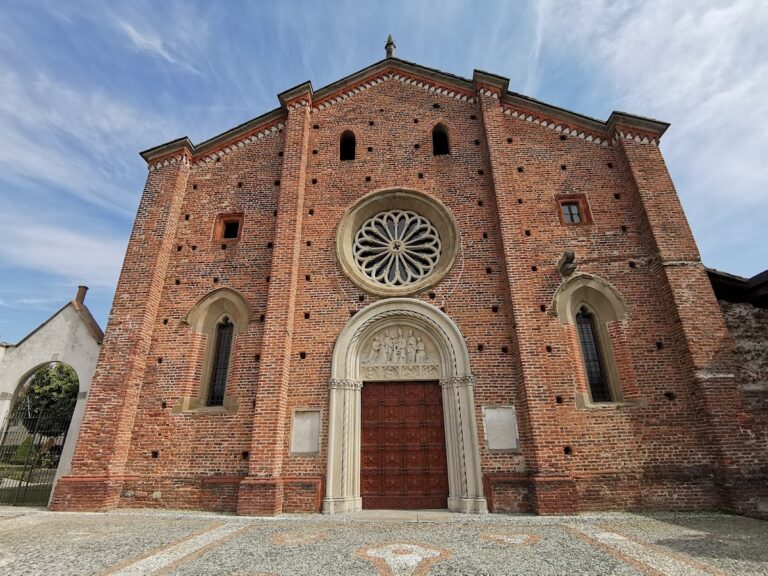
The church stands on a hill that had previously served as a prehistoric burial ground. A forecourt or atrium leads to the building, whose large brick arch opening was added in the seventeenth century. The church has a relatively short rectangular plan with a single nave and three apses, one on each side other than the entrance. The apses are similar in form but differ in their window arrangements. External buttresses reinforce them, and each is covered by a low, semi-conical roof slope.
The interior was probably plastered and enriched with frescoes and stucco. Its floor contained marble inlay motifs comparable to the pavements of Milan’s Early Christian basilicas. Excavations immediately beside the church revealed adjoining buildings, a later ditch system, and a large Carolingian-period tomb near the atrium. The ditch ran southward to another artificial ditch and eastward toward a ravine, forming part of the archaeological setting around the building.
Fresco cycle
Scenes from the childhood of Christ
The surviving ancient paintings cover the walls of the central apse, including the side facing into the church. A wall pierced by a semicircular arch separates this painted area from the nave. The cycle presents episodes from the childhood of Christ and appears to draw substantially on apocryphal Gospels, early Christian writings outside the canonical New Testament. Narratives associated with the Protoevangelium of James and the Gospel of Pseudo-Matthew helped shape some early Christian depictions of Mary, Joseph, and Christ’s childhood.
Among the surviving scenes are the Annunciation, the Visitation, the ordeal of the bitter water, Joseph’s dream, the journey to Bethlehem, the Adoration of the Magi, and the Nativity. Other images are fragmentary or difficult to identify, including a substantially lost scene in the lower register. Taken together, the selected episodes have been interpreted as a structured presentation of the doctrine of the Incarnation and the consubstantiality of Christ.
Apse imagery and symbolic details
Medallions were painted above the windows between the principal scenes. Only the central medallion survives, showing Christ blessing. On the rear wall of the apse, two flying angels carry a sceptre and a globe while facing the empty throne of Christ. This image is an Etimasia, the prepared throne awaiting Christ, and serves as the central symbolic focus toward which the angels turn as they bring their gifts.
The lower register preserves the Announcement to the Shepherds on the left, while the scene on the right is almost entirely lost. The lowest painted zone retains traces of garlands, false niches closed by curtains, birds emerging from some of the niches, and a throne bearing a closed book. One image represents the Earth as a sphere surmounted by a cross, combining a spherical conception of the world with Christian symbolism.
Painting technique and artistic connections
The frescoes use a classical-looking perspective and render settings, human figures, and animals with a strong sense of volume. Firm brushstrokes, luminous diffuse tones, defined shadows, soft modelling, expressive gestures, and strongly articulated faces give the surviving figures their distinctive character.
The paintings have been associated with Eastern artistic traditions, Carolingian art, and the Macedonian artistic revival. Suggested comparisons include surviving apse mosaics from Hagia Sophia in Constantinople, particularly the face of the blessing Christ. Other features, such as the flowing lines, the angels’ clothing, and Christ’s halo, have been compared with Carolingian works including the Utrecht Psalter.
Santa Maria foris portas may also have been the original home of the Epitaph of Wideramn, a rare surviving example of Lombard funerary culture in written form.