Castello di Castiglione Mantovano: A Medieval Defensive Fortress in Italy


Site at a Glance
- Rating
- 3.7
- Popularity
- Very Low
- Country
- Italy
- Primary era
- Medieval
- Eras represented
- Medieval, Early Modern
- Civilizations
- Holy Roman Empire
- Site type
- Military
- Remains
- Castle
On this page5 sections
History
Castello di Castiglione Mantovano, also known as Castel Stilicone, is a medieval fortress in Italy, located in Castiglione Mantovano, a hamlet of Roverbella in Mantua Province, Lombardy. Generally dated to the eleventh century, and with construction also listed as beginning in 1000, it was built on a natural rise beside the ancient road between Mantua and Verona to defend the village.
Medieval Origins and Reconstruction
The fortress was destroyed by forces from Verona in the early thirteenth century. It was subsequently rebuilt, preserving its defensive role along the route between the two cities.
Gonzaga Rule and Destruction
The Gonzaga, the ruling dynasty of Mantua, repeatedly adapted and strengthened the fortress as their political and territorial power shaped fortifications across the surrounding region. In 1630, German-speaking Landsknecht infantry mercenaries sacked the castle and partially destroyed it. The structure remains partially demolished.
Remains
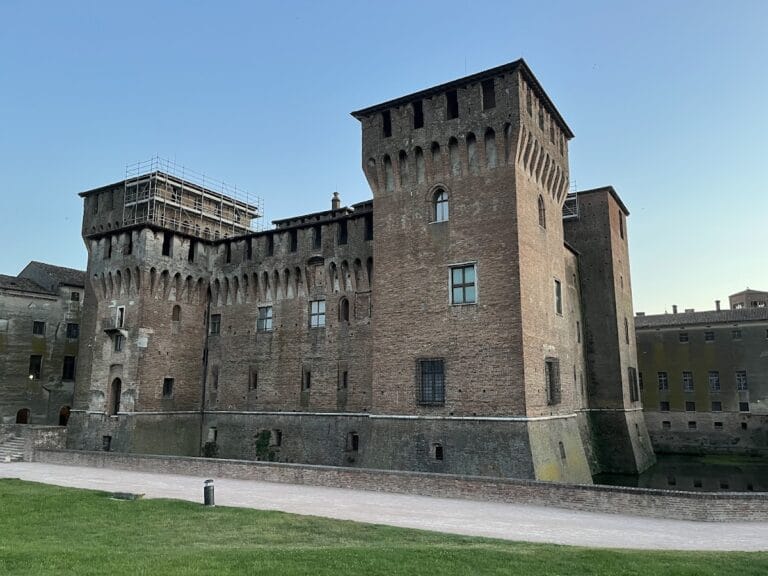
The castle occupies a square plan enclosed by crenellated walls. Crenellations are the alternating raised sections and openings along the top of a defensive wall. Eight quadrilateral towers reinforce the enclosure, expressing the fortress’s original military organization.
Interior Buildings and Moat
Two farmhouses and a sixteenth-century building stand within the fortified area. Part of the moat that once surrounded the walls also survives, preserving a physical element of the castle’s defensive layout.
Nearby sites