Palazzo d’Arco: An Aristocratic Palace and Museum in Mantua


Site at a Glance
- Rating
- 4.7
- Popularity
- Medium
- Country
- Italy
- Primary era
- Early Modern
- External website
- Open
- Eras represented
- Medieval, Early Modern
- Civilizations
- Habsburg, Holy Roman Empire
- Site type
- Domestic
- Remains
- Elite Residence
On this page15 sections
History
Palazzo d’Arco is a historic aristocratic palace in Mantua, Italy, built for the D’Arco family in the Neoclassical period beginning in 1784. Its design followed principles inspired by Andrea Palladio, whose architecture emphasized classical proportions, symmetry, and antique forms. The palace became the family’s principal residence and later a museum preserving its art, library, furnishings, scientific material, and historical collections.
The D’Arco family and the eighteenth-century palace
The D’Arco family came from Trento and settled permanently in Mantua in 1740. After acquiring the residence of the Counts Chieppio, Count Giovanni Battista Gherardo d’Arco commissioned its transformation. The architect Antonio Colonna directed the building works, creating a new aristocratic complex in a Palladian-inspired Neoclassical style. The resulting residence combined domestic rooms with collections of paintings, books, natural-history material, and family possessions.
The family continued to enlarge the complex during the nineteenth century. In 1872, Francesco Antonio d’Arco acquired Renaissance buildings and an adjoining garden from the Marquises Dalla Valle. Stables on the left side of the palace formed part of this expanded ensemble. They were later converted into the Teatrino d’Arco, which has housed the Francesco Campogalliani Theatre Academy since 1946. The academy was founded by Ettore Campogalliani.
Carlo d’Arco and the palace in Mantuan civic life
Count Carlo d’Arco, who lived from 1799 to 1849, was a historian and collector of historical documents. He also served as Mantua’s podestà, the civic chief magistrate appointed to administer an Italian city, from 1847 to 1848.
The palace was also the setting for a judicial event connected with the Tyrolean uprising. In 1810, a tribunal that convened at Palazzo d’Arco condemned Andreas Hofer, a Tyrolean insurgent, to death. One of the museum rooms is dedicated to Hofer and preserves the memory of this episode within the history of the residence.
From family residence to public museum
Giovanna dei Conti d’Arco Chieppio Ardizzoni, Marchesa Guidi di Bagno, was the last member of the family. In her 1956 will, she directed that her property, including the palace and its collections, should become a public museum after her death. She died in 1973 and established the Fondazione d’Arco, which now administers the museum.
The bequest brought together a herbarium, picture gallery, archive, library, musical instruments, furnishings, and weapons. The picture gallery includes works associated with Niccolò da Verona, Bernardino Luini, Alessandro Magnasco, Frans Pourbus the Younger, Anthony van Dyck, Lorenzo Lotto, Tintoretto, Giuseppe Bazzani, and other artists. Its Bazzani collection contains nine paintings, including works from different stages of the artist’s career. In 2014, the Fondazione d’Arco received works donated by Marchese Federico Cavriani, a member of Mantua’s noble Cavriani family. Some of these works were assembled in the Sala Cavriani.
The palace and garden have undergone restoration, preserving the complex as an example of an aristocratic residence whose rooms, collections, and associated buildings remain together as a museum.
Remains
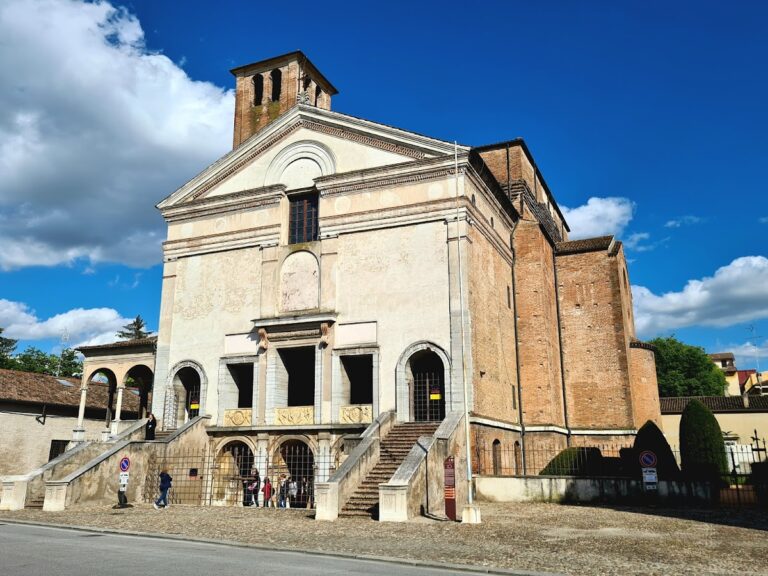
The surviving complex is organized around the Neoclassical palace, its courtyard and garden, and a fifteenth-century Renaissance wing of two small buildings. The main façade faces Piazza Carlo d’Arco, with the entrance at its center. An eighteenth-century three-flight staircase rises to the piano nobile, the principal residential floor traditionally reserved for the most richly decorated rooms. The museum route begins on this level and continues through a sequence of decorated salons, collection rooms, and service spaces.
The Neoclassical palace
The family portrait rooms
The Sala degli Antenati is a large room decorated with stucco and friezes. Sixty portraits of members of the D’Arco family hang here, tracing the family’s history from the sixteenth through the eighteenth century. The Salon of Portraits forms part of the palace’s wider series of collection rooms, while the Red Salon has crimson damask on its walls and furniture purchased in London in 1874. It also contains paintings and family portraits, including an image of Giovanna de’ Capitani d’Arzago, the wife of Luigi d’Arco.
Views, still lifes, and mythological decoration
The Salon of Views contains Romantic landscapes and four episodes from the life of Adonis. The Salon of Still Lifes was arranged as a dining room and displays paintings associated with Vincenzo Campi and the school of Cerano. The Sala di Diana contains mythological paintings attributed to Palma the Younger and Benedetto.
The rooms dedicated to Pallas include a portrait of Vincenzo I Gonzaga by Frans Pourbus the Younger and a portrait of Benedict XIII by Giuseppe Bazzani. The Green Salon, also called the Salon of Justice, contains a Madonna and Child on a gold ground attributed to Nicolò Solimani da Verona. The Alexander the Great Room takes its name from large paintings illustrating the life of the Macedonian king. These works belong to Giuseppe Bazzani’s earliest paintings and date to around 1739.
The sculpture and music rooms
A former small bedroom is now devoted to sculpture and gives access to the Music Salon, which originally served as a dressing room. Historic instruments displayed there include an English harp from the early nineteenth century and a Venetian theorbo dated 1647. A theorbo is a large plucked string instrument with an extended neck and additional bass strings. The instruments are reflected in an Empire-style mirror.
The Neoclassical Salon contains further musical instruments. The Mirror Vestibule leads back toward the Sala degli Antenati, linking the decorated rooms within the museum route.
The library and kitchen
The Neoclassical Library contains more than 10,000 old volumes, including books on natural history. It also holds a copy of Antonio Canova’s statue of the Three Graces. The nineteenth-century Kitchen preserves plates, cooking stoves, and kitchen utensils, presenting the domestic equipment of the palace alongside its ceremonial and collecting spaces.
The Andreas Hofer Room
The Andreas Hofer Room commemorates the tribunal held at the palace in 1810, when the Tyrolean insurgent was condemned to death. Its presence connects the interior sequence to the political and military history associated with the residence.
The Renaissance wing and zodiac frescoes
The Sala dello Zodiaco
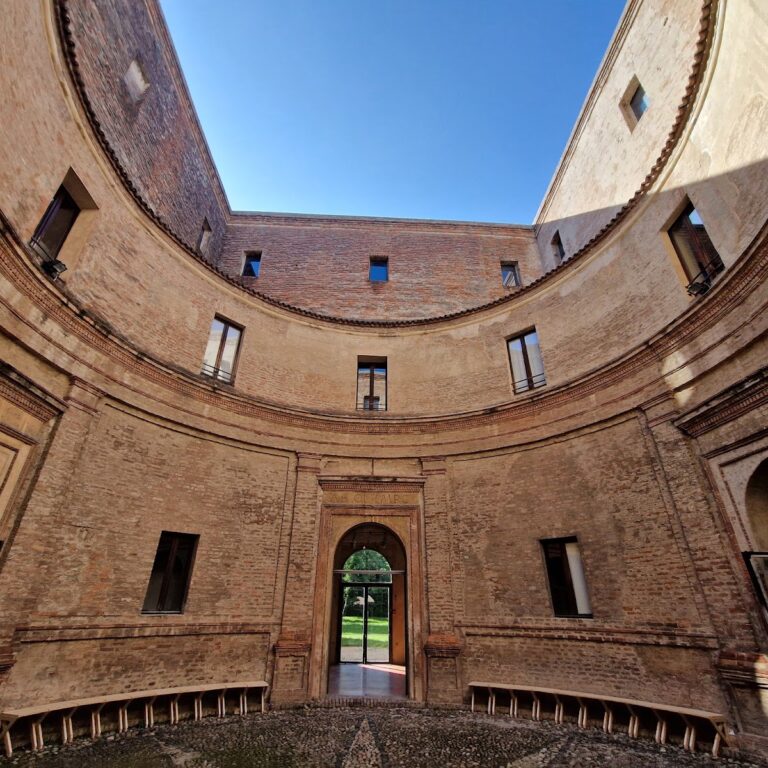
The palace garden is enclosed by or associated with an exedra, a semicircular architectural space, and connects with a fifteenth-century Renaissance wing consisting of two small buildings. The wing is reached through the courtyard and garden. One of its buildings contains the Sala dello Zodiaco, also called the Sala del Falconetto, a frescoed room created around 1515 by Giovanni Maria Falconetto, a Veronese Renaissance painter and architect, with assistants. A fresco is a wall painting made on fresh plaster, so that the pigments become integrated with the surface as it dries.
The room measures 9.70 by 15.40 metres and is 6.30 metres high. Its four walls carry twelve zodiacal compositions, with one on each short wall and five on each long wall. Opposing signs face one another: Aries and Libra, Taurus and Scorpio, Gemini and Sagittarius, Cancer and Capricorn, Leo and Aquarius, and Virgo and Pisces. A fireplace, probably inserted in the seventeenth century, concealed much of the Libra image.
The paintings combine the signs of the zodiac with the months, natural cycles, classical mythology, ancient history, and images of Roman or Byzantine architecture. Sixteen central scenes are surrounded by fantastical teratomorphic figures, forms that combine human, animal, or other creaturely features. Except for the first, twelfth, and fifteenth scenes, these compositions draw on Ovid’s Metamorphoses, the Latin mythological poem that was a major source for Renaissance depictions of classical transformations and myths.
Activities associated with the months usually occupy the foregrounds, while myths, ancient historical episodes, or architectural settings appear behind them. A celestial figure accompanies each zodiac sign. Jupiter appears with Aries, Taurus, Gemini, Leo, Virgo, Sagittarius, and Capricorn; Juno appears with Cancer and Scorpio; and Pisces may also be accompanied by Jupiter.
The monthly imagery appears to derive from Roman frescoes whose literary source was the twelfth-century Byzantine romance The Story of Ismene and Isminias by Eumathios Makrembolites. The cycle has also been linked with Pinturicchio’s cycle of the Months, painted around 1490 for Cardinal Domenico della Rovere’s Roman palace.
Architectural ornament and the Sala dei Cesari
The arches of the Sala dello Zodiaco contain repeated keystones with masks and other motifs. These include a Gorgon or Medusa head, a bull’s head, a comic theatrical mask, the head of Jupiter Ammon, and an eagle. Jupiter Ammon combines the Roman god Jupiter with the Egyptian deity Amun, while Medusa is the Gorgon whose gaze was traditionally said to turn people to stone. The motifs are mirrored in opposing zodiac signs and appear with grotesque ornament and medallions showing Caesars.
The first comprehensive study of the zodiac cycle was undertaken by Paola Moretta in 1918 and published in Rivista d’Arte. Moretta attributed the decoration to the school of Lorenzo Costa the Elder. Ercolano Marani later examined its patronage and proposed identifying the patron as Benedetto Tosabezzi. The frescoes are now considered to have been executed by Falconetto with his pupils. Their combination of literary, mythological, and visual references remains an unresolved interpretive problem in the Renaissance art of Mantua.
Below the Sala dello Zodiaco lies the Sala dei Cesari. It contains copies of eleven Caesars painted by Titian in 1536 for Federico II Gonzaga, the sixteenth-century ruler of Mantua and a major patron of Renaissance art.
The Teatrino d’Arco
The Teatrino d’Arco occupies the former stable building adjoining the palace on the left. Like the main complex, it faces Piazza Carlo d’Arco and forms part of the same architectural ensemble. Its continued use by the Francesco Campogalliani Theatre Academy links the former service building with Mantua’s theatrical tradition.
Nearby sites