Castello di Borgonovo: A Medieval Fortress and Civic Residence in Italy


Site at a Glance
- Rating
- 4.2
- Popularity
- Low
- Country
- Italy
- Primary era
- Medieval
- Eras represented
- Medieval, Early Modern
- Civilizations
- Papal States
- Site type
- Military
- Remains
- Castle
On this page9 sections
History
Castello di Borgonovo is a medieval fortress in Borgonovo Val Tidone, Italy, founded by the municipality of Piacenza in 1196 to defend its western frontier. The fortified settlement was established near a place then known as Casarnerio. Its name, Borgonuovo, distinguished it from Borgo San Donnino, the settlement later called Fidenza, which at the time belonged to Piacenza’s territory.
Foundation and Early Conflicts
The new settlement quickly became involved in the rivalries among the medieval communes of Piacenza, Pavia, and Parma. Pavia’s forces destroyed the complex three years after its foundation, while most of Piacenza’s troops were engaged in the Battle of Fidenza, where they were defeated by forces from Parma. Pavia attacked again in 1215 but failed to take Borgonovo, and several military standards were seized during the fighting.
In 1237, Piacenza’s podestà, Arrigo da Monza, ordered the complex burned and destroyed to prevent its capture by Emperor Frederick II, who was reportedly stationed near Pavia. Ghibelline forces, supporters of the imperial side in the long conflict between imperial and papal factions, damaged the castle under Ubertino Landi in 1267 and returned in 1270. They were involved again in 1272, when they fled Piacenza.
Visconti and Arcelli Control
During the early fourteenth century, the Arcelli family held the castle while allied with the Visconti, the ruling dynasty of Milan that expanded its authority across Lombardy and nearby territories. In 1313, Galeazzo I Visconti demanded that Leonardo Arcelli surrender Borgonovo. Leonardo refused, so Visconti sent troops under Guidotto Sanaserio, a professional military commander whose son was being held prisoner by the Arcelli. After severe fighting, the Arcelli submitted. The settlement was plundered, and the castle was partly destroyed.
The Arcelli regained possession between 1322 and 1355, when Piacenza’s territory was under papal control. They later lost Borgonovo after Azzo Visconti reconquered the area for the Visconti. In 1372, Borgonovo refused to submit to papal authority and remained loyal to the Visconti government. Papal forces commanded by Dondazio Malvicini and the papal legate Pietro Buturicense, a representative of papal authority, consequently plundered and captured the settlement.
Fifteenth-Century Transfers
After Borgonovo returned to Visconti control, Duke Filippo Maria Visconti granted the fief of Borgonovo and Castel San Giovanni to Bartolomeo and Filippo Arcelli in 1412. A fief was land or jurisdiction granted by a superior ruler to a noble vassal. The grant also gave the Arcelli the title of counts of the Tidone Valley.
In 1417, the Visconti government declared the Arcelli rebels. Bartolomeo Arcelli and Giovanni Arcelli, Filippo’s son, were defeated near Gavi and captured by Francesco Bussone. They were taken to Borgonovo and, according to some historians, then to the Fortress of Sant’Antonino in Piacenza, where Filippo had taken refuge. When Filippo refused to lay down his arms, the two prisoners were condemned to be hanged, and Filippo fled to the Republic of Venice.
By 1438, Borgonovo had been elevated to a marquisate, a territory governed by a marquis, and granted to Niccolò Piccinino. His sons Francesco and Jacopo succeeded him in 1445. In 1449, Duke Francesco Sforza removed the fief from the Piccinino family and assigned it to Lazzaro Arcelli. After Lazzaro’s death, the fief passed against his testamentary wishes to Sforza Secondo Sforza, Francesco Sforza’s illegitimate son and the husband of Antonia Dal Verme. Sforza Secondo became Count of Borgonovo in 1468.
Siege, Ducal Administration, and Civic Use
In 1482, after Sforza Secondo’s death and the succession of his nephew Alessandro, the castle was besieged by the French. Alessandro was under the guardianship of his mother, Franceschina Borromeo, who refused to surrender. Sforza heirs controlled Borgonovo until 1679, when Alessandro III died without heirs. The Farnese ducal administration then assumed control after members of several collateral Sforza branches relinquished their claims in exchange for pensions.
In 1691, the Farnese administration transferred the castle to the Zandemaria marquises. They began transforming it into an aristocratic residence and created a picture gallery containing 240 works by renowned painters, including Antonio da Correggio, Il Guercino, and Guido Reni.
On 13 September 1875, Marquise Adele Cesena and her sister Carlotta, whose husbands descended from the Zandemaria family, transferred the castle to the municipality of Borgonovo for 80,000 lire. The municipality filled in the moat and levelled the earthworks through a public-works measure intended to provide employment for unemployed residents. The building was then adapted for municipal offices, the district court, and a district prison. Major restoration took place during the second half of the twentieth century. The castle is designated Italian national heritage, and the municipality of Borgonovo is its current owner.
Remains
Fortification and Layout
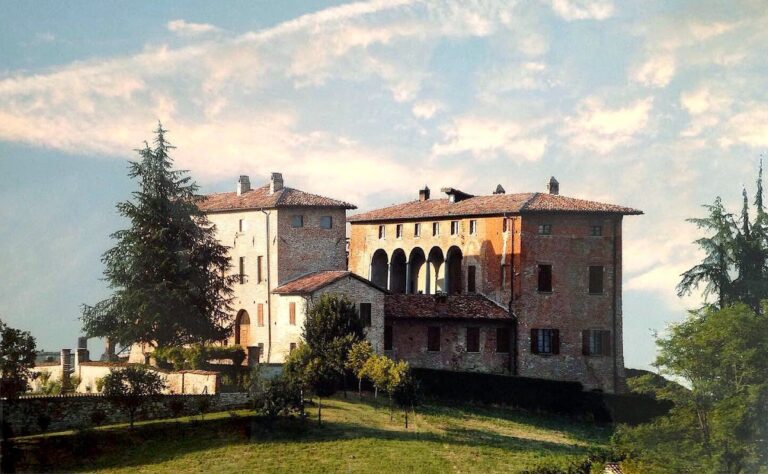
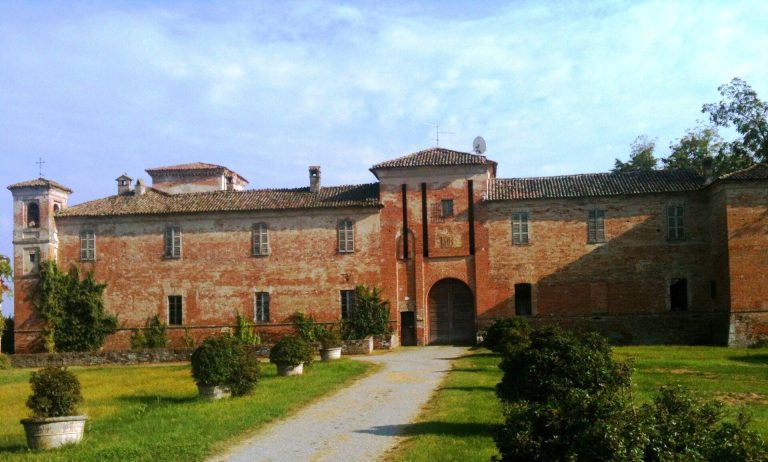
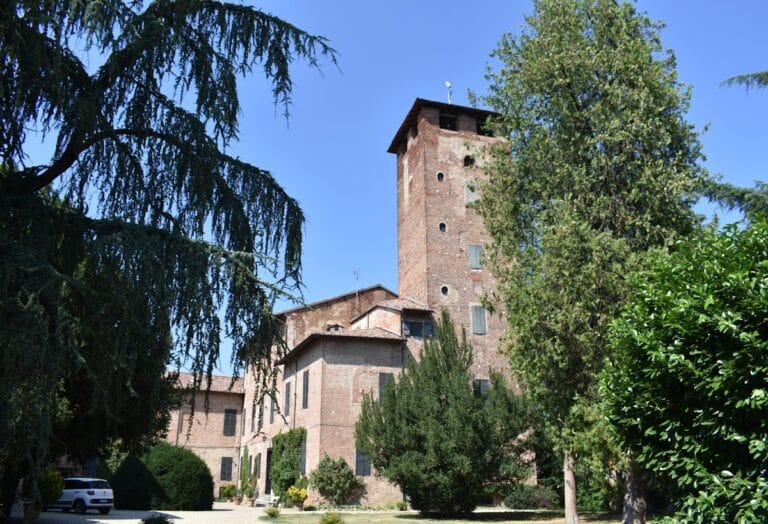
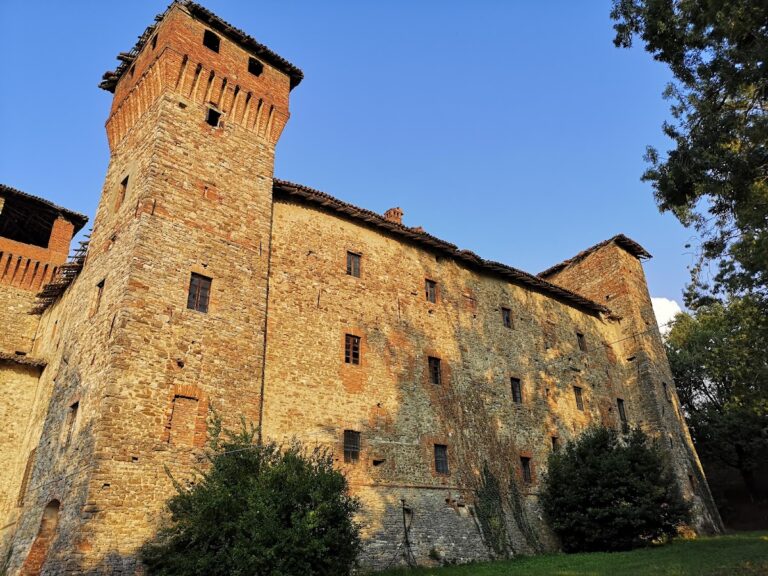
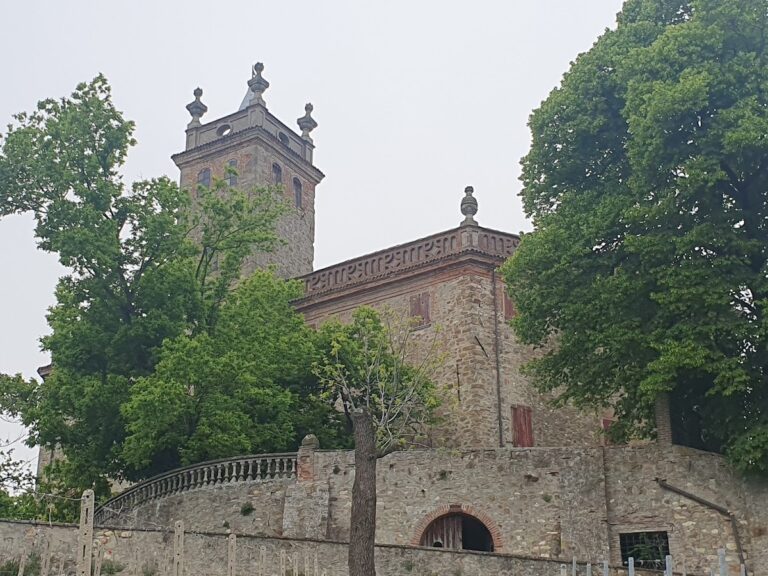
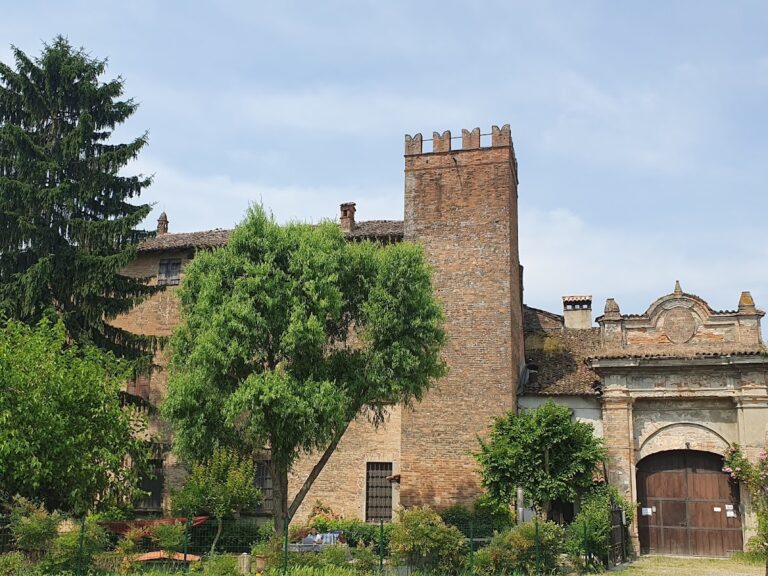
The castle stands in the centre of Borgonovo Val Tidone, in the Po Plain at the edge of the lower Tidone Valley. Built entirely of brick, it has a rectangular plan with towers at the south-west and north-east corners. Its façades retain a saw-tooth pattern characteristic of fourteenth-century construction, while traces of battlements survive along the external fronts. The entrance portals show alterations made during the building’s successive phases.
Entrances and Former Moat
Two entrances serve the complex. One is placed off-centre on the southern side near a tower, and the other lies on the opposite side. Both are approached by masonry bridges spanning the completely dry moat. The bridges rest on pointed arches and replaced earlier drawbridges. During twentieth-century restoration, workers discovered the joints and fittings associated with the former drawbridges. The moat was later filled as part of the municipal works undertaken after 1875.
Residence and Restored Interior
The exterior remains relatively faithful to the original appearance, while the interiors were extensively remodelled in the eighteenth century for aristocratic residential use. These works included a three-level loggia with three or four arches and a large double-flight staircase. The building is in good or restored condition.